Julia Bansal’s “Reading the Dance Floor: Gossip and Nonverbal Communication in Urban Nightlife” emphasizes the importance of taking gossip seriously in night clubs, particularly queer ones, by examining Fran Lebowitz’s “Disco Hints.” Highlighting the essential nature of these clubs as spaces separate from the public sphere where queerness can be expressed and discovered communally, Bansal emphasizes how gossip becomes a tool within these spaces to cultivate queer safety. As a necessary form of social control that is communicated both explicitly through speech as well as nonverbally through clothing expression, it is a means to queer survival that resists larger institutions that have failed to protect these individuals historically. A meditation on Lebowitz’s piece, Bansal maintains that “Disco Hints” is not to be dismissed as a series of “petty complaints,” but actually points to the deep importance of this type of communication. – Sara Spangler, ‘28
Reading the Dance Floor: Gossip and Nonverbal Communication in Urban Nightlife
Julia Bansal ’29
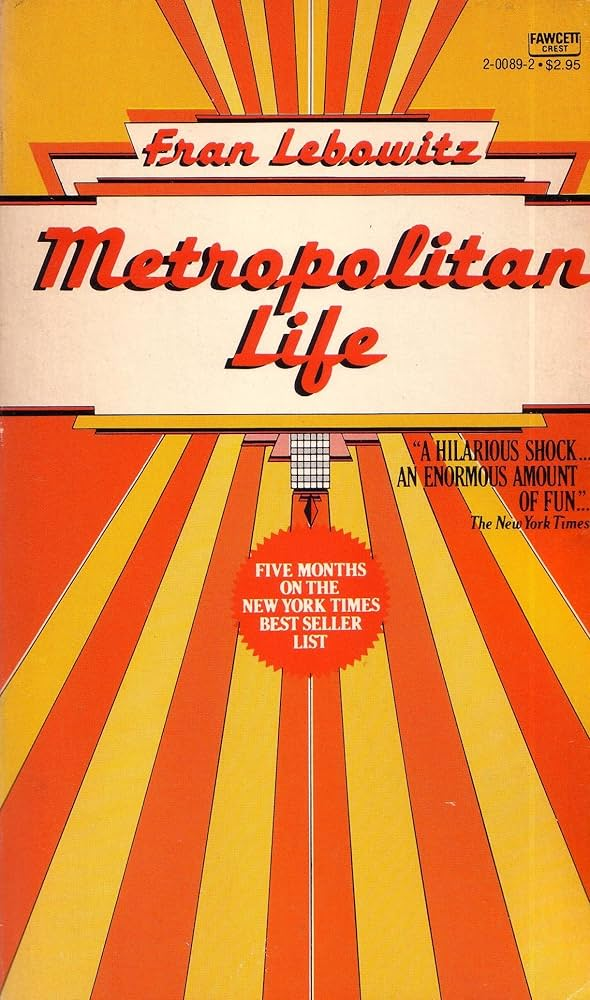
When Fran Lebowitz published The Metropolitan Life in 1978, she was writing from within New York City, where nightlife is more than mere entertainment. Disco clubs functioned as social centers where identity, desire, and reputation were constantly negotiated, especially for queer people living under legal vulnerability, social stigma, and the threat of exposure. As a lesbian writer moving through these spaces with both proximity and ironic distance, Lebowitz positions herself inside queer nightlife while remaining detached from the unwritten rules and status hierarchies performed and enforced on the dance floor. She documents not just what people do in clubs, but how they learn what kinds of behavior are legible, acceptable, or dangerous. “Disco Hints,” an excerpt from The Metropolitan Life, initially appears to be a list of petty complaints about inconsiderate dancers. Beneath the snark, however, the piece reveals how order is actually produced in nightlife spaces: not through formal rules or authorities, but through embarrassment, shared interpretation of social cues, and reputational consequence. Although gossip is often dismissed as shallow or destructive, “Disco Hints” shows that gossip operates as a necessary form of social regulation within queer communities; a way of correcting behavior, distributing knowledge, and maintaining collective safety through both spoken judgment and nonverbal systems.
Lebowitz’s first hint immediately reveals how high the stakes of gossip are in nightlife culture. She warns that it is worse to threaten a club member with “the information that you know his real name and are planning on phoning his hometown newspaper with the true reason why he hasn’t married” than to threaten him with a knife (Lebowitz 42). By doing so, she places reputational exposure—the forced disclosure of queer identity to hostile family, social, and institutional audiences—on the same moral plane as physical violence. This line uses exaggeration, but the danger beneath it is real. The specificity of “real name” and “hometown newspaper” matters here: both point outward, beyond the club, toward spaces where queerness becomes scandal rather than shared knowledge. This is not idle talk or social embarrassment; it is the threat of social annihilation through circulation. Lebowitz does not treat gossip as background noise or harmless chatter. Instead, she shows it as a mechanism capable of forcibly moving someone from a semi-protected queer space into a hostile public sphere. This dynamic directly echoes the ethical framework developed by Mark Alfano and Brian Robinson in Gossip as a Burdened Virtue, where they argue that gossip becomes morally complex under conditions of oppression because it operates as both a danger and a tool of protection (484). Lebowitz exposes that burden precisely. Gossip here is horrifying in its capacity to punish, yet its existence also testifies to the fact that queer safety depends on controlling who knows what, and where.

Importantly, this regulation does not rely only on explicit speech or confrontation; it also operates through subtler forms of coordination that do not require words at all. Lebowitz’s second hint shifts attention from spoken threat to the quieter, but no less meaningful, language of clothing. After noting that dancers are “likely to become quite warm”, she warns them not to take off their shirts (Lebowitz 43). Here, Lebowitz addresses club-goers directly, offering guidance on how to manage their visibility and avoid miscommunication; her hints function as a set of behavioral instructions shaped by the risks and expectations of the space. Instead, they can “take that bandanna out of your back pocket and blot your forehead. Just be sure you put it back on the right side” (43). This instruction about the “right side” only makes sense if the reader already knows the hanky code. As Evelyn Bauer explains, flagging—also known as the hanky code—is “a way to wordlessly tell other queer people your sexual preferences,” usually by wearing particular colors in the left or right back pocket to signal top/bottom roles and specific kinks. Bauer emphasizes that this practice “originated in the ’70s, a time when it was illegal in most places to have queer sex” and when queer sex often happened in “dark public places with low foot traffic” because hotel rooms and apartments were heavily policed. Under those conditions, as Jack Gieseking notes in his interview with Bauer, the code functioned as a way to signal desire when queer men “could not talk so much in a lot of these spaces.” Communication had to be quick, discreet, and legible only to those who already understood the code. Lebowitz’s casual insistence on putting the bandanna back “on the right side” quietly invokes this whole infrastructure of clandestine communication (43). The bandanna is not just a neutral accessory; it is a portable message. Misplacing it is not merely a fashion mistake but a potential misrepresentation of one’s desires and boundaries, with real social consequences.
Seen alongside Alfano and Robinson’s account, the hanky code begins to resemble a nonverbal form of gossip. They define gossip as a “normatively laden speech act” that relies on shared background knowledge to guide communal expectations and warn others about potential harms (Alfano et al. 474). The hanky code operates in a very similar way, except that the “speech” is visual rather than verbal. The meaning of a red or blue square of fabric in a particular pocket depends entirely on a decentralized, collectively maintained understanding. Bauer stresses that “there is no central queer body of people defining what queerness is” and, with that, there has never been a single authority to pin the code down. It remains open to adjustment, which is why it has always existed in multiple versions, shifting slightly from club to club and city to city. That description could just as easily apply to gossip itself. Both systems are informal, evolving, and enforced socially rather than institutionally, not because queerness resists structure in the abstract, but because these spaces demand it. In clubs shaped by surveillance, legal danger, and the constant possibility of being read by the wrong audience, anything fixed travels too loudly. What circulates instead has to move quickly, quietly, and sideways—knowledge that can change hands without stopping the music. In Lebowitz’s hint, the bandanna is doing what gossip does: broadcasting information about a person in a way that only insiders can interpret, and that can quietly shape how others approach, avoid, or judge them without a word being spoken. Under these circumstances, gossip is shaped toward the specific needs of queer nightlife; it becomes a way of managing exposure, coordinating desire, and preserving a fragile sense of safety without ever having to speak openly.

Lebowitz’s third hint pulls focus away from identity signaling and toward atmosphere, showing how gossip also disciplines how people take up space. She critiques a particular kind of club-goer, those for whom “an evening without amyl nitrite is like a day without sunshine”, warning against becoming the person whose use of poppers turns into public excess, and insisting it remain in the privacy of one’s “own truck and not in the middle of a crowded dance floor” (Lebowitz 43). The issue here is not the use of poppers itself, which has long been part of gay club and sex cultures, but the public performance of it. One person’s visible intoxication can quickly hijack the collective experience, forcing others to accommodate, manage, or simply endure it. Staying in control is less about moral judgment than about cultivating a sense of shared safety and manageability. This code of conduct implies an unwritten rule: do what you want, but don’t force everyone else to witness or manage your high. In Alfano and Robinson’s terms, this is where gossip becomes a mechanism of “partner control” (477). They argue that gossip can “disincentiviz[e] norm violation” by marking certain behaviors as socially costly without needing formal punishment (Alfano et al. 478). When someone becomes “that guy” whose popper theatrics everyone remembers, the story of his behavior travels as a warning. Lebowitz’s advice functions like pre-emptive gossip. By describing this archetype in print, she helps her readers recognize—and silently judge—the same type of person in their own nightlife, thereby reinforcing a shared sense of standards about what counts as acceptable.
Her fourth hint extends that logic to one’s taste in music, revealing that cultural choices are just as subject to backstage commentary as bodies are. Lebowitz reminds disc jockeys that their job is “to play records that people enjoy dancing to and not to impress possible visiting disc jockeys with your esoteric taste” (Lebowitz 43). She indicts “sixteen-minute instrumentals by West African tribal drummers” as typically responsible for “undue amyl nitrite consumption and shirt removal” (43). The line is obviously over the top, and it has its own racial and cultural blind spots, but structurally, it shows how quickly a DJ’s self-indulgent performance can become a shared grievance. The DJ holds a kind of soft power: they control what everyone hears and how long the crowd has to put up with it. When they abuse that role by privileging their own reputation over the dancers’ pleasure, gossip becomes a way of checking that power. Alfano and Robinson argue that “gossip by the oppressed about their oppressors” can be “a low-cost and relatively safe mechanism for fighting against the norms and values of their oppressors”, especially when formal accountability fails (474, 484). While their discussion of gossip and oppression focuses on larger institutions, the logic still applies at this smaller scale. The DJ occupies a privileged position within the club, and the crowd’s leverage lies in their ability to talk about them afterward—to label them boring, pretentious, or out of touch. Over time, that talk shapes who gets hired and what counts as a good set. Once again, Lebowitz’s commentary points to gossip as a diffuse but powerful way of asserting communal priorities: danceability over prestige, shared pleasure over individual performance.
Bauer’s account of the hanky code’s history reinforces this picture of gossip-like practices as survival tools under specific material pressures. She traces flagging back to “state sodomy laws” in the 1960s and 1970s that pushed queer sex into marginal spaces and notes that people needed ways to signal interests quickly and safely when conversation itself could be incriminating (Bauer). What began in gay leather and cruising scenes later expanded into lesbian contexts and beyond. Early issues of the lesbian erotica magazine On Our Backs introduced “white lace for Victorian scenes, maroon for menstruation, and pink for breast fondling,” showing how communities “reinterpreted the hanky code and made it their own” (Bauer). In other words, the code became a decentralized queer knowledge and culture project: a living, collaborative gossip archive written in color and cloth. Alfano and Robinson call traits like this “burdened virtues”—qualities that “make a contribution to human flourishing only because they enable survival of or resistance to oppression” (484). Gossip, for them, becomes virtuous when it is used by those with less power to protect one another, especially when institutions actively betray victims or fail to properly investigate harm. The hanky code fits this pattern. It is not frivolous decoration but a protective, if imperfect, system developed under duress. Lebowitz’s offhand nod to it in “Disco Hints” is thus doing double work: it grounds the essay in a very specific queer semiotics and underlines how much of nightlife communication operates below the level of explicit speech.

If flagging once allowed people to signal what they wanted in cruising grounds and clubs, its movement online makes clear that these systems were never tied to a single space or time. The kinds of reputational knowledge that once circulated through glances on the dance floor, whispers at the bar, or stories told after a long night now move through group chats, close friends’ stories, and carefully anonymized “storytime” videos that warn others about unsafe people or spaces without naming names outright. What matters is not the platform but the practice: indirect speech, shared context, and collective interpretation remain central. Alfano and Robinson’s claim that gossip can function as a form of resistance when other options are too risky still holds, but “Disco Hints” shows that this resistance is rarely dramatic or heroic. It lives in attention, memory, and the quiet decisions people make about where to go, who to trust, and how to move through shared spaces. For queer and other marginalized communities, these informal systems are not optional; they exist because institutions have repeatedly failed to offer meaningful protection. Taking gossip seriously, then, is not about celebrating cruelty or rumor but about recognizing the ethical labor communities already perform to keep one another safe. Lebowitz’s essay ultimately asks readers to see gossip not as social noise to be dismissed, but as knowledge infrastructures worth listening to—and protecting—precisely because so much is at stake when they disappear.
Works Cited
Alfano, Mark, and Brian Robinson. “Gossip as a Burdened Virtue.” Ethical Theory and Moral Practice, vol. 20, no. 3, 2017, pp. 473–87. JSTOR, http://www.jstor.org/stable/44955530. Accessed 11 Dec. 2025.
Bauer, Evelyn. “What Is the Hanky Code? The History behind Gay Flagging.” Them, 28 Feb. 2023, www.them.us/story/what-is-the-hanky-code-gay-flagging. Accessed 11 Dec. 2025.
Dschwen, “NYC Top of the Rock Night.” Photograph. Wikimedia Commons. May 26, 2008.
Editrrix, “Fran Lebowitz Signing Metropolitan Life @ BBF.” Photograph. Wikimedia Commons. September 17, 2011.
Lebowitz, Fran, et al. Metropolitan Life / Fran Lebowitz. Fawcett Crest, 1978. EBSCOhost, research.ebsco.com/linkprocessor/plink?id=abe50b33-054f-302a-996e-41d1e267c27b. Accessed 11 Dec. 2025.
Muzzlesf, “HankyCode.” Photograph. Wikimedia Commons. September 28, 2009.
“ON OUR BACKS: AN ARCHIVE.” The NewBridge Project, https://thenewbridgeproject.com/events/on-our-backs-an-archive/. Accessed 12 Dec. 2025.
Recent Comments