In this fascinating paper, Thanh Luong examines the complicated production and cultural importance of Vietnamese street food xiên bẩn, or “dirty skewers.” Despite widespread concerns about the hygiene and legitimacy of ingredients, Luong finds that Vietnamese youth are drawn to buy dirty skewers because of the affordable, communal nature of the stalls. Luong positions the dirty skewer industry simultaneously as a market in need of regulation that would ensure transparency and safety for consumers, and as an important site for cultural expression. Informed by their personal experience with the food and research conducted on the safety and legality of its production, Luong presents readers with proposed solutions that would ensure that xiên bẩn can become safer without compromising the essence of what makes the food beloved. –Maya Smith ‘27
Bitter Sizzles: The Hidden Cost of Vietnam’s “Dirty Skewers”
Thanh Luong ’29
Introduction
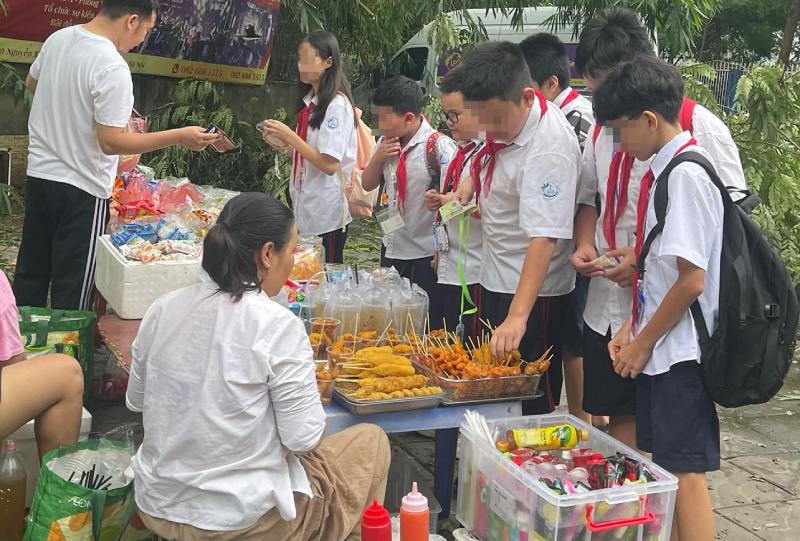
Vietnam’s street food culture is widely recognized as a cornerstone of national identity, famous for its low price, accessibility, and rich cuisine. From a steaming bowl of Pho to a crisp banh mi, Vietnamese street food carries more than 150 years of artisanal heritage, preserving the essence and depth of flavor passed down from past generations. However, the rapid expansion of urbanization and industrial food production has introduced a growing public health concern within Vietnam’s ecosystem: the rise of xiên bẩn, or “dirty skewers.”
The term “xiên bẩn” is often used colloquially to refer to a vast array of processed items, but its composition is remarkably consistent across vendors. Unlike traditional street foods, dirty skewers rely heavily on processed, low-cost ingredients and informal preparation methods that often bypass food safety standards. These skewers, commonly sold near schools and densely populated areas like Hanoi, have become especially popular among younger consumers due to their affordability and social appeal. Yet their production frequently involves unsafe practices, including the use of low-quality meat, repeated oil reuse, and exposure to unhygienic environments.
I still remember my primary school days, when the final bell rang and the school gates became the most crowded place in the neighborhood. The air was thick with the smell of frying oil and sweet, smoky sauce, drifting from small carts lined up along the sidewalk. My friends would gather around, pointing at skewers sizzling in the pan, debating which ones to share with the few coins we had left. I often hesitated, aware of the rumors about “dirty” ingredients, yet drawn in by the noise, the smell, and the simple joy of standing there together after a long day.
The proliferation of dirty skewers highlights a critical problem in Vietnam’s food production landscape, namely, the combined effects of industrialized low-cost food supply, weak regulatory enforcement, and shifting consumer behavior. By analyzing its production processes, chemical risks, and cultural drivers, this study proposes that addressing this issue will require a solution involving stricter supply chain monitoring and behavioral change among consumers.
The Anatomy of a Skewer: Processing, Ingredients, and Admixture
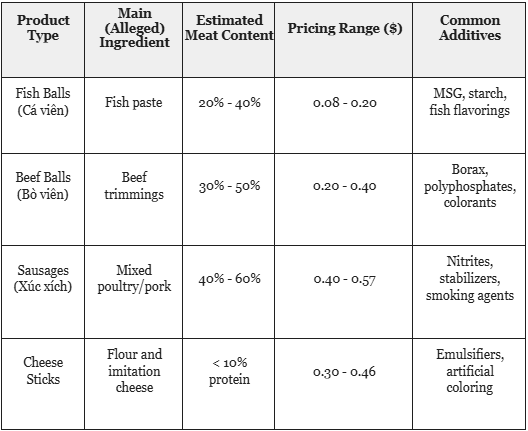
According to research conducted by FoodNK and the National Institute for Food Control (NIFC), despite being marketed under labels such as beef balls, fish balls, shrimp balls, or cheese sticks, the actual meat content in dirty skewers is often secondary to fillers and chemical enhancers. The primary structural component of these products is typically a mixture of flour (starch) and processed protein “paste.” In many cases, the product contains only 20% to 50% meat, with the remainder consisting of binders and flavorings designed to simulate a meat-like texture. This allows the skewers to remain affordable, with prices ranging from 2,000 VND ($0.08 USD) for a basic fish ball skewer to 15,000 VND ($0.63 USD) for a processed sausage or grilled meat stick.
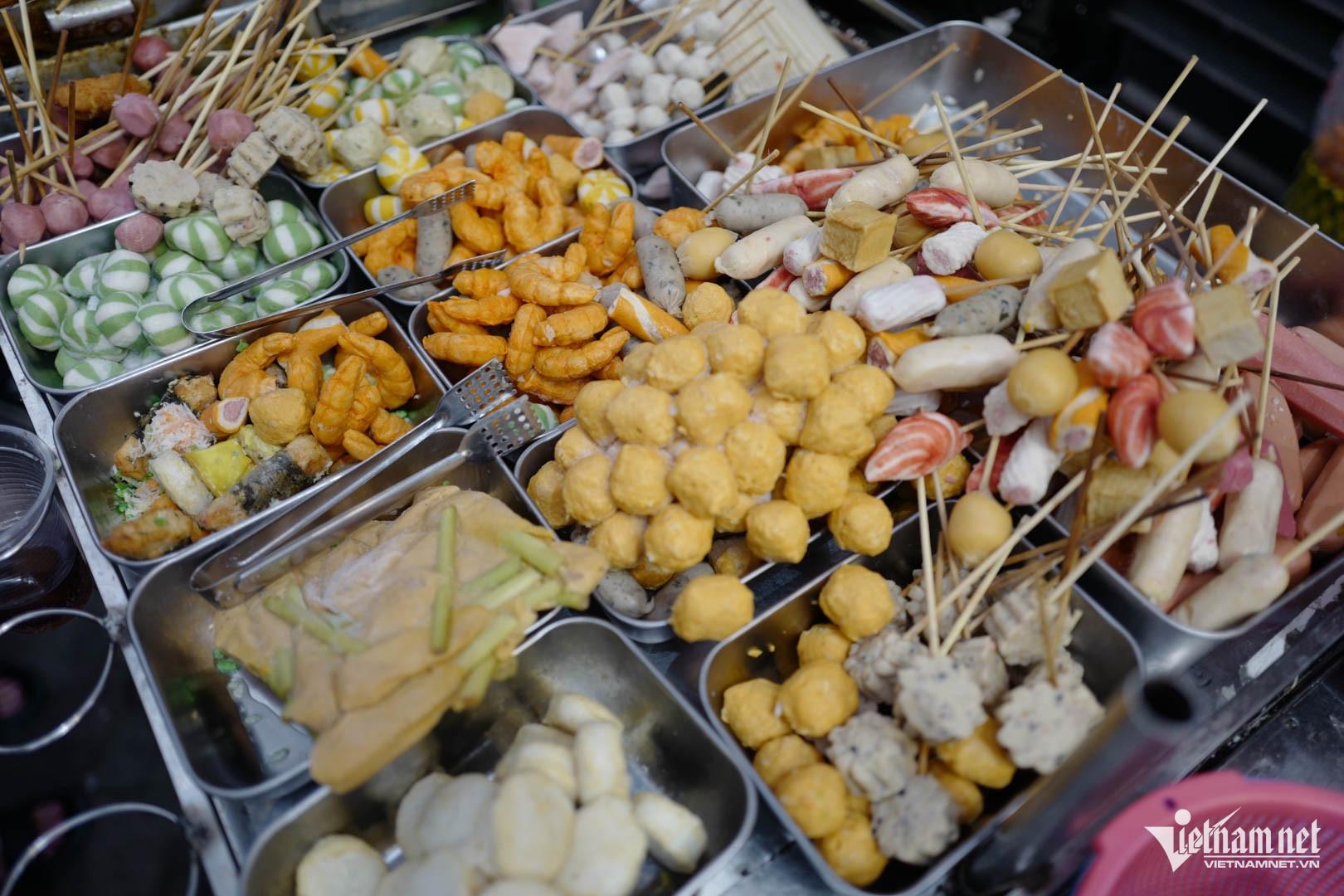
What makes dirty skewers particularly concerning is not only their affordability, but the striking gap between what is advertised and what is actually consumed. The table below, with information from FoodNK and VietnamNet, highlights this discrepancy.
The Sidewalk Economy: Informal Markets and Global Supply Chains
The prevalence of dirty skewers is sustained by a robust and highly profitable informal economy. These businesses are notably agile, requiring minimal infrastructure and allowing vendors to bypass many of the overhead costs associated with formal restaurants. As a result, they can operate with remarkable flexibility in dense urban environments.
Within this informal system, the business model of a dirty skewers vendor depends on high turnover and low ingredient costs. A typical vendor in a student-populated area like Hanoi can sell between 5 kg and 10 kg of skewers daily. Because the necessary equipment–a mobile cart, a small gas burner, and a deep fryer–is relatively inexpensive, vendors can reach profitability quickly, especially if they secure a high-traffic location.
This emphasis on location naturally ties vendors to predictable patterns of demand. In particular, their reliance on student customers makes them highly sensitive to school schedules. School gates effectively become primary marketplaces, where vendors gather in large numbers during the late afternoon to capture the surge of students finishing classes. The convenience of these snacks–easy to eat while walking or standing on the sidewalk–aligns closely with the social habits of this youth demographic, reinforcing consistent daily demand.
However, while demand is localized and predictable, the supply chain behind these products is far more complex and difficult to regulate. A critical challenge lies in the origin of the raw materials used in xiên bẩn. According to reports from Báo Lào Cai and Báo Lạng Sơn, Vietnamese border guards frequently report seizing large quantities of frozen meat and processed sausages smuggled from China. These shipments often lack documentation regarding their manufacture, ingredients, or expiration dates.
Recent enforcement actions illustrate the scale of the issue. In early 2026, border authorities in Lào Cai seized multiple shipments of smuggled frozen food totaling over 1.8 tons, including 150 kg of dried sausages, 120 kg of frozen sausages, and 80 kg of frozen meat skewers–many already thawing at the time of inspection. In separate operations, more than 500 kg of illegally imported sausages were destroyed in Lào Cai, while authorities in Lạng Sơn have repeatedly intercepted tons of moldy sausages and frozen meat at mountain border crossings.
These smuggled goods are particularly attractive to vendors because they are significantly cheaper than domestically produced and inspected meats. Yet this cost advantage comes with substantial risks. The absence of a reliable cold chain, combined with unclear manufacturing standards in informal export markets, means that the “mystery meat” arriving at school gates is often already compromised, potentially contaminated with pathogens or laden with high levels of preservatives, before it even reaches the frying pan.
Sociocultural Framing: Gen Z and the Irony of Dirty Skewers
Perhaps the most fascinating aspect of this food culture is its naming. While “xiên bẩn” literally translates to “dirty skewers,” the term is not always used as a deterrent. Instead, it has been embraced by the youth as a form of linguistic irony and a marker of cultural identity.
A market research conducted by Rubik Top indicates that Gen Z consumers in Vietnam are highly aware of the hygiene issues associated with street food. Surveys show that while they agree street food is “diverse, delicious, and reasonably priced,” they also express consistent concerns about cleanliness. Despite this awareness, Gen Z in Vietnam continues to spend a disproportionate share of their food budget out of home, with surveys showing that roughly 18% of young consumers prefer roadside eateries over formal restaurants, and that street snacking remains a daily habit even among students with limited income.
This behavior suggests a psychological threshold where social and sensory benefits outweigh perceived health risks. For many students, consuming xiên bẩn is a shared experience, one that often unfolds after school or during moments of stress, such as after high-pressure exams. In these settings, food functions less as nourishment and more as a form of social bonding, where the act of eating together provides both comfort and release. Calling the food dirty becomes a playful acknowledgment of its junk food status, reflecting a conscious yet casual acceptance of risk.
This pattern is further reinforced by subtle peer influence and what might be described as a “treat culture.” Choosing to join friends at a street cart is often more about participation than hunger, where opting out can feel like distancing oneself from the group. At the same time, this behavior highlights a broader generational divide. While parents tend to prioritize cleanliness and home-cooked meals, many young consumers embrace street food as a symbol of independence and urban identity. In this sense, eating dirty skewers, despite known concerns, becomes a small but meaningful expression of autonomy shaped by both personal choice and social belonging.
These offline social dynamics are even further amplified by digital platforms. The rise of TikTok in Vietnam, which reached a 68% penetration rate by 2024 (Statista, “Vietnam: Tiktok penetration rate by generation, 2023”), has profoundly reshaped the street food landscape. The platform’s algorithm favors short-form, high-energy content, making the visual aesthetic of sizzling skewers and vibrant sauces highly shareable. Everyday influencers and content creators create viral trends by highlighting “hidden gem” vendors, generating a sense of social proof that can override hygiene concerns. In this environment, popularity itself becomes a marker of legitimacy: if a stall is trending online, it is perceived as a must-try destination, regardless of its “dirty” reputation.
Regulatory Challenges and the Policy Landscape
The Vietnamese government faces a significant challenge in regulating the hundreds of thousands of street food vendors that operate across the country. These vendors are a vital part of the economy and provide livelihoods for millions, yet their informal nature makes oversight difficult.
In 2011, Vietnam adopted a revised food safety law that provided the first formal guidelines for street food stalls, including requirements for clean water, waste disposal, and clear ingredient origins. More recently, cities like Hanoi have implemented Plan No. 210/2024 (issued by the Hanoi People’s Committee), which aims to achieve 100% safety certification for food production and service businesses around schools.
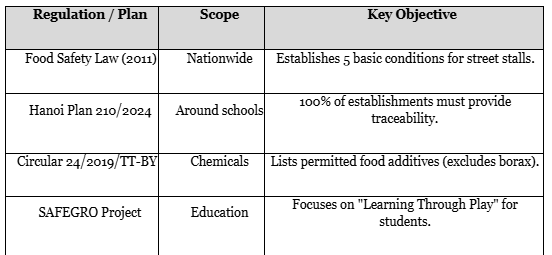
Despite these laws, enforcement remains reactive rather than proactive. Authorities often focus on “action months” or inspections following a major food poisoning incident. The “cat-and-mouse” game between vendors and urban management means that vendors often relocate or hide their carts when inspectors are present, only to return hours later.
Recognizing that strict prohibition is unlikely to succeed, some initiatives are focusing on behavioral change. The SAFEGRO project, funded by the Government of Canada, has introduced “Learning Through Play” methods to educate preschoolers and elementary students about food safety. By teaching children to recognize “safe” behaviors, such as handwashing and checking for covered food, the project aims to create a more discerning consumer base that will naturally pressure vendors to improve their standards.
Similarly, the concept of “Verified Safe” stickers or digital certificates for street vendors is being explored. If consumers can use their phones to verify a vendor’s commitment to using clean oil and traceable meat, the market may reward those who invest in safety, making dirty skewers an increasingly marginalized category.
Solutions: A Path Toward Sustainable Street Food
The problem of dirty skewers is a symptom of rapid urbanization and the lag between industrial food technology and regulatory capacity. To surmount this challenge, a multi-pronged approach is necessary, focusing on the supply chain, the vendor, and the consumer.
- Strengthening Supply Chain Traceability: The most effective way to eliminate dirty skewers is to cut off the supply of smuggled and uninspected meats. This requires stricter border controls in provinces and also the creation of a legalized, affordable wholesale market for street vendors. If vendors have access to domestically produced, safety-certified skewers at prices that compete with smuggled goods, the economic incentive to buy “mystery meat” is removed.
- Formalizing the Informal Sector: Urban planning should include dedicated “Street Food Zones” equipped with centralized water, sanitation, and waste disposal infrastructure. By providing these services for a small fee, the government can transform informal carts into regulated micro-businesses. This formalization should be paired with low-cost training programs that use digital platforms to teach vendors the chemistry of oil degradation and the risks of illegal additives.
- Helping Consumers Make Informed Choices: Finally, the narrative around dirty skewers must be reframed. Rather than simply labeling it as dirty, public health campaigns should leverage the same digital platforms like TikTok and Facebook that vendors use. “Digital storytelling for trust” can highlight vendors who use clean oil and high-quality ingredients, turning food safety into a competitive advantage. By educating Gen Z consumers to demand transparency, the fun experience of street food can be decoupled from the risk of illness.
Conclusion
Dirty skewers are a complex culinary artifact that reflect the economic and social realities of modern Vietnam. They are a food of the masses: cheap, flavorful, and deeply embedded in the social routines of the youth. However, the chemical and microbiological risks they pose represent a significant threat to the nation’s long-term health. The path forward lies in the evolution of street food. Through a combination of supply chain reform, infrastructure investment, and digital-embedded education, Vietnam can preserve the vibrant soul of its sidewalk culture while ensuring that the snacks sold at the school gate are as safe as they are delicious.
At the same time, the persistence of dirty skewers also reveals something less visible, that is, the way food becomes a form of cultural expression. The irony embedded in the name reflects a generation that is fully aware of the risks, yet continues to participate in it as part of shared identity, humor, and social belonging. In this sense, dirty skewershave become a symbol of how modern Vietnamese youth negotiate autonomy and tradition in everyday life.
The transition from “dirty skewers” to “clean skewers” is therefore both a regulatory goal and a cultural transformation. It reflects how everyday food practices shape trust, identity, and collective experience in modern Vietnam.
So, if dirty skewers are as much a symbol of youth culture and social belonging as they are a public health concern, how can Vietnam make street food safer without stripping away the experiences that make it meaningful? And ultimately, who should bear the responsibility for making that change: the government, the vendors, or the consumers themselves?
Works Cited
Báo Lao Động. “Học sinh Hà Nội nghiện ăn vặt từ xiên bẩn đến que cay, đối diện nhiều nguy hại.” (Hanoi students addicted to snacking from ‘dirty’ skewers to spicy sticks, facing many dangers). https://news.laodong.vn/suc-khoe/hoc-sinh-ha-noi-nghien-an-vat-tu-xien-ban-den-qu e-cay-doi-dien-nhieu-nguy-hai-1625755.ldo
Báo Giáo dục và Thời đại. “‘Xiên bẩn: Hiểm họa khôn lường.” (Dirty skewers: Unpredictable dangers.) https://giaoducthoidai.vn/xien-ban-hiem-hoa-khon-luong-post725328.html
Hà Nội Online. “Xiên bẩn: Mối nguy từ ẩm thực đường phố.” (Dirty skewers: The danger from street food.) https://hanoionline.vn/xien-ban-moi-nguy-tu-am-thuc-duong-pho–308340.htm
Kenh14. “Xiên bẩn bủa vây trường học: Nguy cơ ngộ độc rình rập trẻ nhỏ nhưng nhiều phụ huynh vẫn chủ quan.” (Dirty skewers surround schools: Risk of poisoning lurking for children, yet many parents remain complacent.) “Xiên bẩn” bủa vây trường học: Nguy cơ ngộ độc rình rập trẻ nhỏ nhưng nhiều phụ huynh vẫn chủ quan
VietnamNet. “Cheap but risky: The booming business of ‘dirty skewers’ in Hanoi.” Cheap but risky: The booming business of ‘dirty skewers’ in Hanoi
Viện Kiểm nghiệm An toàn Vệ sinh Thực phẩm Quốc gia (NIFC). “Hàn the trong thực phẩm: công dụng, tác hại và biện pháp phòng ngừa.” (Borax in food: its uses, side effects and preventive measures. Borax in food: its uses, side effects and preventive measures
FoodNK. “Tìm hiểu về xúc xích và các loại phụ gia thường dùng trong xúc xích.” (Understanding sausages and common additives used in sausages.) Tìm hiểu về Xúc xích và các loại phụ gia thường dùng trong xúc xích
Báo Lào Cai. “Tiêu hủy hơn 2,5 tấn xúc xích, lạp xưởng, trứng gia cầm non nhập lậu.” (Destroying more than 2.5 tons of smuggled sausages, Chinese sausages, and poultry eggs.) https://baolaocai.vn/tieu-huy-hon-25-tan-xuc-xich-lap-xuong-trung-gia-cam-non-nhap-lau-post402384.html
Báo Lạng Sơn. “Lào Cai tiêu hủy hơn 500kg xúc xích lậu.” (Lào Cai destroys more than 500kg of smuggled sausages.) Lào Cai tiêu hủy hơn 500kg xúc xích lậu – Báo và Phát thanh, Truyền hình Lạng Sơn
UBND Thành phố Hà Nội. “Kế hoạch số 210/KH-UBND – Kiểm soát an toàn thực phẩm dịch vụ ăn uống, thức ăn đường phố quanh cổng trường học.” (Plan No. 210/2024 – Controlling food safety of food services and street food around school gates). VietnamNet. Hanoi implements strict food safety controls around schools for 2024-2025
Hanoi Times. “Food safety in and around schools strengthened in Hanoi.” Food safety in and around schools strengthened in Hanoi
SAFEGRO Project. “Safe Food for Growth Project – General Information.” SAFE FOOD FOR GROWTH PROJECT (SAFEGRO) – safegroproject.com
Statista. “Vietnam: TikTok penetration rate by generation 2023.” Vietnam: TikTok penetration rate by generation 2023| Statista
Rubik Top. “Street food vs fast food: What wins the hearts of Gen Z in Vietnam.” Street food vs fast food what wins the hearts of Gen Z in Vietnam
Recent Comments