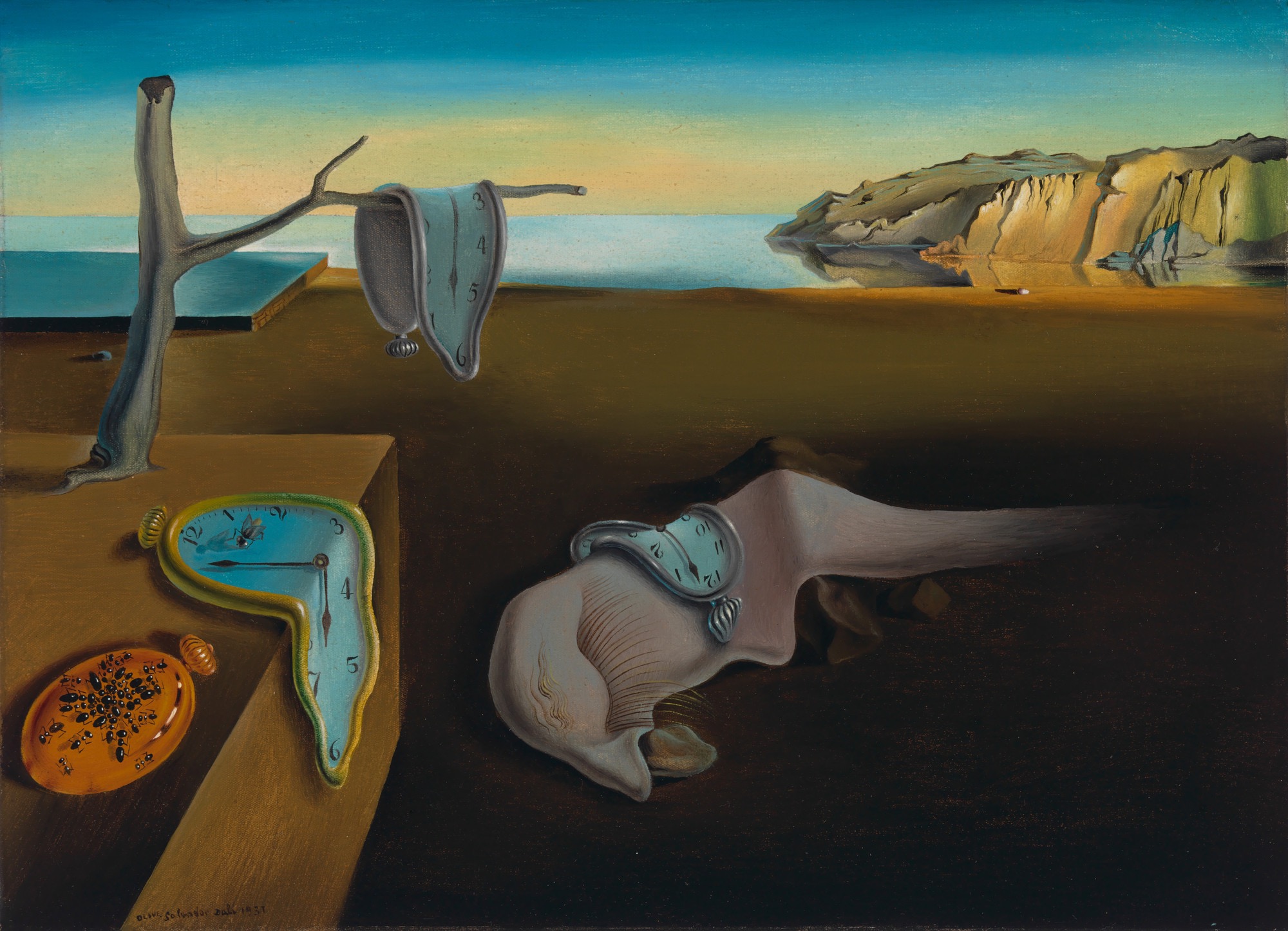
It is 6:55. Half of the face shines bright white, while the rest is shaded. Deep brown hands point persistently, although their compass is folded in ninety degrees. A polished gold frame surrounds the face and knob. It is 6:55 on Dalí’s clock.
In “Against Interpretation,” Susan Sontag argues that people spend too much time searching for hidden meanings instead of appreciating the artwork for its visual presentation. While Sontag insists that one should approach works of art by examining their form and not speculate about their deeper meaning, the painting entitled The Persistence of Memory by Salvador Dalí proves that it is equally important to consider both aspects when examining any artwork. In his piece, the melting clocks, surreal landscape, and realist painting techniques provide an aesthetic appeal that Sontag urges viewers to focus on in her essay. Nevertheless, these symbols have an inevitable connection to time that draws the audience’s attention toward interpreting the symbols.
By incorporating melting clocks and distorting mundane objects, Dalí’s painting offers a perspective that supports Sontag’s point that people should look at an artwork’s form and not rush into trying to uncover its message. At face value, the painting is beautiful. Three clocks are soft and almost liquid, with pearly white faces and silver or gold frames. They melt as the sun rises on a peaceful beach. One clock hangs on a block, another on a tree, the third on a shell. Glassy water appears behind the distorted clocks. The contrast between recognizable objects and their impossible shapes makes the painting unusual. The viewer notices these shapes before knowing what they symbolize. The physical transformation of these familiar objects immediately captures the audience’s attention. According to Sontag, this allure is the “sensuous surface of art” (8). The “sensuous surface” contains the physical traits of art. Sontang emphasizes that viewers should pay attention to the visual qualities of a work of art, rather than trying to dissect its deeper meaning. Dalí’s artwork creates a viewing experience that is valuable even without analyzing its symbolism, demonstrating the power of its aesthetic qualities.
By using realist painting techniques on impossible objects, Dalí makes The Persistence of Memory particularly interesting. Though the objects have an unusual form, they are painted with attention to light, shadow, and texture. In reality, clocks do not melt over trees. A clock bent at a 90 degree angle would not be able to function. The clocks appear soft, but Dalí makes their surfaces look believable. The mixture of pearl, gold, and silver is eye-catching. Shadows help give the objects a three-dimensional appearance, which adds to the commonality of these objects. They do not feel too unrealistic because they are common objects, just physically unusual. Everyone uses a clock daily. The distant cliffs and water look much more realistic than the objects in the foreground. It feels relatable yet unreal. The landscape appears quiet and still, which contrasts with the distorted clocks. The scene in the painting feels realistic but warped. Sontag urges viewers that “what is important now is to recover [their] senses” (10). Viewers must examine the art by focusing on its visual qualities. People must “recover” their sensuality of art. The audience needs to focus on what they can see and not waste time on what might be there. An audience without their “sensuality” misses out on the aesthetic appeal of the viewing experience.
While the visual elements of the painting are significant, the melting clocks and dreamlike setting additionally makes the audience consider concepts such as time, memory, and reality. Given these associations, interpretation enhances artwork rather than diminishes it. Appreciating the sensuality of art is important, but this experience is not lessened by the addition of artistic symbolism. Sontag claims that “the function of criticism should be to show how it is what it is, even that it is what it is, rather than to show what it means” (10). Sontag wants critics to comment on the form of a piece of art, particularly its style and technique, rather than searching for its deeper meaning. But, the value of art also lies in its meaning. Throughout time, art has been used for reasons beyond its visual appeal, to communicate deeper meaning. Art is used in protests to communicate political messages, in religion to represent beliefs, and in memorials to honor people and preserve their memory. Dalí’s The Persistence of Memory has an automatic connection to memory and time. One cannot look at a clock without thinking about time. The clocks distort, yet they still keep the time. Time is moving. This is similar to the nature of memory: how time ages and distorts memories. The clocks are clearly clocks, just melted now. Dalí’s clocks deepen the experience by provoking thoughts about how time and memory are connected, demonstrating how interpreting the painting can add meaning beyond its figure. The realist style of painting and juxtaposition of the natural background and unnatural objects forces viewers to think about the line between reality and imagination. These deeper connections benefit the audience’s experience. The associations about time, memory, and reality cannot be separated from Dalí’s painting.
Although Sontag emphasizes the importance of appreciating art for its visual qualities, Dalí demonstrates that interpretation is equally important. The melting clocks, realist painting techniques, and surreal landscape create a visually appealing experience, but they also encourage viewers to question the meaning behind what they see. The connection between the clocks and the passing of time is difficult to ignore, just as the contrast between realistic and unrealistic objects raises questions about reality. These interpretations do not take away from the painting’s visual appeal but instead add to its value. While Sontag argues that viewers should focus on how art appears rather than what it means, Dalí’s painting challenges this distinction. Through his combination of familiar objects and impossible imagery, Dalí creates a painting that invites both visual appreciation and intellectual curiosity. The clocks in Dalí’s painting inevitably invite interpretation, making form and meaning impossible to completely separate. Ultimately, art can be appreciated for both its visual qualities and its deeper meaning, and neither should be valued over the other. The relationship between what we see and what we understand may be what makes art worth examining in the first place.