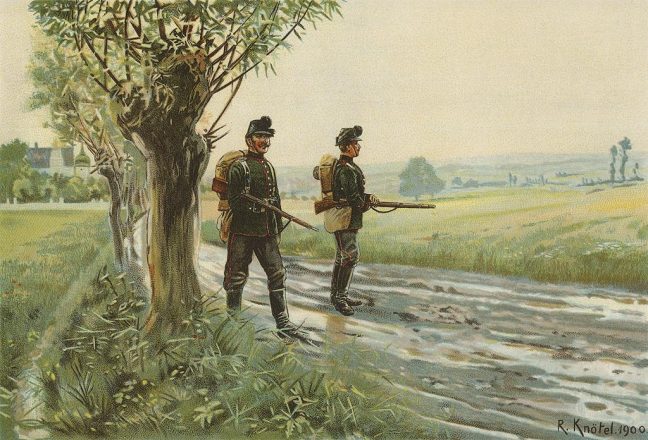
Two Saxon Jägers on picket duty.
Deutschlands Ruhmeshalle in Wort und Bild im 19. Jahrhundert (Germany’s Hall of Fame in the 19th Century in Words and Pictures)
Transitions: From the Old Order to the New 1890-1930
GER 297 | Fall 2018
Two Saxon Jägers on picket duty.
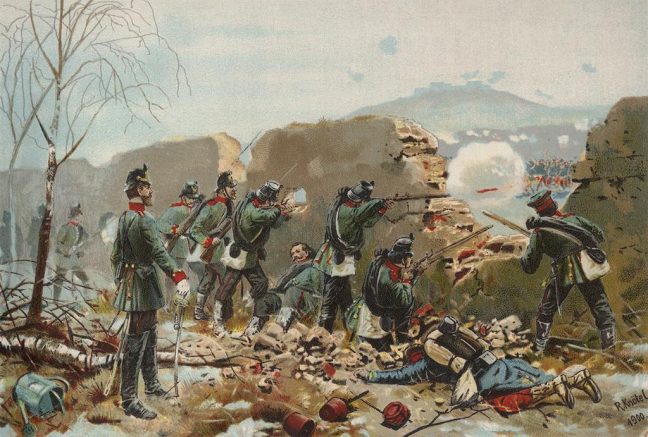
The Prussian Fifth Jäger Battalion at the Battle of Mont-Valerien on January 19, 1871.
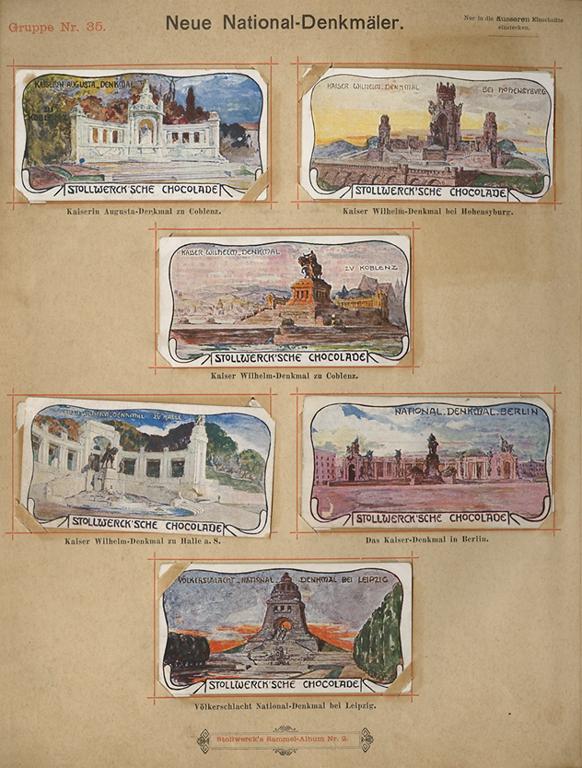
This page from the Stollwerck trade card album of 1898, titled “New National Monuments”, shows six of the most recent monuments in Germany at that time. Pictured from left to right, starting at the top, are: The monument to Empress Augusta (wife of Kaiser Wilhelm II) in Koblenz; the Kaiser Wilhelm Monument in Hohensyburg; the Kaiser Wilhelm Monument in Koblenz; the Kaiser Wilhelm Monument in Halle; the “Emperor Monument” in Berlin, and the monument commemorating the “Battle of the Nations” at Leipzig in 1813, in which Germany revolted against Napoleon and French rule.

Pictured here are various German cities and their most famous landmarks or monuments. From left to right, the cards show: Berlin, with the Brandenburg Gate; Cologne, with its medieval Cathedral; Munich, with its 15th-century Cathedral of Our Lady (the “Frauenkirche”); Dresden, with its Royal Palace; Stuttgart, with its “Jubilee Pillar” celebrating the 25th year of the reign of King Wilhelm I of Wuerttemberg in 1841; and the Niederwald Monument in Ruedesheim that celebrates the German victory over France in the Franco-Prussian War of 1870-71.
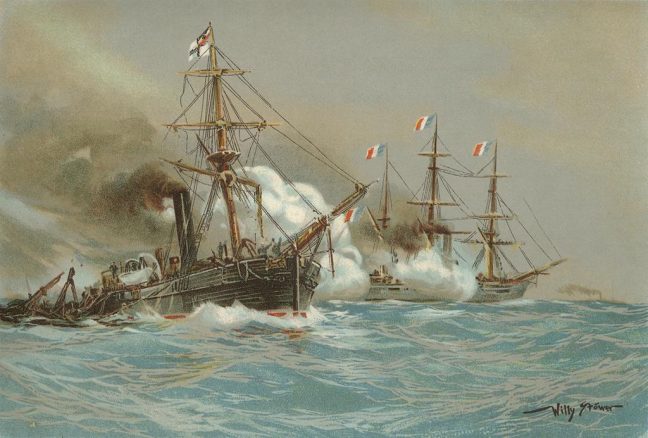
This painting by Willy Stoewer portrays a naval battle between a German gunship and a French corvette off the coast of Havana, Cuba during the Franco-Prussian War in 1871.
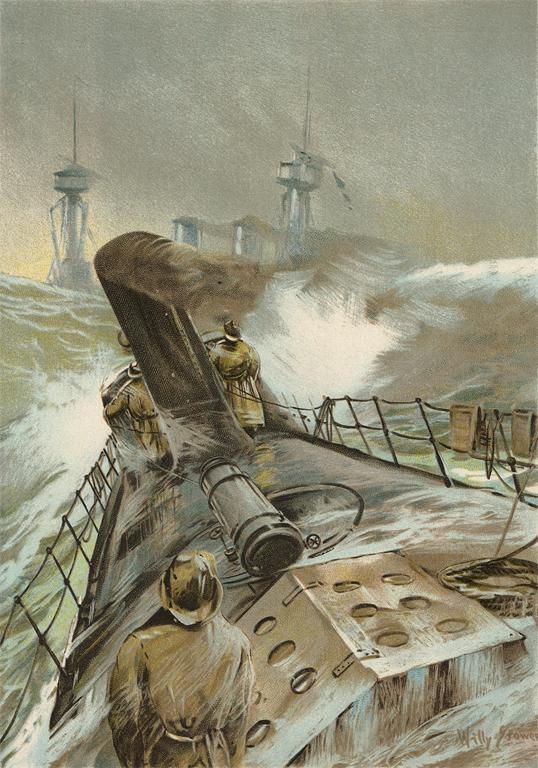

The sinking of the German gunship “Iltis” off the coast of China on July 24, 1896.

This painting by Willy Stoewer from 1897 shows German marines taking possession of the new German colony at Tsingtao, China in 1898. This small colony also became the base for Germany’s Far East Naval Squadron on November 14th, 1897.
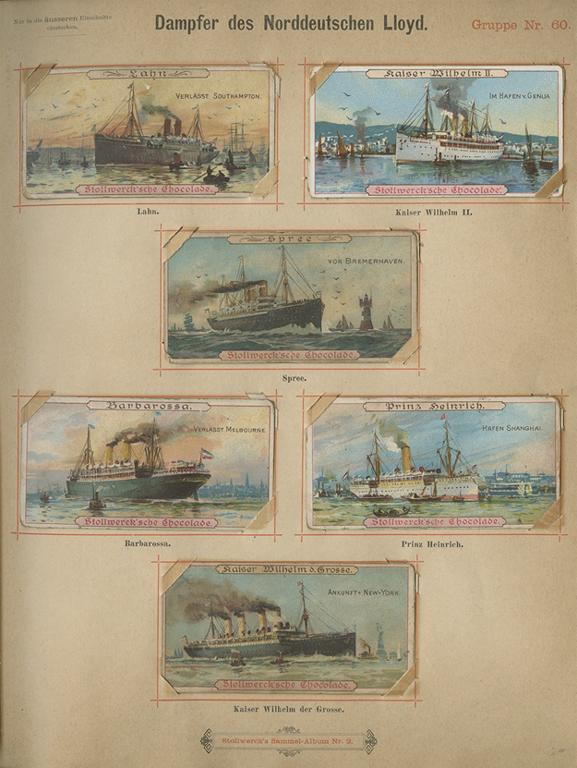
German immigration to the Americas increased in the 1880s and 1890s, due primarily to economic conditions. Most of the immigrants were carried to the new world on the steamships of the North German Lloyd Co., based in Bremen, or the Hamburg-America Line, based in Hamburg.
This page shows some of the main steamship liners of the North German Lloyd Co.
Picture 1: The Liner “Lahn”. Built in 1887, this ship is one of the most beautiful and comfortable of
German passenger liners. It is 141.5 meters long, 14.9 meters wide and can carry 224 first-class
passengers, 104 second-class passengers and 600 third-class passengers. Its engines produce 9,000 HP
and it can reach a top speed of 18.5 knots. It displaces 5,351 registered tons and has a crew of 210 men.
For a trip from Bremen to New York the ship requires about 1,500 tons of coal and takes about 8 days.
Picture 2: The Liner “Kaiser Wilhelm II”. This exquisite ship, built in 1889 cost about 4 Million Marks.
Four double-boilers produce 6,500 HP which drives its screw to a top speed of 16 knots. In addition to
carrying up to 1,100 passengers, the ship can also carry 3,600 tons of freight. The liner is 142 meters
long, 15.5 meters wide and has a draught of 11.4 meters and displaces 6,660 tons.
Picture 3: The Liner “Spree”. This was one of the first passenger steamships in German service, being
built in 1890 in Stettin. It is 146.6 meters long, 14.8 meters wide and has a draught of 11.3 meters. The
engines produce 12,500 HP and a top speed of 19.5 knots with a displacement of 6,875 tons. It can
transport 274 first-class passengers, 142 second-class passengers and 400 additional people in steerage.
Its interior is elegantly appointed. A trip from Bremen to New York takes on average 8 days.
Picture 4: The “Barbarossa”. This two-screw steamer was launched in 1896 in Hamburg. It is 165.8
meters long, 18.3 meters wide and has a draft of 11.58 meters. It displaces 10, 769 registered tons. It
can transport 216 first-class passengers, 158 second-class passengers and some 2,000 third-class
passengers as well as an additional 7,400 cubic meters of freight. It produces 7,000 HP and can achieve a
top speed of 15 knots.
Picture 5: The Liner “Prince Heinrich”. This mail and passenger steamship was launched in 1894 by its
namesake. It was built for the mail run between Germany and the Far East. Its three engines can
produce a total of 7,500 HP and a top speed of 14 knots. The ship is 143.7 meters long, 15.5 meters wide
and has a draught of 10 meters with a displacement of 6,263 tons. The ship can transport 96 first-class
passengers, 89 second-class passengers and 1,255 third-class passengers on board. The trip from
Germany to Shanghai takes about 45 days.
Picture 6: The Liner “Emperor Wilhelm the Great”. On May 4, 1897 this two-screw ship, which was built
in Stettin and was one of the largest and fastest liners of its time, was christened by Emperor Wilhelm II.
The ship is 198 meters long, 20 meters wide and has a draught of 13 meters with a displacement of 14,
349 tons. It generates 27,000 HP and a top speed of 22 knots. It can carry 400 first-class passengers, 350
second-class passengers and 800 third-class passengers, along with a crew of 450 men. The trip from
Bremen to New York takes only 7 days.
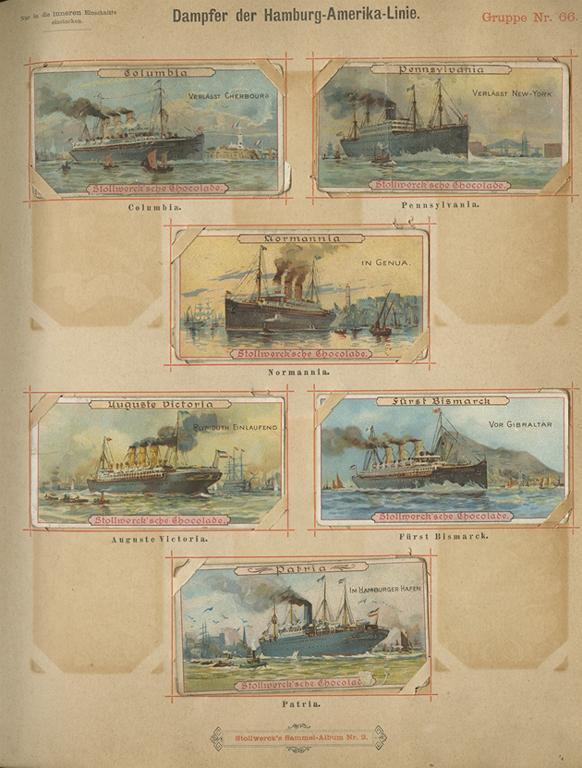
German immigration to the Americas increases in the 1880s and 1890s, due primarily to economic conditions. Most of the immigrants were carried to the new world by steamships of the North German Lloyd Co., based in Bremen, or the Hamburg-America Line, based in Hamburg.
This page shows some of the main steamship liners of the Hamburg-Amerika Line around 1900: The Columbia, the Pennsylvania, the Normannia, the Augusta Victoria, the Prince Bismarck, and the Patria.