Pictured here is the back side of the 100-Mark bill issued in 1910 by the German National Bank. The seemingly blank space on the right contains the watermark.
Reichsbanknote (Imperial Bank Note)

Transitions: From the Old Order to the New 1890-1930
GER 297 | Fall 2018
Pictured here is the back side of the 100-Mark bill issued in 1910 by the German National Bank. The seemingly blank space on the right contains the watermark.

Pictured here is a report card for a student in the first grade of a girls school in 1915. It is typical of the prewar and war period in Germany in that the large sections on the left evaluate the student’s behavior and personal traits.
Young Kathy, whose report card this is, received a “very good” (the highest grade) in “Behavior”. She only received a “good” (equivalent of a “B”) for “Diligence and Attention in Class”. She once again excelled, however, in the category “Orderliness” with a “very good” and missed only 1 day of school. The subjects she took in first grade are listed on the right: Religion, German, Composition, Reading, Literature, Handwriting, Math, History, Geography, the Study of Nature, French, Drawing, Singing, Crafts and Physical Education. These grades were in the “B” to “B-” range.
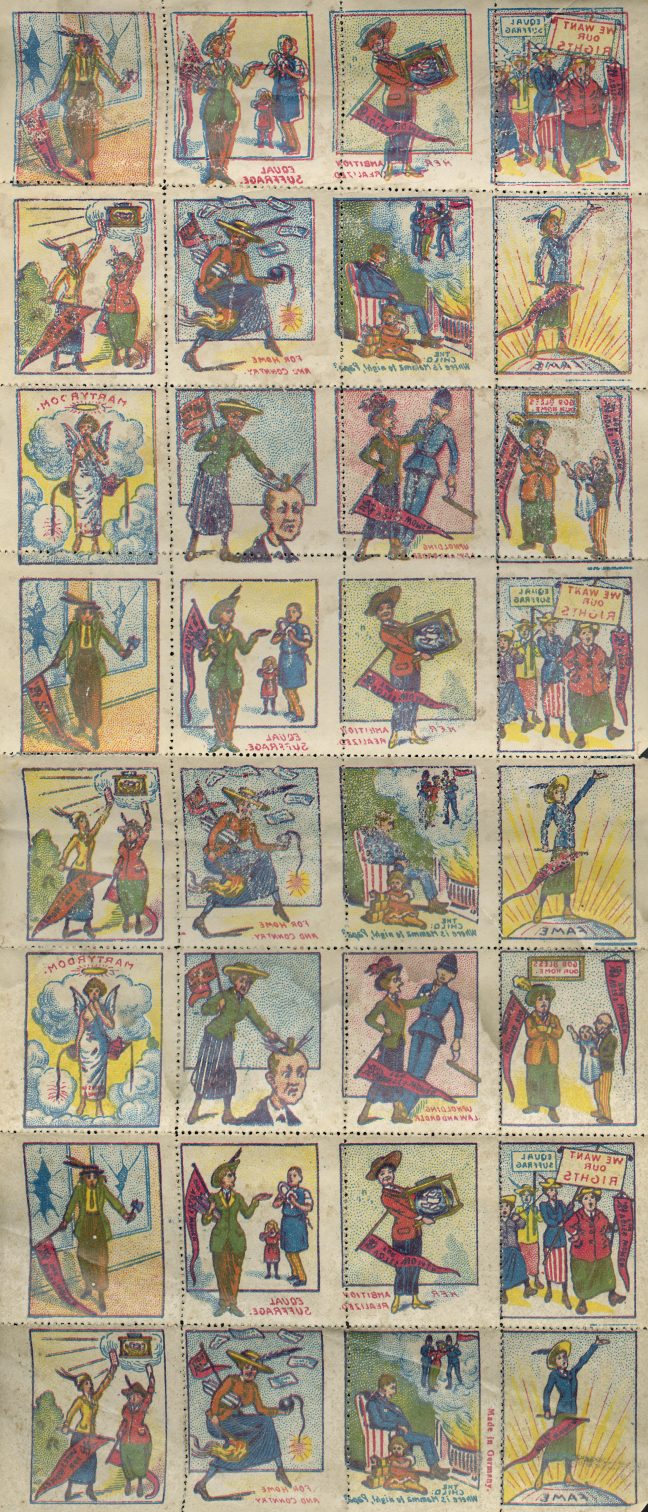
Pictured here is a page of vignettes (stamps not used for postage) showing various scenes from the Suffragette Movement.
The stamps were printed in Germany, likely before or during the war, but are printed in English. This may reflect the British influence on the Women’s Rights Movement in Germany in the early 20th century, as reflected in the opening of Germany’s first club for accomplished women, the Lyceum Club, in Berlin in 1905. The club was opened in Berlin by the founder of the London Lyceum Club, Constance Smedley, together with Maria von Bunsen, a German writer, painter and supporter of the arts.
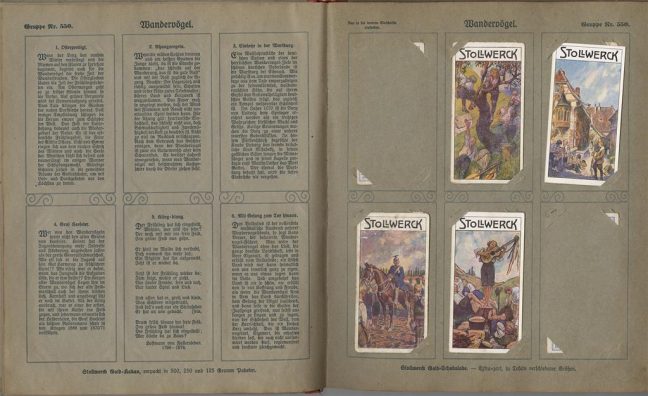
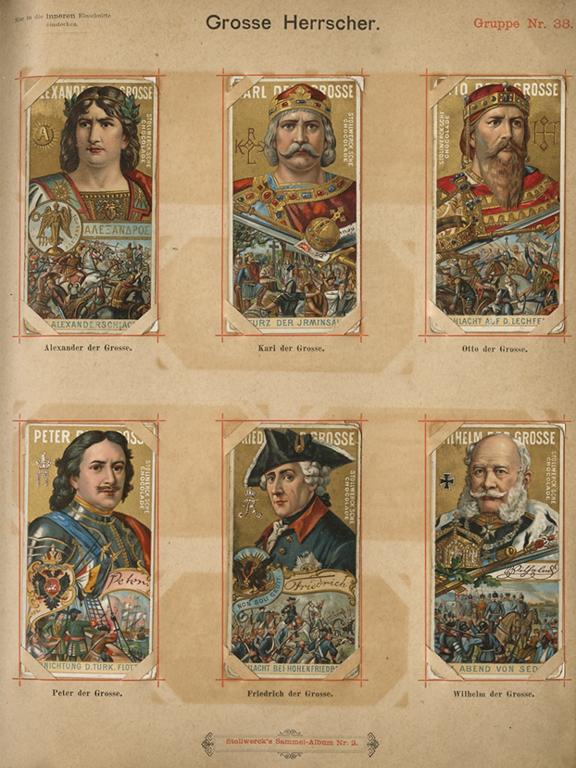
This is a set of trade cards issued by the Stollwerck Chocolate Company in 1897 titled “Great Rulers”. Pictured here are from left to right: Alexander the Great of Macedonia, Charlemagne of the Holy Roman Empire, Otto the Great of the Holy Roman Empire, Peter the Great of Russia, Frederick the Great of Prussia and Wilhelm the Great of Prussia.
In seeking to establish itself among the Great Powers of Europe, Germany implies in this order of rulers an imperial heritage that stretches back into antiquity (Alexander the Great). The last two rulers pictured are Prussian Kings who contributed to Prussia’s rise to power in the 18th century (Frederick the Great) and its eventual unification (Wilhelm the Great).

This is a set of six cards issued by the Stollwerck Chocolate Company in 1898 titled “The Six Regents of the European Great Powers”. Pictured here are (from left to right): Emperor Franz Joseph I of the Austro-Hungarian Empire, Kaiser Wilhelm I of Germany, King Umberto I of Italy, Czar Nicolaus II of Russia, Queen Victoria of England and President Felix Faure of France.
After its unification in 1871 Germany wanted to be recognized as one of the Great European Powers, and so acquired colonies, built a high seas naval fleet, and developed its industrial economy to one of the strongest in Europe.

This portrait series of the Emperor and Empress of Germany is part of a trade card album titled “Aus grosser Zeit” (From Times of Greatness), issued in 1913 by the Stollwerck Chocolate Company. The album celebrated both the 100th anniversary of the German uprising against Napoleon at the Battle of Leipzig and the 25th year of the reign of Emperor Wilhelm II.
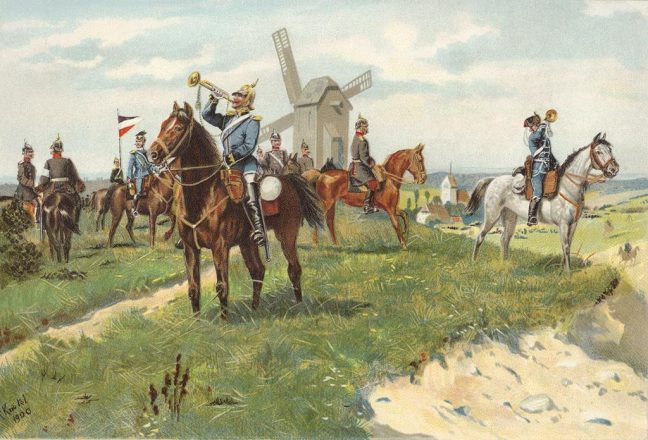
Calling together the staff officers of the XII Saxon Army Corps.
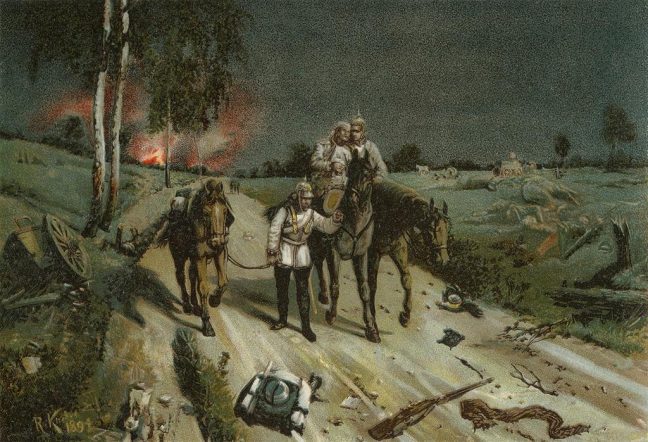
Injured German soldiers leave the battlefield through the war-ravaged countryside.
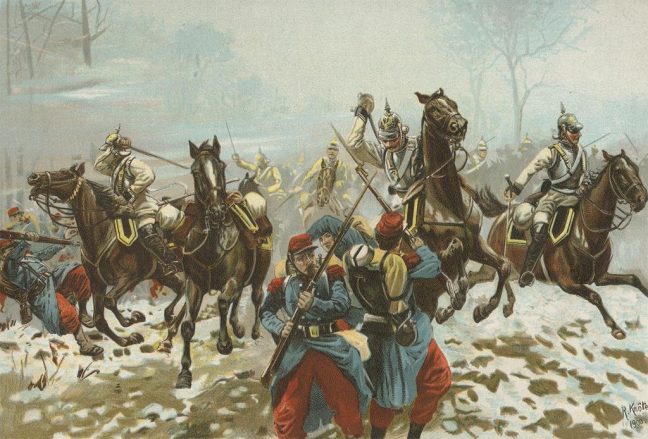
The First Prussian Curaissier Regiment at Poupry (Orleans) on December 2, 1870.