Regenten der Europäischen Grossmächte (The Six Regents of the European Great Powers)

This is a set of six cards issued by the Stollwerck Chocolate Company in 1898 titled “The Six Regents of the European Great Powers”. Pictured here are (from left to right): Emperor Franz Joseph I of the Austro-Hungarian Empire, Kaiser Wilhelm I of Germany, King Umberto I of Italy, Czar Nicolaus II of Russia, Queen Victoria of England and President Felix Faure of France.

After its unification in 1871 Germany wanted to be recognized as one of the Great European Powers, and so acquired colonies, built a high seas naval fleet, and developed its industrial economy to one of the strongest in Europe.

Zum Regierungs-Jubiläum (For The Anniversary of the Government)

This portrait series of the Emperor and Empress of Germany is part of a trade card album titled “Aus grosser Zeit” (From Times of Greatness), issued in 1913 by the Stollwerck Chocolate Company. The album celebrated both the 100th anniversary of the German uprising against Napoleon at the Battle of Leipzig and the 25th year of the reign of Emperor Wilhelm II.

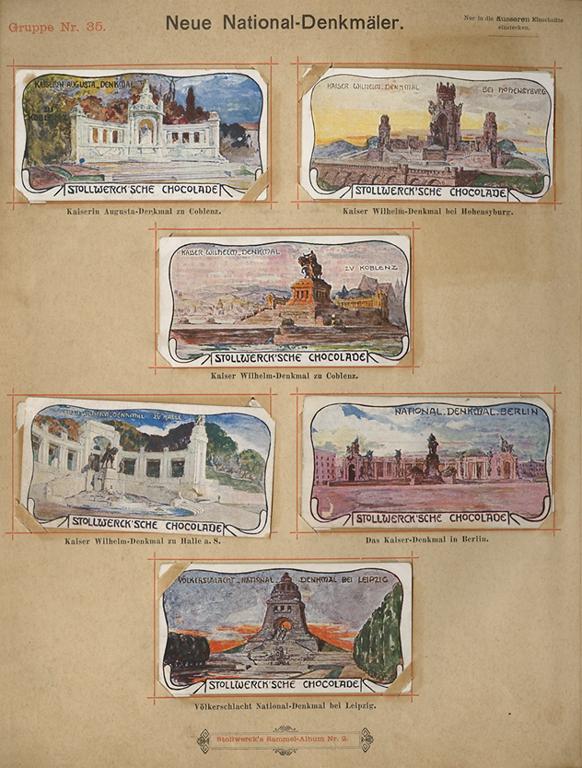
Neue National-Denkmäler (New National Monuments)

This page from the Stollwerck trade card album of 1898, titled “New National Monuments”, shows six of the most recent monuments in Germany at that time. Pictured from left to right, starting at the top, are: The monument to Empress Augusta (wife of Kaiser Wilhelm II) in Koblenz; the Kaiser Wilhelm Monument in Hohensyburg; the Kaiser Wilhelm Monument in Koblenz; the Kaiser Wilhelm Monument in Halle; the “Emperor Monument” in Berlin, and the monument commemorating the “Battle of the Nations” at Leipzig in 1813, in which Germany revolted against Napoleon and French rule.

Städte-Bilder (Cityscapes)

Pictured here are various German cities and their most famous landmarks or monuments. From left to right, the cards show: Berlin, with the Brandenburg Gate; Cologne, with its medieval Cathedral; Munich, with its 15th-century Cathedral of Our Lady (the “Frauenkirche”); Dresden, with its Royal Palace; Stuttgart, with its “Jubilee Pillar” celebrating the 25th year of the reign of King Wilhelm I of Wuerttemberg in 1841; and the Niederwald Monument in Ruedesheim that celebrates the German victory over France in the Franco-Prussian War of 1870-71.