Unknown

Transitions: From the Old Order to the New 1890-1930
GER 297 | Fall 2018

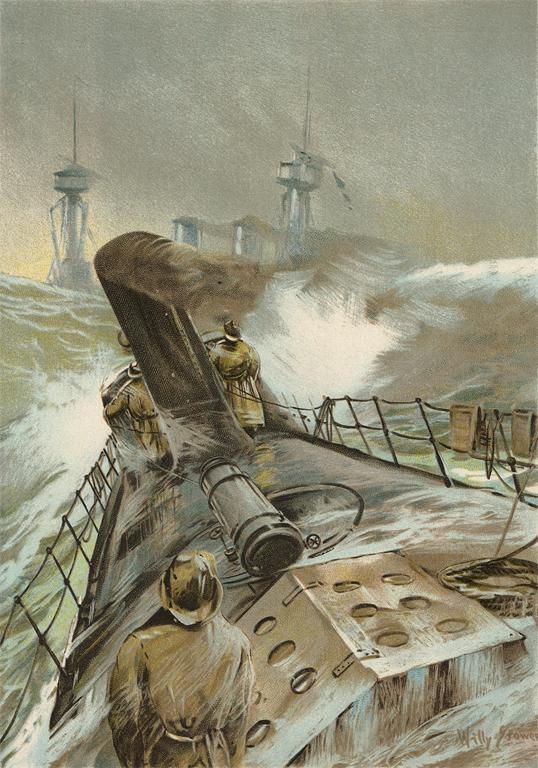
The sinking of the German gunship “Iltis” off the coast of China on July 24, 1896.

This painting by Willy Stoewer from 1897 shows German marines taking possession of the new German colony at Tsingtao, China in 1898. This small colony also became the base for Germany’s Far East Naval Squadron on November 14th, 1897.

This picture shows a “Dolmen”, a prehistoric grave site, in Barozza, Italy. According to local tradition, if a young woman about to be married sits in the shade of the stones and makes a wish about her future, it will be granted her.
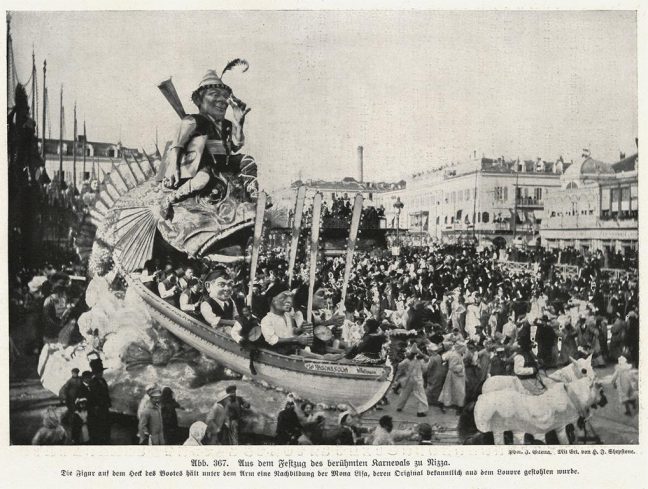
This picture shows a float from the Carneval (Mardi Gras) celebration in Nice, France. This tradition is celebrated primarily in Catholic parts of Germany and represents a final celebration before the start of Lent, when fasting and prayer are the order of the day.

One of the factors that led to Germany’s rise in Europe in the late 19th century was its pre-eminence in many fields of science. This was true not only in the natural sciences, but also in the social sciences, where German scholars and explorers contributed to the creation of a new field: Anthropology. As German researchers spread out around the world, recording their contacts with both familiar as well as lesser-known cultures, they laid the groundwork for this new discipline.
The book cover pictured here is that of the four-volume series “Die Sitten der Voelker” (The Peoples of the World and their Customs) by Dr. Georg Buschan that was published in 1914.
The cover art of this book evokes the “exotic” lands and cultures that this work covers.
From left to right:
This picture shows a float from the Carneval (Mardi Gras) celebration in Nice, France. This tradition is celebrated primarily in Catholic parts of Germany and represents a final celebration before the start of Lent, when fasting and prayer are the order of the day.
This picture shows a “Dolmen”, a prehistoric grave site, in Barozza, Italy. According to local tradition, if a young woman about to be married sits in the shade of the stones and makes a wish about her future, it will be granted her.
Pictured here is a woman from Lapland in clothing made of animal pelts.
Pictured here is the chief of the Yakun tribe of the Sudan in formal robes.
Pictured here are two female members of the Bundu Order second class, who serve as shamans or medical practitioners in their tribe in West Africa. They are wearing the mask and clothing that they must put on in order to practice their arts as “Bundu Devils”.
Pictured here is a young woman from Bueckeburg, in the Lower Saxony region of Germany. She is dressed in traditional wedding attire, which is often the same piece passed down for generations.
Pictured here is a young woman from Serbia in colorful traditional clothing.
Pictured here is a woman from the Siebenbuerger Mountains of Romania in the traditional clothing of this region.
This picture shows the “Flute Ceremony” of the Hopi tribe in North America. This ceremony, also known as “Lenya” can last as long as nine days.
Pictured here is a Mexican Christmas tradition, a ceremonial parade that stops at a residence and asks for shelter for Mary and Joseph, the parents of Jesus.
Pictured here is a highly decorated casket used by the Mongo tribe of the Congo region of Africa. After the deceased has been washed by family members or slaves, the body is kept in a hut for at least a month. Then, the body is placed in the decorative casket and paraded through the village, accompanied by song and dance.
Pictured here is the royal residence of the King of the Shilluk tribe in East Africa. The hill on which these buildings rest was artificially built. The King rarely leaves the compound with his body guard of between 12 and 20 men.
Pictured here are masked ceremonial dancers of the Opaina tribe of Brazil in the region near the Apaporis River.
This photograph shows a Swedish bridal procession of the 19th century.
This picture shows a wedding in a farming community in the German region of Swabia. The painting was done by Theodor Lauxmann.
This picture is titled “Choosing a Bride on Christmas Eve”. The text reads: “In some Russian villages it is a custom, that young women who wish to marry go to the house of the oldest person in the village on Christmas Eve. They all take a seat next to one another and are covered with a large cloth. Then, the young men of the village who wish to marry enter the house one at a time. If they bow before one of the young women, the elder raises the cloth and the young couple are considered engaged. However, the young couples usually arrange a sign of some sort in advance, so that the young man can recognize the women he wishes to select before the veil is raised.”
This photograph shows a Russian folk dance troupe performing the Russian National Dance.
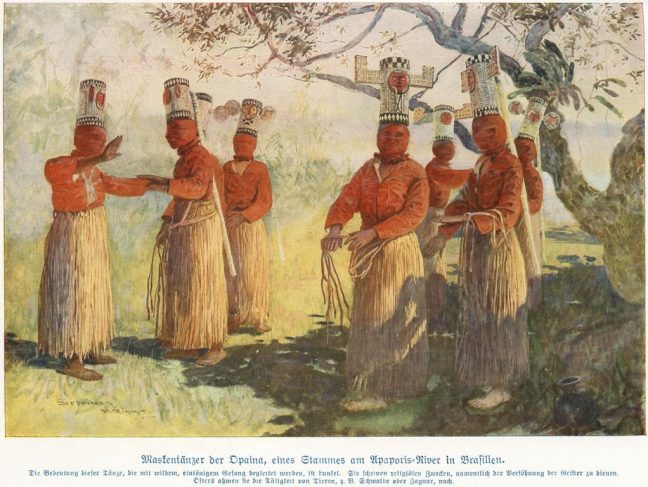
Pictured here are masked ceremonial dancers of the Opaina tribe of Brazil in the region near the Apaporis River.
German immigration to the Americas increased in the 1880s and 1890s, due primarily to economic conditions. Most of the immigrants were carried to the new world on the steamships of the North German Lloyd Co., based in Bremen, or the Hamburg-America Line, based in Hamburg.
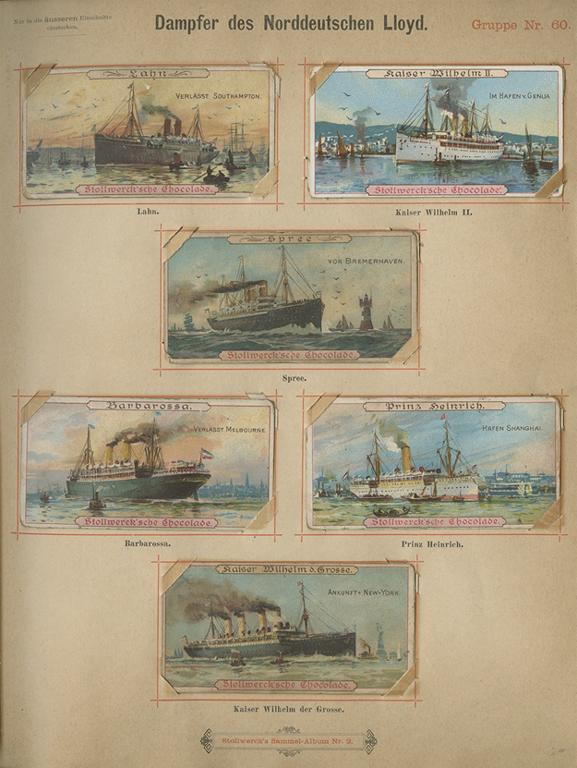
This page shows some of the main steamship liners of the North German Lloyd Co.
Picture 1: The Liner “Lahn”. Built in 1887, this ship is one of the most beautiful and comfortable of
German passenger liners. It is 141.5 meters long, 14.9 meters wide and can carry 224 first-class
passengers, 104 second-class passengers and 600 third-class passengers. Its engines produce 9,000 HP
and it can reach a top speed of 18.5 knots. It displaces 5,351 registered tons and has a crew of 210 men.
For a trip from Bremen to New York the ship requires about 1,500 tons of coal and takes about 8 days.
Picture 2: The Liner “Kaiser Wilhelm II”. This exquisite ship, built in 1889 cost about 4 Million Marks.
Four double-boilers produce 6,500 HP which drives its screw to a top speed of 16 knots. In addition to
carrying up to 1,100 passengers, the ship can also carry 3,600 tons of freight. The liner is 142 meters
long, 15.5 meters wide and has a draught of 11.4 meters and displaces 6,660 tons.
Picture 3: The Liner “Spree”. This was one of the first passenger steamships in German service, being
built in 1890 in Stettin. It is 146.6 meters long, 14.8 meters wide and has a draught of 11.3 meters. The
engines produce 12,500 HP and a top speed of 19.5 knots with a displacement of 6,875 tons. It can
transport 274 first-class passengers, 142 second-class passengers and 400 additional people in steerage.
Its interior is elegantly appointed. A trip from Bremen to New York takes on average 8 days.
Picture 4: The “Barbarossa”. This two-screw steamer was launched in 1896 in Hamburg. It is 165.8
meters long, 18.3 meters wide and has a draft of 11.58 meters. It displaces 10, 769 registered tons. It
can transport 216 first-class passengers, 158 second-class passengers and some 2,000 third-class
passengers as well as an additional 7,400 cubic meters of freight. It produces 7,000 HP and can achieve a
top speed of 15 knots.
Picture 5: The Liner “Prince Heinrich”. This mail and passenger steamship was launched in 1894 by its
namesake. It was built for the mail run between Germany and the Far East. Its three engines can
produce a total of 7,500 HP and a top speed of 14 knots. The ship is 143.7 meters long, 15.5 meters wide
and has a draught of 10 meters with a displacement of 6,263 tons. The ship can transport 96 first-class
passengers, 89 second-class passengers and 1,255 third-class passengers on board. The trip from
Germany to Shanghai takes about 45 days.
Picture 6: The Liner “Emperor Wilhelm the Great”. On May 4, 1897 this two-screw ship, which was built
in Stettin and was one of the largest and fastest liners of its time, was christened by Emperor Wilhelm II.
The ship is 198 meters long, 20 meters wide and has a draught of 13 meters with a displacement of 14,
349 tons. It generates 27,000 HP and a top speed of 22 knots. It can carry 400 first-class passengers, 350
second-class passengers and 800 third-class passengers, along with a crew of 450 men. The trip from
Bremen to New York takes only 7 days.
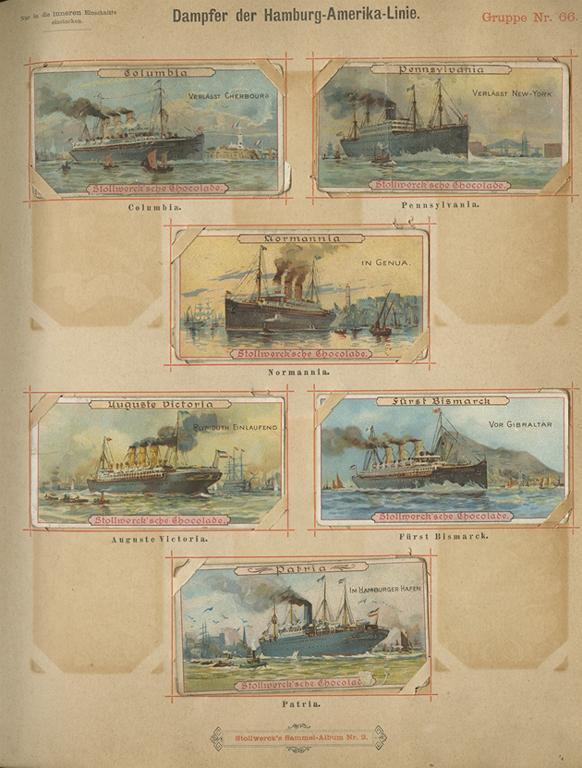
German immigration to the Americas increases in the 1880s and 1890s, due primarily to economic conditions. Most of the immigrants were carried to the new world by steamships of the North German Lloyd Co., based in Bremen, or the Hamburg-America Line, based in Hamburg.
This page shows some of the main steamship liners of the Hamburg-Amerika Line around 1900: The Columbia, the Pennsylvania, the Normannia, the Augusta Victoria, the Prince Bismarck, and the Patria.
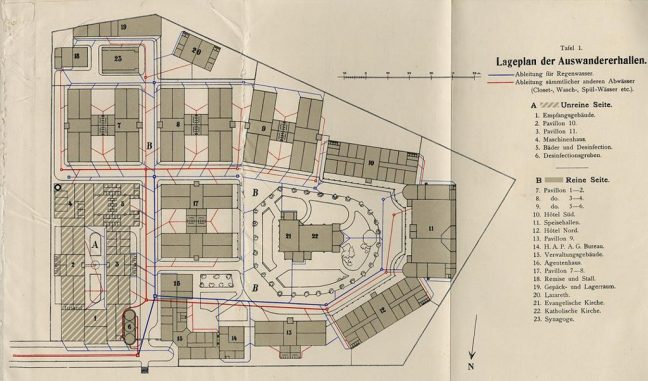
This booklet was prepared in 1904 for those emigrating from Germany and other
Central European nations through the port of Hamburg. In addition to an outline
of the facilities, there is also a chart listing the yearly number of persons traveling
with the ships of this company between 1831 and 1903 as well as the number of
trips made by the ships of the Hamburg-Amerika Line each year. On average
between 700 and 1,000 ships departed for America each year in the latter half of
the 19th century, with the number of passengers reaching yearly highs of 141,000
in 1891 and 144,000 in 1903.
The facilities in the Waiting Halls included cafeterias, a medical station, two
hotels, baths, disinfection stations, as well as a Catholic chapel, an Evangelical
Lutheran chapel and a Jewish synagogue.