Magdeburgifche Zeitung

This newspaper extra is part of the 18th of February, 1915, edition. The top headline says ‘What We Captured in East Prussia’, and is a report from the German General Headquarters. The report details that the Germans captured 64,000 Russian troops, along with 71 cannons and over 100 machine guns and planes. At the time, Germany was fighting in the Winter Battle of the Masurian Lakes. By the 21st of February, the survivors of the Russian 20th Army Corps surrender after being surrounded by the German Tenth Army. This gave Germans a front in Russia and the Germans drove the Russians from East Prussia. The bottom headline details the crash of ‘Airship “L3”’, but informs the reader that its crew was rescued when the airship experienced motor problems off the west coast of Denmark and went down whilst on a reconnaissance mission. February 18th is also the date that the Germans begin U-boat warfare and they attack ships in the waters around the British Isles.

Kriegs Zeitung ( War Newspaper)

The Halberstadt and General News published this paper on February 14th, 1915. The top headline reports on 29,000 Russians being captured in the Carpathian Mountains of Romania as of that date. The Carpathian Winter War was fought in 1915, where snow, freezing temperatures, and the dangerous mountain terrain were more deadly enemies than the Germans. Only a few train tracks and roads ran through the mountains which made it difficult to travel and ship supplies to these lines, and it proved problematic to manoeuvring. In the end, most fatalities came from the severe cold and terrain. The Russians were more prepared to deal with these temperatures and this terrain, but the additional manpower they poured into this region proved fatal for them later when Germany attacked the Eastern Front in May, 1915.

The middle headline is “The American Note to the German Government” where ‘the American government expresses its concern about German naval ships raiding trade vessels and notes that if any American ships or citizens are injured by such actions, the American government will consider retaliatory action’. This is foreshadowing to the sinking of the RMS Lusitania in May of 1915, in which the British-owned steamship was torpedoed by a German U-boat, killing around over a thousand people, including 128 Americans. This is what started a series of events that led to the United States entering World War One.

The final headline announces that German native forces in German-occupied East Africa repelled an attack by English colonial troops.

Hamburger Fremdenblatt

Long after the end of World War I, its aftermath shaped much of the political discourse in Germany. This newspaper from 1939 looks back at the beginning of the war in a multi-page spread of photos showing German soldiers marching off to what they thought would be a short war. The enthusiasm of the beginning of World War I was viewed with nostalgia in the late 1930s as a period of national unity. A few short months after this article was printed, Germany entered World War II with similar enthusiasm and confidence that would soon be reversed through the reality of that conflict.

War Generals

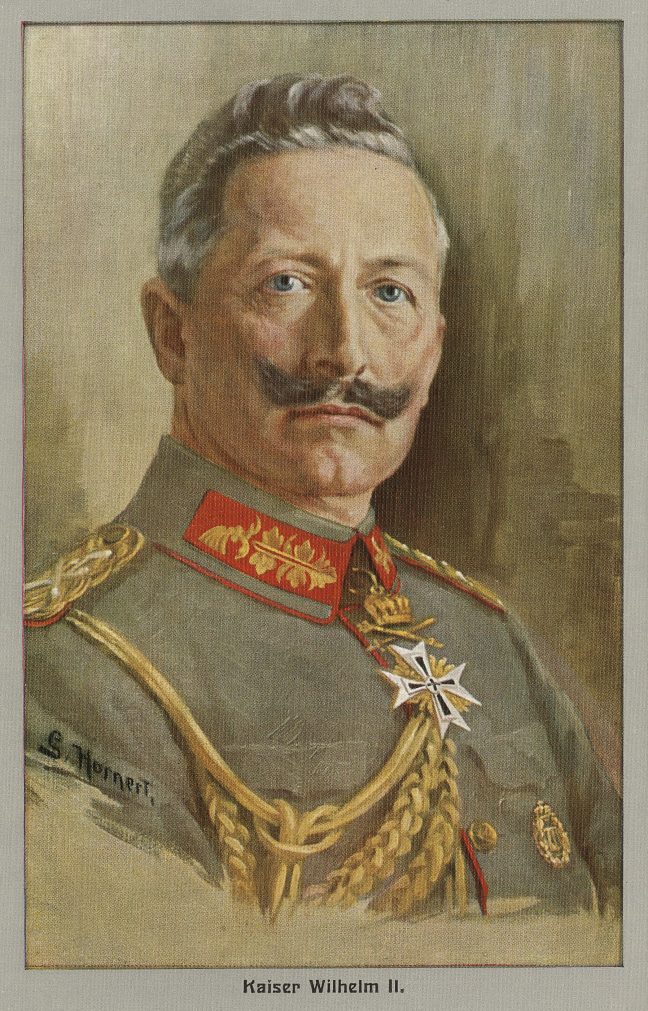
This set of 9 portraits feature important figures from Germany’s history and wars. Included in these portraits are Kaiser Wilhelm II, Kaiser Franz Joseph, Prinze (Prince) Heinrich of Prussia, Kronprinz (Crown Prince) Rupprecht von Bayern, Fürst (Prince) Otto von Bismarck, Kriegminister (War Minister) von Falkenhayn, Generaloberst (Colonel General) von Kluck, Herzog (Duke) Albrecht von Wurttemberg, and Generalfeldmarschall (General Field Marshall) Graf Moltke. Whilst the figures were not painted during World War One, they were painted to remind the German people of their proud victories and leadership in order to raise morale and governmental support. These nine portraits are significant because of their important roles their subjects played in the formation of modern (early 20th century) Germany. They were a set of postcards printed using lithography with ink on cardboard, which shows their everyday use as a part of average German lives. They also serve as a subtle reminder of Germany’s successes- just look at their lavish uniforms!

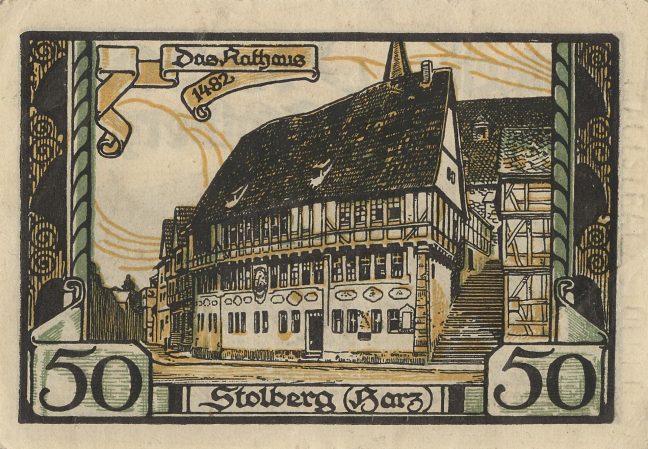
50 Notgeld der Stadt Stolberg (harz)

This is 50 Pfennig (cents) of emergency money from the city of Stolberg. It is paper due to its material when gold was no longer linked to the Papiermark, shortly after the beginning of World War One. Notes were decorated with different artwork from artists and time period in Germany’s history. This note, in particular, features a stag in the wilderness on one side and has the Stolberg town hall on the other side. The wilderness reflects the hardy nature of the German people, who spent time outdoors earning their livelihood and boasted a strong, healthy population, as well as a reminder of Grimm’s fairy tales, which extensively feature German forests. The art style is simple but modern, as it was easier to print than detailed drawings, but was not modern enough to cause outrage.

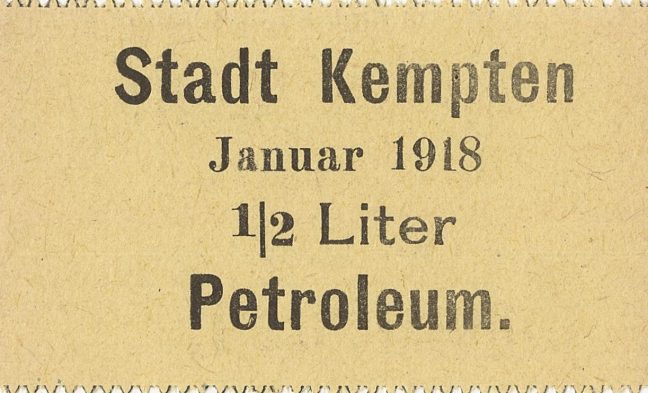
Stadt Kempten Dezember 1918 1/2 Liter Petroleum

This was a ration card valid for the town of Kempten in December of 1918, valid for half a litre of petroleum. World War One may have ended on November 11th, 1918, but fuel, food, and medicine were all still in short supply. In 1908, the Ford Model T had a fuel efficient of 21 miles per gallon, and in 1935, fuel efficiency was around 14 miles per gallon. Assuming this is not a new car and fuel efficiency was probably low, we’ll accept 14 miles per gallon. 0.13 gallons is 1 litre, so 0.13 x 14 = 1.82 miles. With this ration card, someone could drive about 1.8 miles.


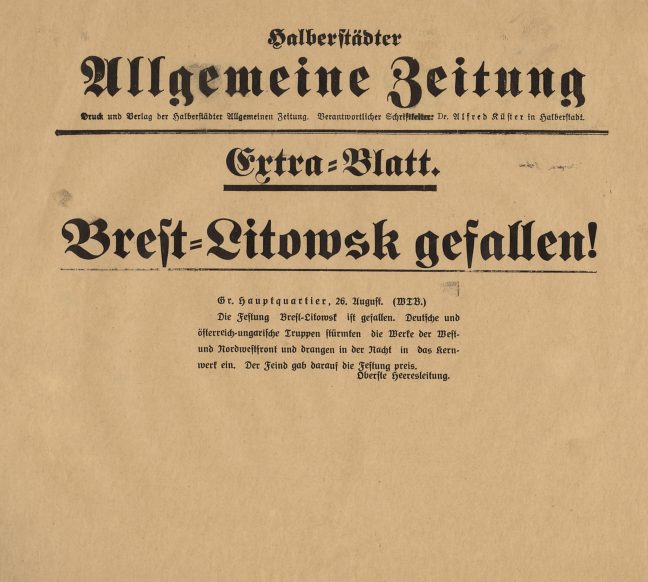
Allgemeine Zeitung Extrablatt!

In The Halberstadt General News’ extra edition from the 26th of August, 1915, the title reports ‘Brest-Litowsk Taken!’, which is a fortress in what is now Brest, Belarus. The article proclaims that “the fortress of Brest-Litowsk has fallen to advancing German troops. German and Austro-Hungarian troops stormed the city on its Western and Northern fronts and penetrated the inner defensive works during the night. This was the last of the Russians’ strongholds in Poland. Shortly thereafter, the defenders surrendered”. The retreating Russian army burnt the city to the ground, and so when delegates came to sign the Treaty of Brest-Litowsk in 1918, they were housed in temporary structures in the courtyards.

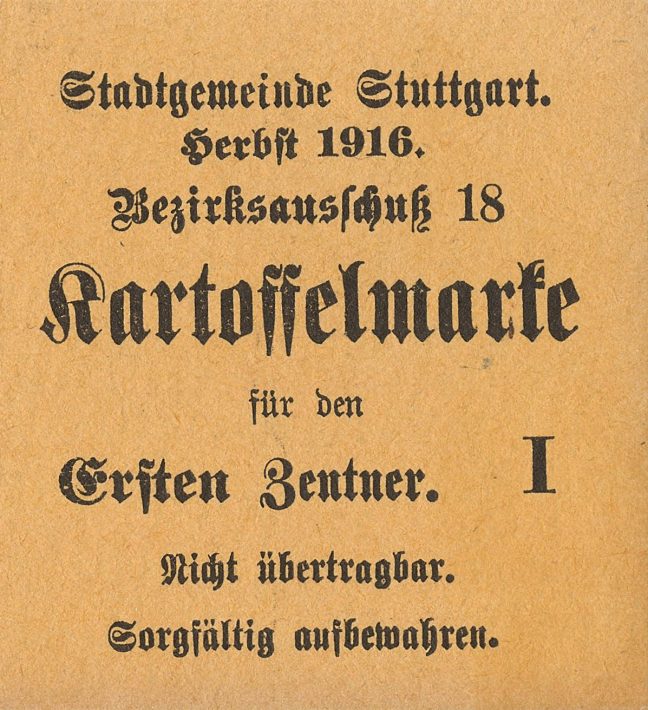
Kartoffelmarke Ersten Zenter

The rush at the beginning of the war to stock up led to the slaughtering of a third of Germany’s pigs in 1915, which later damaged fertilizer and food supplies as the war went on. By 1916, a group of women petitioned the government to end the war to bring their boys and husbands back home, and because they didn’t want to starve anymore. The blockade was not lifted until the summer of 1919, and so the food supplies did not become stable again until after this. Some rations stayed in place until as late as 1922. This ticket was valid for Stuttgart, Germany, valid for the first user and is not transferable.