Assorted Postcards During World War One

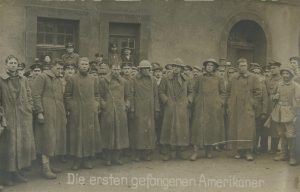
These postcards are addressed between soldiers on the battlefront and their families during the First World War, from 1914 to 1918. During this time, the government did not want everyone to know where the troops were stationed in case of hostile intelligence as well as the soldiers’ quick movement around battle. One postcard, in particular, is significant because it is a photo of the first American Prisoners of War to be captured during World War One, printed onto a postcard. This is an example of propaganda during the war in Germany, in addition to a valuable photograph that highlights American involvement. Sadly, these postcards were found in someone’s attic collecting dust, and their original owners could not be traced for the most part, due to missing addresses or illegibility.
Der Weltkrieg Cards ( Technology)

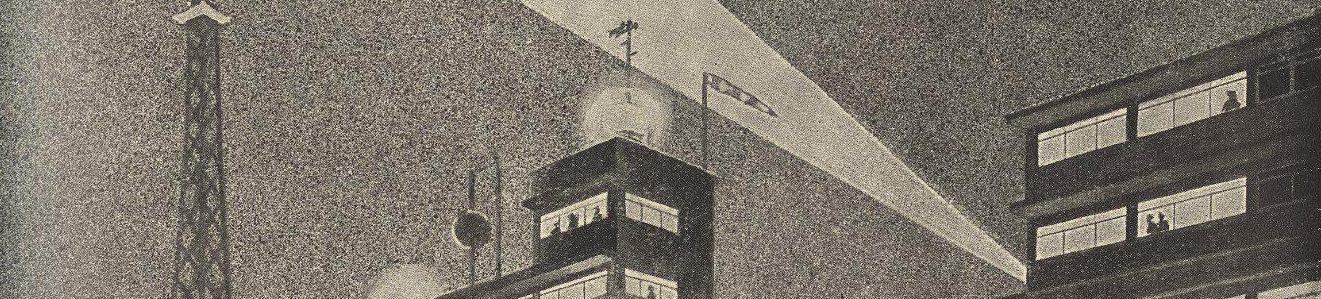
These cards were issued in 1937 by a  number of German cigarette companies and were included in packs of cigarettes.  Although these cards were created after the war, they are colorized versions of photos taken by the German War Ministry during the war. They show many of the new technologies in use during World War I : tanks, bomber and fighter aircraft, machine guns and poison gas all of which made WWI incredibly deadly. Also pictured here are Austrian troops laying telephone lines. Communication lines were of the utmost importance for troop coordination and this was the first conflict in which telephones were used at the front. Observation balloons ( hot air balloons essentially) were used to identify targets for artillery, however wind and enemy planes made this a dangerous job.


Der Weltkrieg Cards (Just Soldiers)

These cards were issued in 1937 by a number of German cigarette companies and were included in packs of cigarettes for collecting by the consumer. Although these cards were created after the war, they are colorized versions of photos taken by the German War Ministry during the war. They show scenes of soldiers’ daily life during the First World War. In this collection there are scenes from a makeshift trench barber shop, soldiers playing a piano in an evacuated town, and soldiers heading to battle. Barber Shops were important in the later parts of the war since large bushy beards made the use of gas masks ineffective.

Der Weltkrieg Cards (The People)

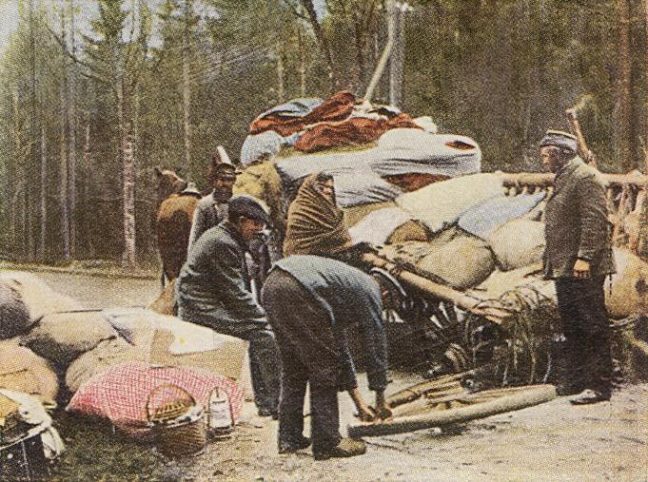
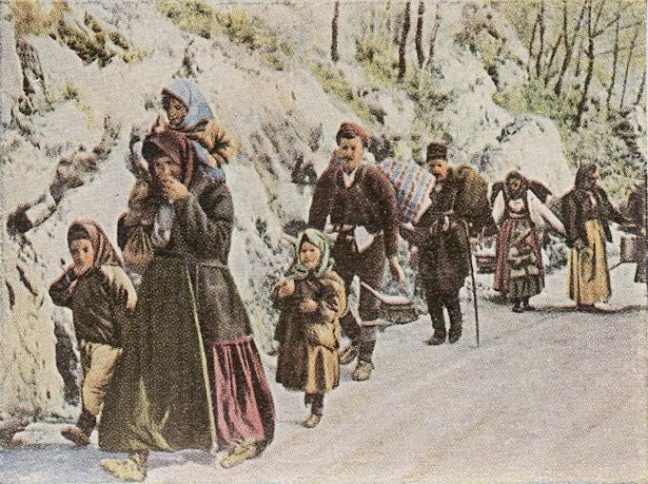
These cards were issued in 1937 by a number of German cigarette companies and were included in packs of cigarettes for collecting by the consumer. Although these cards were created after the war, they are colorized versions of photos taken by the German War Ministry during the war. They show scenes of civilian life during the first world war. During the war many resources were scarce, including food. Featured in this collection is a scene of civilians lining up outside a food distribution center. It is estimated that 762,796 people died of malnutrition during WWI. Also included is a scene from a factory worked by teenagers and women and a picture of refugees fleeing their homes due to the fighting.


Der Weltkrieg Cards (The Trenches)

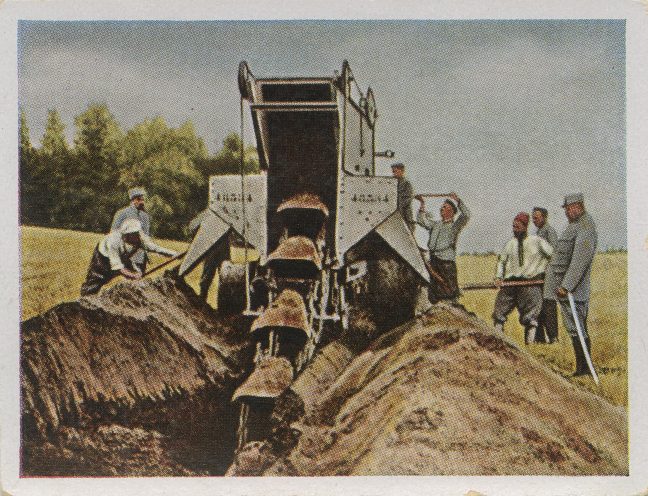
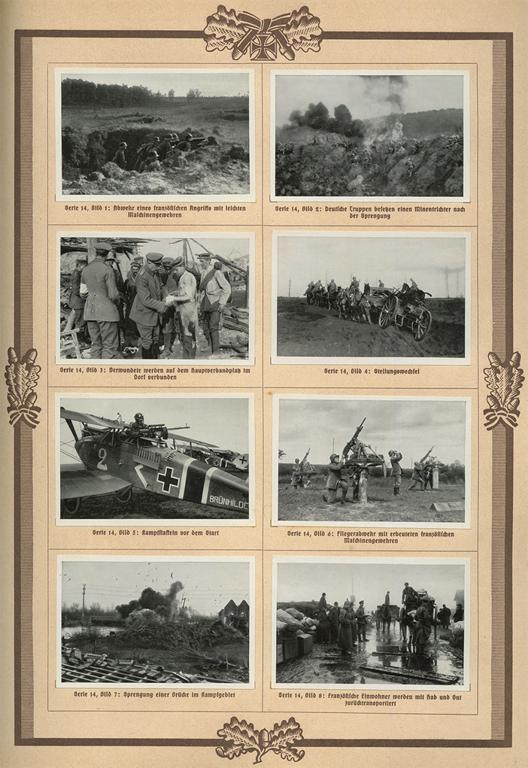
These cards were issued in 1937 by a number of German cigarette companies and were included in packs of cigarettes for collecting by the consumer. Although these cards were created after the war, they are colorized versions of photos taken by the German War Ministry during the war. They show scenes of trench warfare during the First World War. Trenches were characteristic of WWI and new technologies such as trench diggers and portable gas/electric spotlights made this possible. Life in the trenches was hard and many soldiers developed trench diseases, such as trench foot or trench fever.

Der Weltkrieg Cards (Animals)

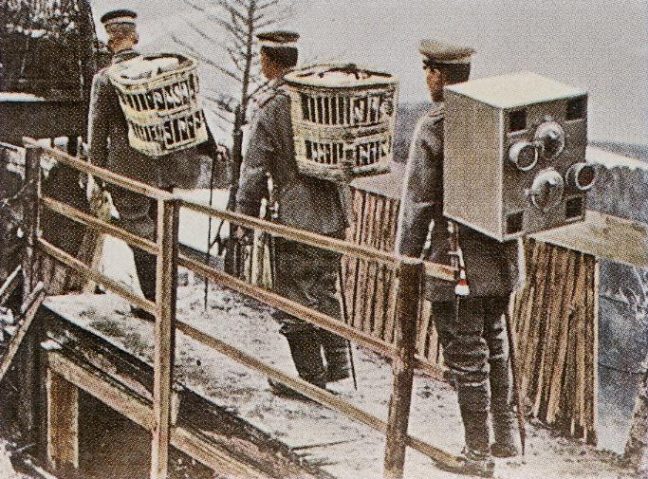
These cards were issued in 1937 by a number of German cigarette companies and were included in packs of cigarettes for collecting by the consumer. Although these cards were created after the war, they are colorized versions of photos taken by the German War Ministry during the war. They show scenes of how animals were used during the first world war. Messenger dogs were used when there was no cover for humans to move across the terrain or when communication lines were not functioning. These dogs usually had two masters, one at each end, and were usually used on routes two Kilometers or less. Messenger pigeons were also trainer and utilized in world war one. They were usually transported in backpacks or baskets to the front and would then be released to fly back to the home cage with a message. They were particularly helpful when it came to warfare in the mountains. Horses also played a big role on WWI, despite the invention of new transportation technologies. Due to gas warfare soldier now had to worry about protecting their horses from gas attacks as well.

Stollwerck Sammel-Album No. 15, Jungdeutschland

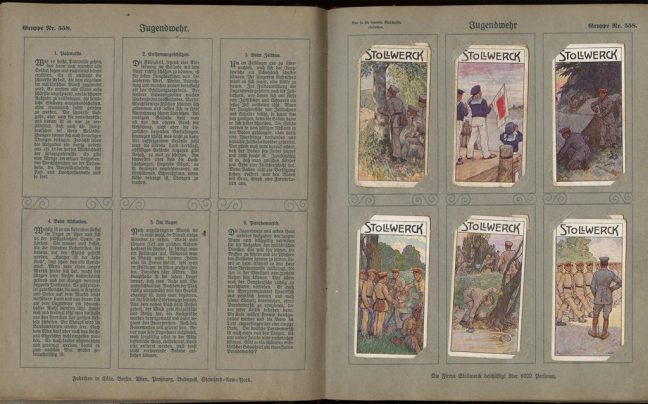
These cards were manufactured by a German chocolate company during WWI. They are featured here in a book made by the company to showcase all the cards in their series. The topic of these cards is “Junge Wehr auf Borkum” (“Youth Defense Group on the Island of Borkum”).

Description of the cards (left to right):

  1. A Guard at his Post. Off the East Frisian coast in the North Sea lies the island of Borkum. It was called the “green island” because of its beautiful green meadows. Members of the Youth Defense Group regularly patrol the beaches to identify suspicious activity along the coast.
  2. A Bike Patrol Underway. The Youth Defense Groups have their own headquarters on the island where they get their assignments every morning. From the headquarters the groups spread out over the entire island. The bicycle patrols that are part of the surveillance cannot go to all parts of the island
  3. Practicing Shooting in the Dunes. The Youth Companies usually perform their exercises in the dunes on the island that lie in the form of a horseshoe. The dunes, made of a fine-grained sand and covered with seagrass can get as high as 60 feet and cover many square kilometers. The young defenders find here an excellent battlefield to practice their skills.
  4. On the Attack. The Youth Companies on Borkum are led by an officer and are trained according to strict military rules.
  5. Rest after the Battle. After hours of conducting military exercises in the hot sun the trumpet calls everyone together. An evaluation of the maneuvers is given, then everyone puts their weapons together in pyramids and take a rest in the field.
  6. A parade on the Beach. It is always a happy occasion when the Youth Companies parade before their officers on the beach. Young men and young women parade in tight rows in their respective groups with their gun on their shoulders. Those who do not have a gun carry a spade over their shoulder for digging trenches in the sand. All of the tourists come to these events on the island’s parade grounds.

Stollwerck Sammel-Album No. 15, Jungdeutschland

The pictures of the Stollwerck trade card album “Jungdeutschland” (Young Germany) show how such youth groups were engaged in activities to prepare them for war. Here are the titles and selected excerpts from these six pictures (only four are shown):


  1. Storming the Wall. Storming up a steep hill with full pack is strenuous but a German Boy Scout is not fazed by such obstacles. We are imitating our brave warriors who stormed Lüttich, Antwerp and Soissons, even if our fighting is just practice.
  2. A Good Meal After Training. When the training exercises are done we are all tired, but also hungry. In building a cooking fire out in the field, there is much that has to be learned. You will need a source of water for cooking and at least three matches.
  3. Setting Up Tents. You have the good fortune today to be able to sleep in a tent, rather than under a tree. Here are some directions for correctly setting up your tent.
  4. Building a Hut. If tents are not available, a hut constructed from available materials is the next best thing. The location has to be carefully selected, with enough wood and water nearby.
  5. An Anecdote. Field Marshal Haeseler tells about an encounter with a Boy Scout troop that invited him to inspect them. He asked one of the Scouts “Where are you from?” The boy answered: “Rostock”. Haeseler then asked the boy “Who was born there?”, hoping to hear the name “Blücher”. The boys answered: “I was”, to which Haseler continued: “But what great man was born there?” The boy said without hesitation: “My older brother”.
  6. Passing the Time on a Winter Evening. When the scouts are gathered together on a cold winter’s night, there are many ways that they entertain themselves, with activities such as chess, carving wooden figures, etc.

Magdeburgische Zeitung, 755

This newspaper was printed on the 11th of October, 1914 in the Magdeburgische Zeitung, which was the oldest German-speaking newspaper, first published in 1664, until it merged with another newspaper on the 1st of September, 1944. A week from now on October 18th, the First Battle of Ypres (Belgium) would begin between Germany, France, and England. This clip is a story about ‘After the Fall of Antwerp (Belgium)’. The Siege of Antwerp went on until the 10th of October, 1914, lasting for 12 days, and resulted in a German victory. Other news mentioned in the Magdeburg News is the progress of the Austrians in Galicia, the Russian Czar taking command of the Russian Army, speculation on whether Prince Nikolai will be the new heir to the Russian