Throughout the late twentieth century, individual feminist theologians formed both formal and informal webs of collaboration and support to sustain their work. These networks included publications, organizations, and lecture series. For more, see Collections at Smith.
Publications
In addition to theologians’ individual books and articles, a key aspect of thinkers’ scholarship during the late twentieth century was the creation of journals dedicated to feminist theology. The most widely known publication is the Journal of Feminist Studies in Religion, founded in 1985 by Judith Plaskow and Elizabeth Schussler Fiorenza. Plaskow later wrote that this journal filled a gap in existing literature, since existing publications focused on women and religion were generally targeted towards religious communities and lacked peer-reviewed scholarship.
“We wanted to provide a forum for discussion and dialogue among women and men of differing feminist perspectives in a way that would contribute to the transformation of both the academy and religious and cultural institutions.”
Judith Plaskow, A Short History of the JFSR, nd.1
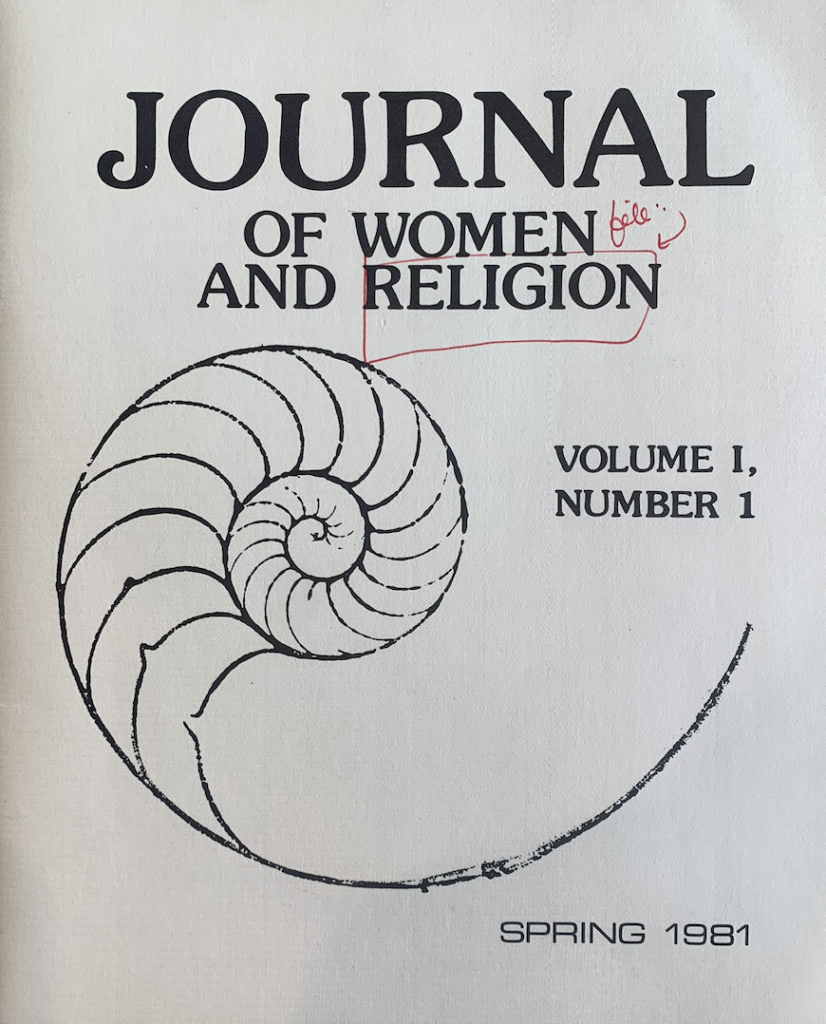
Cover of the Journal of Women and Religion’s Spring 1981 issue. This publication served a similar role to JFSR, and created space for feminist theologians to publish their work.2
They also aimed to legitimize feminist work within the field of theology, so that scholars could publish their work and make it “count” for tenure, promotion, and employment. Publications like the JFSR were crucial for expanding these thinkers’ influence in religious studies, and broadening the reach of feminist thought. Plaskow also wrote that they wanted to create a space for feminist theologians to resolve disputes and disagreements, and make room for individuals with different lived experiences. Intersectionality was a crucial consideration, and Plaskow and Fiorenza were intensely aware of how women of color and other marginalized scholars had been shut out of theological conversations in the preceding decades.3 She believed that the journal provided a space that had previously been absent for crucial conversations and analysis.
Organizations
Beyond publications, other organizations found ways to connect theologians and foster the spread of ideas. As thinkers and believers created theological centers across the country, they established formal and informal links with each other. For example, groups focused on using feminist theology to re-develop religious practices built a “Network of Women’s Centers for Spirituality and Liberation” in the late ‘90s, to collaborate and build a collection of shared resources.4
Some of the members in this network included:
- Holy Ground, based in Skyland, North Carolina
- Re-Imagining Community, based in Minneapolis, Minnesota
- Resource Center for Women in Ministry, based in Durham, North Carolina
- Women’s Theological Center, based in Boston, Massachusetts
- Women’s Multi-Faith Center, based in Maitland, Florida
- Women’s Interfaith Institute, based in Housatonic, Massachusetts
- Women’s Alliance for Theology, Ethics, and Ritual, based in Silver Spring, Maryland
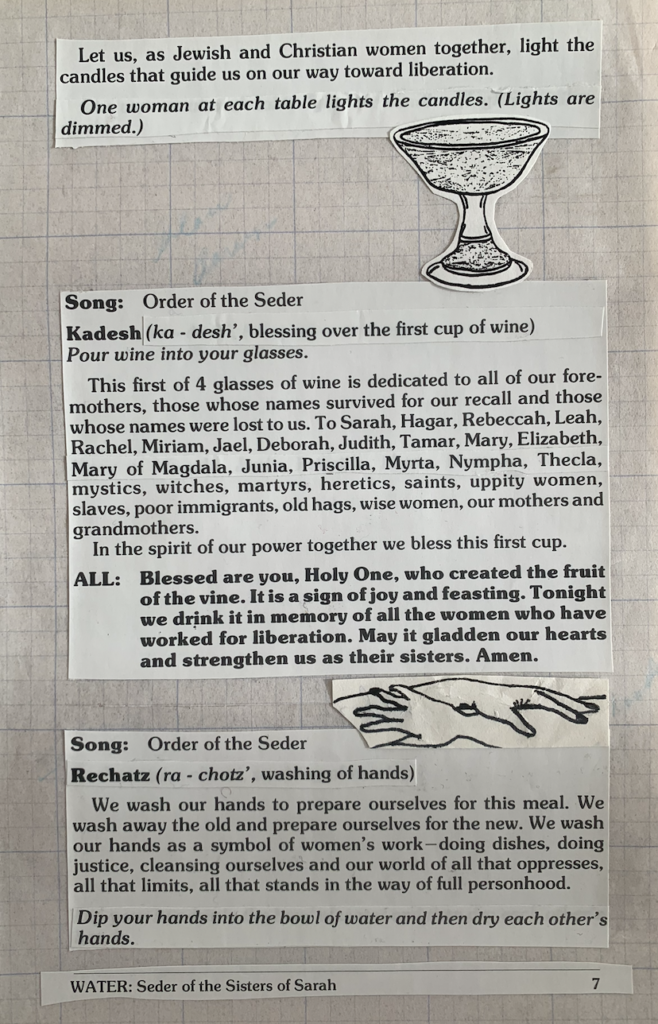
A page from “A Seder of the Sisters of Sarah,” created by Ronnie Levin and Diann Leu for WATER.5 Described as a “Holy Thursday and Passover Feminist Liturgy,” it was part of their interfaith efforts to reclaim liturgical materials.
Many of these organizations focused on interfaith feminist theology, and worked to build shared resources that individuals from a variety of religious traditions could use. The Women’s Alliance for Theology, Ethics, and Ritual (WATER) had a wide range of projects, but one of their most significant involved the creation of explicitly feminist liturgical resources. Many other organizations created these kinds of materials for religious communities, but WATER’s records in Special Collections contain an extensive collection of them. These liturgical tools directly applied feminist understandings of faith to worship, and helped move feminist religious thought outside the bounds of academia.
Organizations like WATER also built international connections outside of the United States. In 1995, they created the Feminist Liberation Theologians’ Network to connect international scholars and activists. They also established the Women Crossing Worlds/Mujeres Cruzando Mundos Project to link feminist scholars from North America, South America, and Europe.6 Both of these groups remain active today.
Within academic institutions, some previous theological networks became increasingly focused on feminist thought towards the end of the twentieth century. The Theological Opportunities Program (TOP) at Harvard Divinity School, for example, was established in 1973 as a standard lecture series for the general public. The audience was predominantly women, and so were the individuals planning the program. As the field of feminist theology grew, it because a focus of TOP lectures and programming.7 This space became a forum for a wider audience to engage with feminist theology, and bring these ideas into their own life and practices.
“We thought we were doing a lecture series. But we became a women’s faith community, a place of learning but also of transformation, a safe place that validated our feelings and encouraged our unfolding, a place for tears of pain and tears of gladness.
We created this place for one another. Over the years all of us together created it, and it has given us gifts beyond measure. But perhaps the most precious of all gifts, it has given us the experience of ourselves—empowered, authentic, fully voiced—the selves we are becoming.”
Introduction to the TOP’s 25th anniversary celebratory booklet8
For a more comprehensive list of organizations related to feminist theology, see the Collections at Smith page. For further reading, see Secondary Sources.
- History of JFSR by Judith Plaskow, nd., Journal of Feminist Studies in Religion records, Sophia Smith Collection, SSC-MS-00726, Smith College Special Collections, Northampton, Massachusetts. ↩︎
- Journal of Women and Religion, 1981, Women’s Interfaith Institute records, Sophia Smith Collection, SSC-MS-00734, Smith College Special Collections, Northampton, Massachusetts. ↩︎
- History of JFSR by Judith Plaskow, nd., Journal of Feminist Studies in Religion records, Sophia Smith Collection, SSC-MS-00726, Smith College Special Collections, Northampton, Massachusetts. ↩︎
- Network member list, nd., Women’s Interfaith Institute records, Sophia Smith Collection, SSC-MS-00734, Smith College Special Collections, Northampton, Massachusetts. ↩︎
- “Seder of the Sisters of Sarah,” nd., Women’s Alliance for Theology, Ethics and Ritual Records, Sophia Smith Collection, SSC-MS-00530, Smith College Special Collections, Northampton, Massachusetts. ↩︎
- Women’s Alliance for Theology, Ethics and Ritual Records, Sophia Smith Collection, Smith College, Northampton, Mass. https://findingaids.smith.edu/repositories/2/resources/860 Accessed April 28, 2026. ↩︎
- Theological Opportunities Program records, Sophia Smith Collection, SSC-MS-00567, Smith College Special Collections, Northampton, Mass. https://findingaids.smith.edu/repositories/2/resources/1135 Accessed April 28, 2026. ↩︎
- 25 Anniversary Booklet, 1998, Theological Opportunities Program records, Sophia Smith Collection, SSC-MS-00567, Smith College Special Collections, Northampton, Massachusetts. ↩︎