The collection features the personal and professional papers of many prominent feminist theologians throughout the twentieth century. Scholars like Judith Plaskow, Mary Daly, and Charlene Spretnak worked both within and outside of academia. For a larger list of individual theologians represented within Special Collections, see the Collections at Smith page.
Judith Plaskow
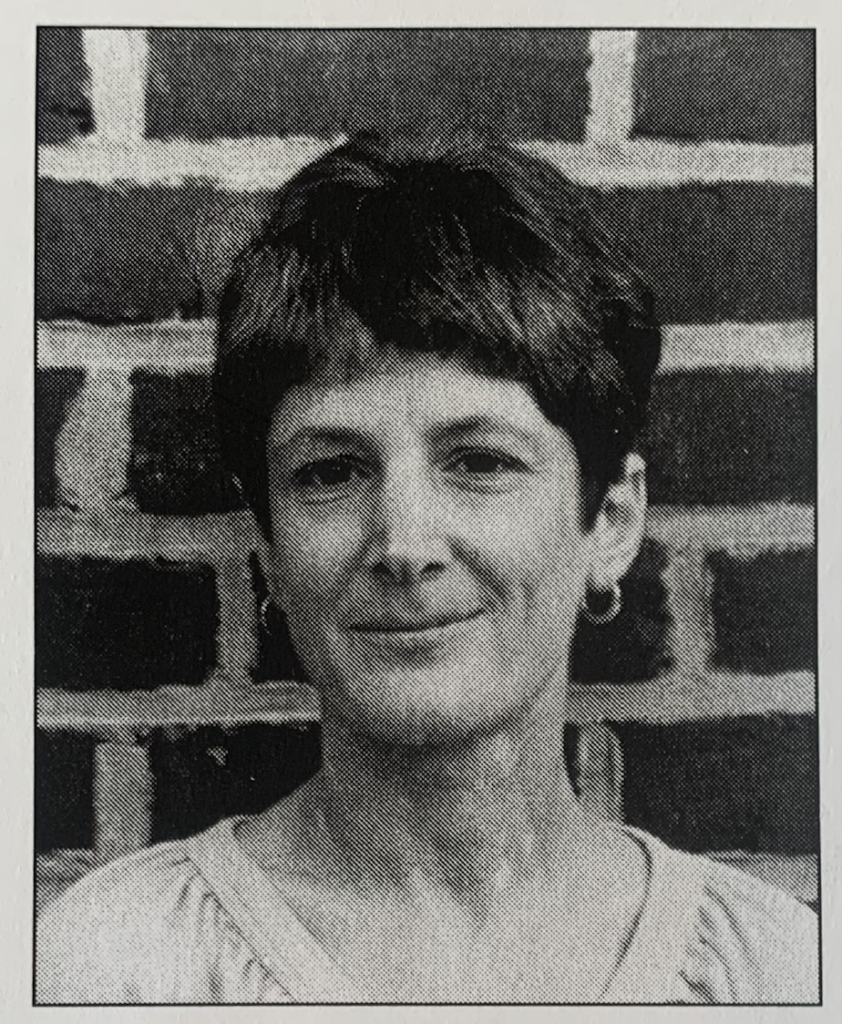
Plaskow (b. 1947) is one of the most famous Jewish feminist theologians in the United States. She was raised Reform, and studied both Jewish and Christian theology. Throughout her professional life, she focused primarily on Jewish theology. She is widely known as one of the founders of the field of feminist theology.1
Her work is key for understanding how feminist theologians re-interpreted religious texts and scripture. For example, Standing Again at Sinai: Judaism From a Feminist Perspective (1990) critiques patriarchal depictions of Judaism’s history and illuminates the role of women in shaping the religion since its founding.2 This book is one of her best-known texts, and a helpful starting point for exploring the development of Jewish feminism.
Within Special Collections, many of Plaskow’s papers relate to her work in the classroom as an educator. Her syllabi from various religion courses offer insight into her teaching methods, subjects covered, and assigned readings. Her courses explored the impact of organized religion on modern society, as well as more metaphysical topics like debates over the exact nature of God.4 Throughout her career, she remained keenly attuned to sociological factors beyond gender that shaped individuals’ relationships with organized religion. She highlighted this in lessons, and focused on issues like the intersection of class and religion.5
Queer life and human sexuality were other issues that often overlapped with Plaskow’s broader analysis of women and religion. She identifies as a lesbian, and came out publicly in the 1980s.6 Her commitment to the LGBTQ rights movement shaped her theological work, as did contemporary controversy about sex and sexual values. For example, one of her courses at Manhattan College from Fall 1998, titled “Sexuality and the Sacred,” traced the development of Christian attitudes toward sex throughout time. Her planned discussions focus on topics like sex and stigma, the “virgin/whore dichotomy,” and the relationship between biological sex and God’s perceived maleness.
Plaskow’s work extended far beyond her individual publications and classes, though. She helped create the Journal of Feminist Studies in Religion in the early 1980s, and founded Jewish feminist group B’Not Esh (Daughters of Fire) in 1981.
Mary Daly
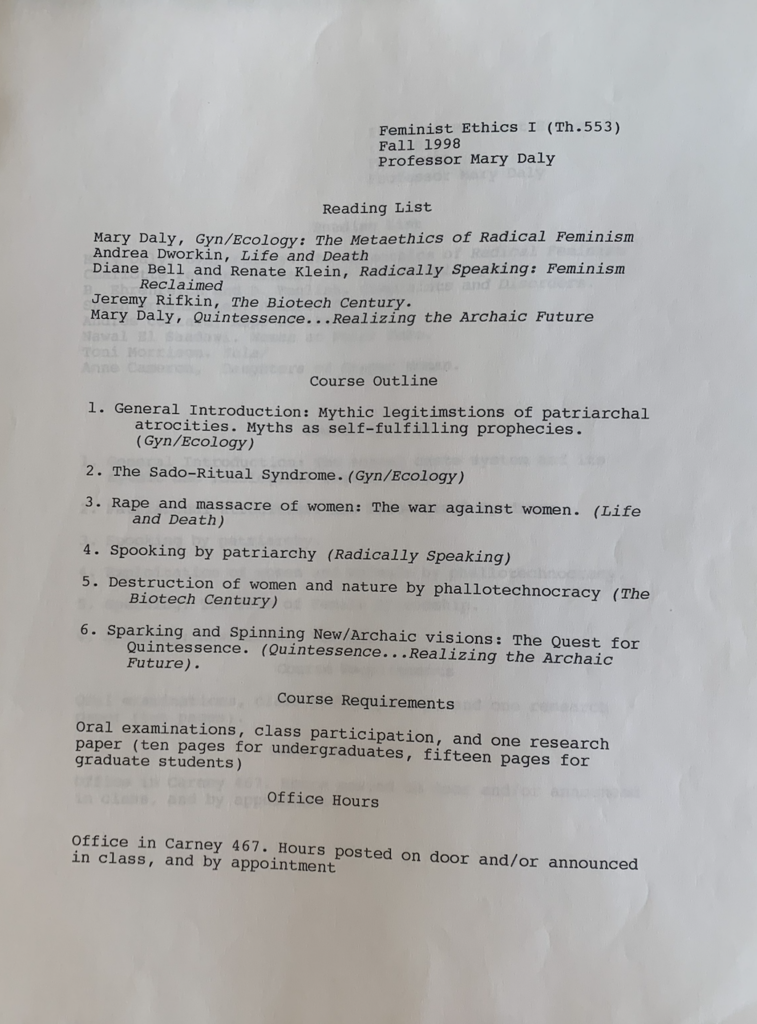
Daly (1928-2010) was a prominent feminist theologian who focused on Catholicism early in her career, and later evolved to focus on non-institutional spirituality/religion after officially leaving the Church. She is widely remembered as one of the earliest public religious feminists, and was invited to be the first woman to deliver a sermon at Harvard’s Memorial Church in 1971. During this sermon, she publicly stated she did not think feminist reform would succeed within institutional Christianity, and walked out of the building in protest.7
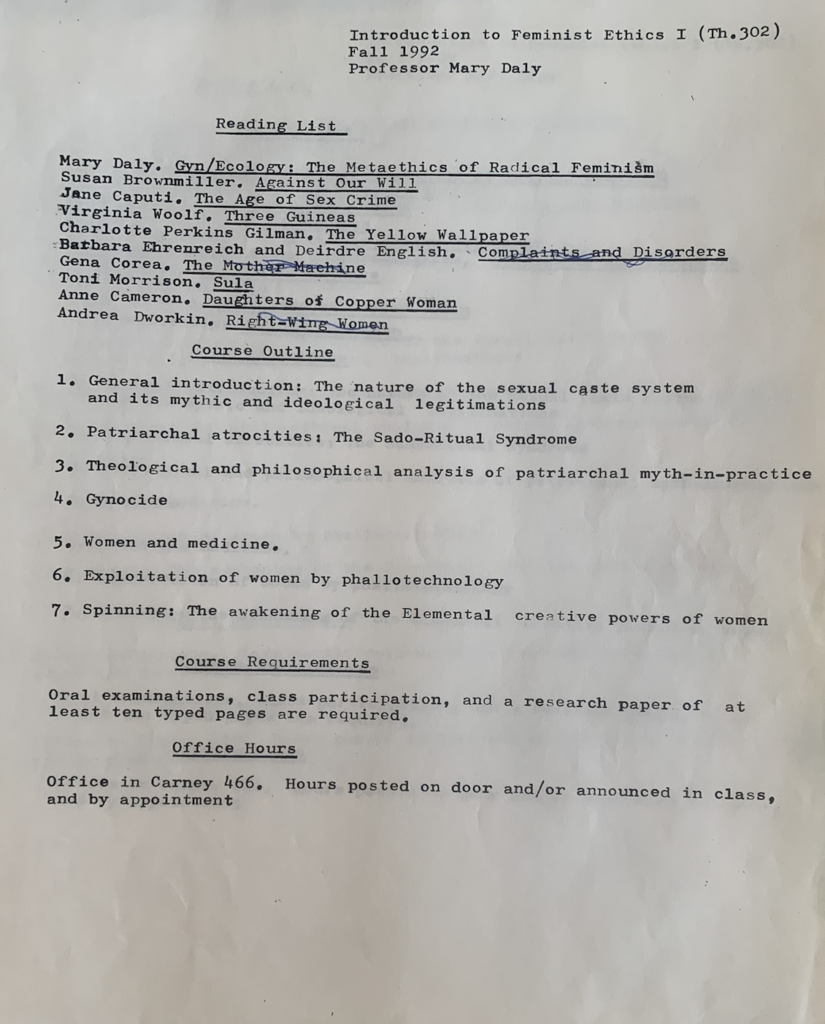
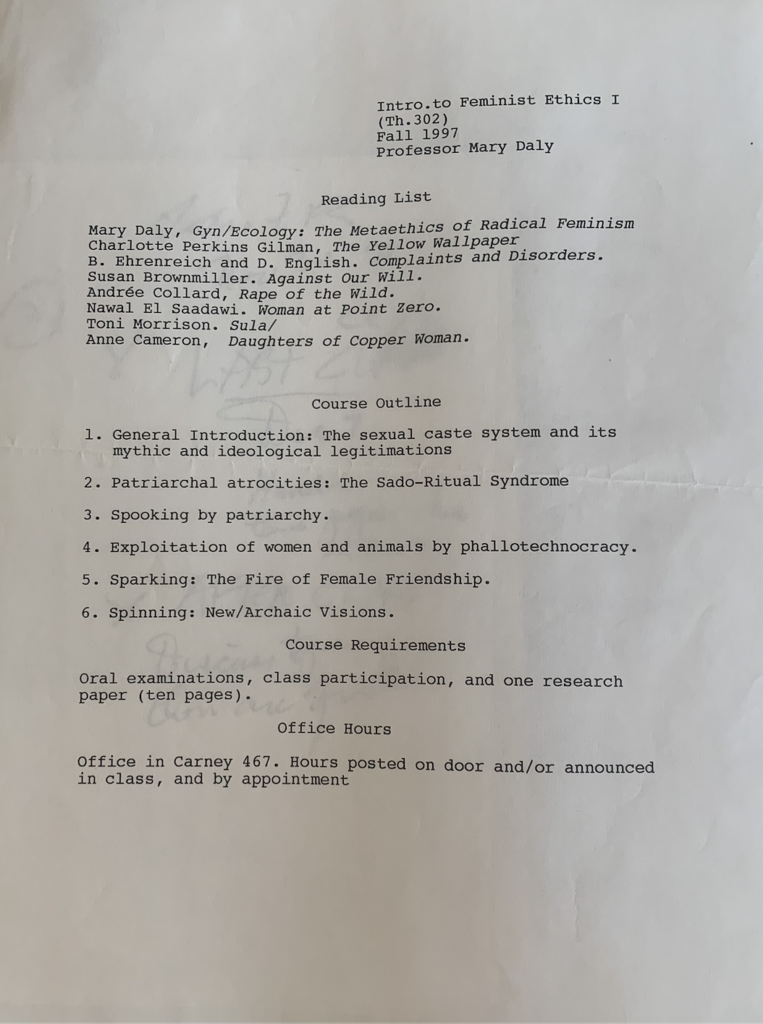
Like Plaskow’s records, the Mary Daly papers in Special Collections contain a wealth of materials related to her career in academia. There are excerpts of drafts and publication information related to her writings, including some of her most influential books The Church and the Second Sex (1968) and Beyond God the Father (1973). There are also syllabi from courses she taught at Boston College, which covered both theology and broader feminist concepts.
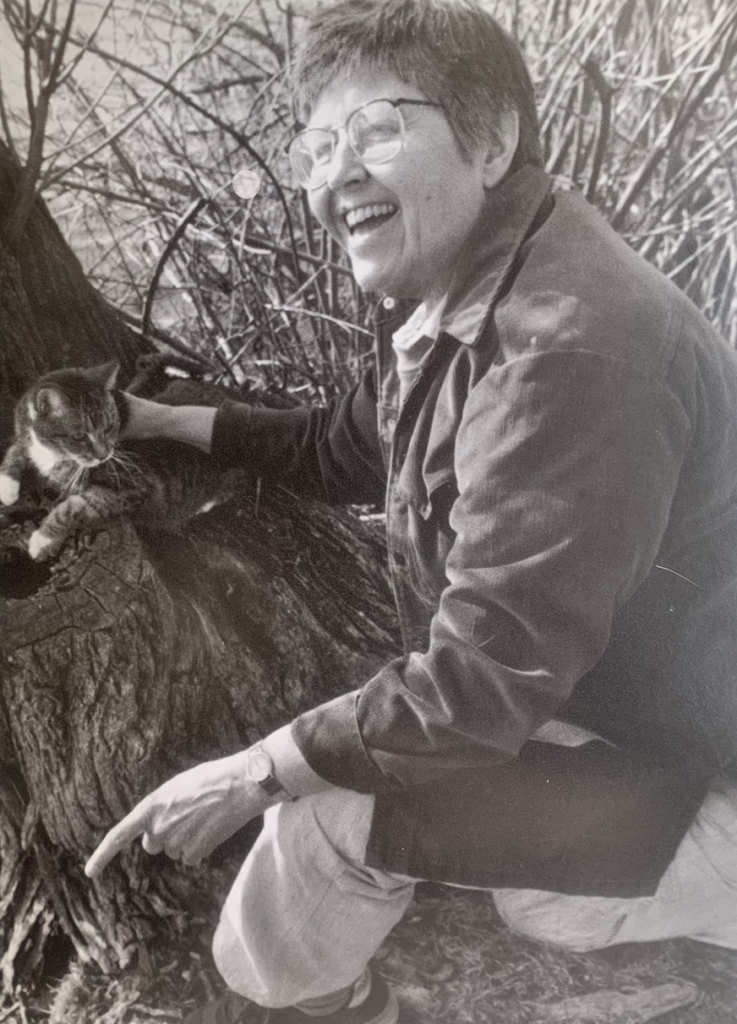
Beyond an understanding of how feminist theology operated in the classroom, her records highlight the tension that was often present between religious institutions and feminist theologians. While teaching at Boston College, a Jesuit school, Daly came into conflict with the institution’s values several times. In 1968, just after the release of her first book, she was dismissed due to her criticism of the Vatican and the Catholic Church. After students’ protests, she was reinstated and received tenure.9 She went on to teach at Boston College for over thirty years, until she resigned after a second legal dispute.
Charlene Spretnak
The work of Spretnak (b. 1946) highlights another side of feminist theology: the development of non-institutional spirituality. While many feminist theologians studied and re-interpreted the traditions of organized religions, many others focused on defining or rebuilding other forms of spirituality. Spretnak’s work often focused on neopaganism and Goddess-worship, and she tied this belief system into both her academic and political careers. She also studied some traditional religions, including Buddhism and Roman Catholicism.11
Much of her life was devoted to ecofeminism and the Green Party of the United States, and these commitments were both rooted in her spirituality. She emphasized a “spiritual ecology,” which combined faith and scientific knowledge in an effort to encourage greater conservation efforts. This inherently involved a feminist rejection of the patriarchy, which she viewed as the source of both conflict and environmental degradation. Ultimately, her goal was tangible action.
“Knowledge of nature must precede respect and love for it. We could urge that ecological wisdom regarding God’s creation be incorporated in Sunday school as well as in sermons and prayer. We could suggest practices such as the planting of trees on certain holy days. We could mention in the church bulletin ecological issues that are crucial to our community. There is no end to what we could do to focus spiritually based awareness and action on saving the great web of life.”
Spretnak, “The Spiritual Dimension of Green Politics,” nd.12
Because of the wide range of beliefs present in feminist neopaganism, theologians’ perspectives on this faith were also incredibly diverse. One common theme, which was present in Spretnak’s work, was the presence of a Goddess. For some, this was a singular divine figure, while others believed in a pantheon of female deities. A large segment of neopagans also understood the Goddess as a singular entity that manifested in many forms, including a range of individual deities and nature itself. The power of this belief is clear in some of Spretnak’s writings, in which she listed goddess names between analytic paragraphs on spiritual history and patriarchal myths: Anat, Aphrodite, Artemis, Ahsherah, Athena, Attor, etc.13 The act of invoking these names was spiritually meaningful, and demonstrates the close relationship between her academic work and personal faith.
The materials in this collection offer valuable insights into both non-institutional feminist spirituality and the intersection of feminist theology and political work. For more resources that relate to these topics, see the Collections at Smith page.
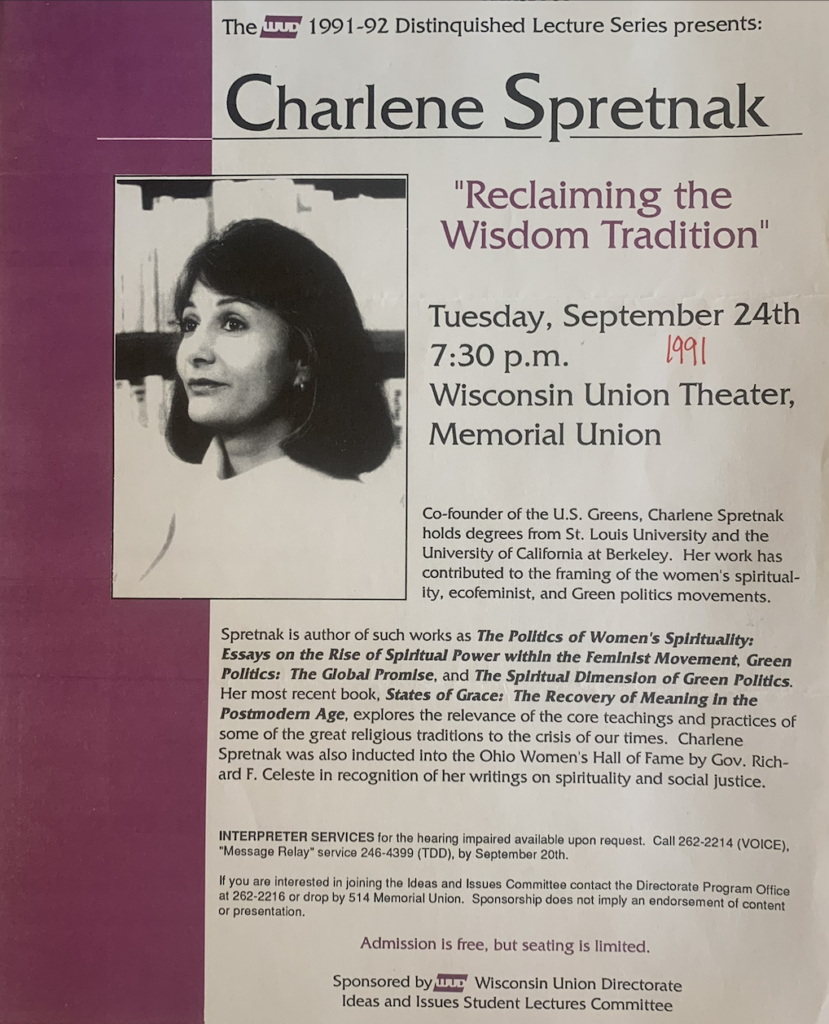
Flyer for a talk by Charlene Spretnak, 1991.14
- Documenting Lesbian Lives Oral History Project, Sophia Smith Collection, Smith College, Northampton, Mass. https://findingaids.smith.edu/repositories/2/archival_objects/164958 Accessed April 28, 2026. ↩︎
- Joyce Antler, Jewish Radical Feminism: Voices from the Women’s Liberation Movement (NYU Press, 2018), 220. ↩︎
- Bucknell University lecture flyer, Judith Plaskow papers, Sophia Smith Collection, SSC-MS-00565, Smith College Special Collections, Northampton, Massachusetts. ↩︎
- “Rethinking God” notes, Judith Plaskow papers, Sophia Smith Collection, SSC-MS-00565, Smith College Special Collections, Northampton, Massachusetts. ↩︎
- “The Realities of Class in the U.S.” lecture notes, Judith Plaskow papers, Sophia Smith Collection, SSC-MS-00565, Smith College Special Collections, Northampton, Massachusetts. ↩︎
- Documenting Lesbian Lives Oral History Project, Sophia Smith Collection, Smith College, Northampton, Mass. https://findingaids.smith.edu/repositories/2/archival_objects/164958 Accessed April 28, 2026. ↩︎
- Rita Gross, Feminism and Religion (Beacon Press, 1996), 40. ↩︎
- “Women Who Dare” 1995 Calendar, Mary Daly papers, Sophia Smith Collection, SSC-MS-00637, Smith College Special Collection, Northampton, Massachusetts. ↩︎
- Mary Daly v. Boston College, 2001, Mary Daly papers, Sophia Smith Collection, SSC-MS-00637, Smith College Special Collection, Northampton, Massachusetts. ↩︎
- Syllabi, 1992-1998, Mary Daly papers, Sophia Smith Collection, SSC-MS-00637, Smith College Special Collection, Northampton, Massachusetts. ↩︎
- Charlene Spretnak papers, Sophia Smith Collection of Women’s History, SSC-MS-00828, Smith College Special Collections, Northampton, Massachusetts. https://findingaids.smith.edu/repositories/2/resources/1680 Accessed April 28, 2026. ↩︎
- “The Spiritual Dimension of Green Politics,” nd., Charlene Spretnak papers, Sophia Smith Collection of Women’s History, SSC-MS-00828, Smith College Special Collections, Northampton, Massachusetts. ↩︎
- Cynthia Eller, Living in the Lap of the Goddess: The Feminist Spirituality Movement in America (Beacon Press, 1993), 133-134. ↩︎
- Flyer, 1991, Charlene Spretnak papers, Sophia Smith Collection of Women’s History, SSC-MS-00828, Smith College Special Collections, Northampton, Massachusetts. ↩︎