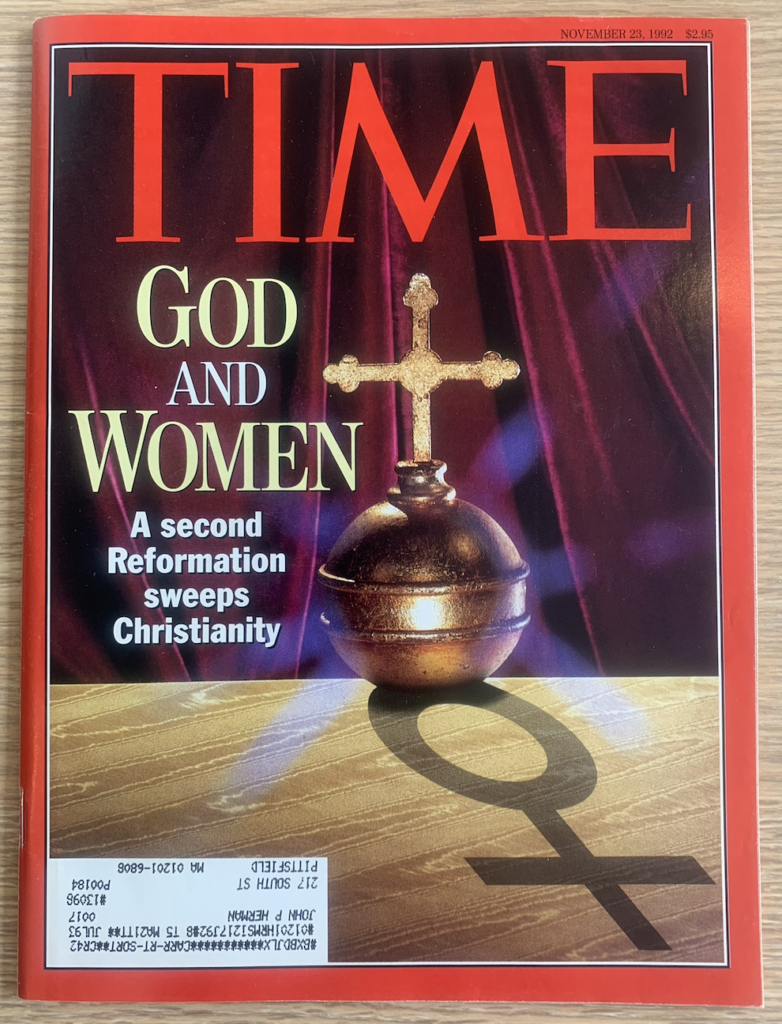
The cover of TIME magazine’s November 1992 issue.1 This issue’s cover story discussed women’s ordination throughout the past thirty years within Christian denominations. It offered an overview of successful ordination efforts in several Protestant denominations, and the Vatican’s opposition to female deacons or priests.
As the religious feminist movement grew, one of activists’ primary goals was to increase opportunities for women’s leadership of religious and spiritual communities. Although equal participation in religious life was a key component of this, it went much farther than efforts to just get women’s voices into the room. This movement focused on centering women’s issues in religious discussions, redefining traditionally masculine understandings of divinity, and undoing the links between patriarchy and power in faith communities. It was deeply tied to the development of feminist theology, and the framework provided by this field was crucial for congregational leaders.
Like all other aspects of the religious feminist movement, the struggle for congregational leadership took many forms. In her work, theologian Rita Gross defines what she saw as the two possible paths of feminist religious leadership: one focused on advocating for reform that remains grounded in established religious traditions, and another focused on rejecting established religious traditions in favor of creating something entirely new.2
Gross’ second path was more common for Christian or formerly-Christian individuals, who often turned to personalized forms of spirituality like Neopaganism or New Age practices. For individuals whose faith was deeply tied to cultural identities, though, the first path was more likely. Many Jewish feminists, for example, remained deeply committed to maintaining Jewish culture and did not see this abandoning it as a feasible solution. So, they largely focused on reforming their existing religious institutions.3
Some feminist leaders chose a third, middle path: experimentation within traditional religions. They rejected institutional authority but ultimately focused on granting women access to existing systems of power. The Roman Catholic Women Priests, for example, emphasized that their ordinations are valid within the Catholic Church as they simultaneously rejected the Vatican’s rulings against female deacons or priests.4
Within Special Collections, most of the material related to women’s congregational leadership focuses on attempts to include women in existing power structures. Many collections contain information about the struggle for women’s ordination in both the Protestant and Catholic Churches. There are also a number of collections related to individual feminist leaders, and the networks they developed to build connections support their ministry.
- TIME Magazine, 1992, Women’s Interfaith Institute records, Sophia Smith Collection, SSC-MS-00734, Smith College Special Collections, Northampton, Massachusetts. ↩︎
- Rita Gross, Feminism and Religion (Beacon Press, 1996), 48. ↩︎
- Joyce Antler, Jewish Radical Feminism: Voices from the Women’s Liberation Movement (NYU Press, 2018), 217. ↩︎
- Women’s Alliance for Theology, Ethics and Ritual Records, Sophia Smith Collection, Smith College, Northampton, Mass. https://findingaids.smith.edu/repositories/2/archival_objects/583759 Accessed April 28, 2026. ↩︎