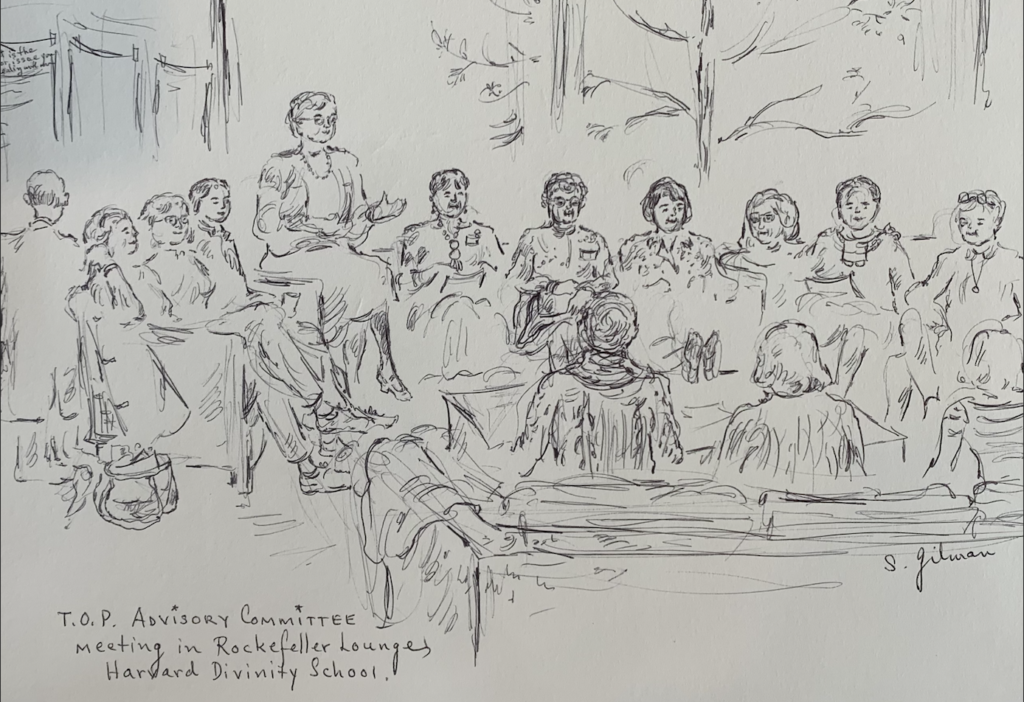
An illustration of an advisory meeting of Harvard’s Theological Opportunities Program, which served as an important site of feminist theological thought throughout the late twentieth century.1
The development of feminist theology stands out as one of the most significant impacts of religious feminism throughout the twentieth century. It was a core aspect of the broader push for women’s equality in faith communities, and has shaped religious discussions and debates for decades.
Before the late 1900s, academic theology was a field largely dominated by the groups that held power in religious structures. These elites, who were often white, wealthy men, framed divinity with their own patriarchal worldview. Feminist theology, on the other hand, focused on studying religion academically through a feminist lens. It took many forms, and involved reclaiming scripture, liturgy, and religious practices.2
The development of feminist theology emerged amidst the growth of the broader American feminist movement, but was not solely a religious offshoot of it. Early Catholic feminism in the 1960s, for instance, grew from within the faith as theologians used their own perspectives to frame their work.3 In all traditions, thinkers used their lived experiences to inform and shape their theological studies, similarly to the larger gender studies field that emerged at the same time. The issues they discussed, and their solutions, were often guided by their spiritual priorities and desires.
This relationship between scholars’ personal commitments to their faiths and their field was a key dimension of their work. Like religion more broadly, feminist theology could be public and deeply personal at the same time. In Special Collections, most theologians’ papers reflect both their individual relationships with religion and their academic studies. In some cases, there is intense overlap, while in others the two remain rigidly separate.
Although feminist theologians in the ’50s and ’60s were somewhat disconnected from each other, this was not the case for long. By the ‘80s, scholars and writers had developed a wide network of connection and collaboration. They founded journals focused on feminist theology, created organizations designed to foster this academic work, and built on each others’ ideas.
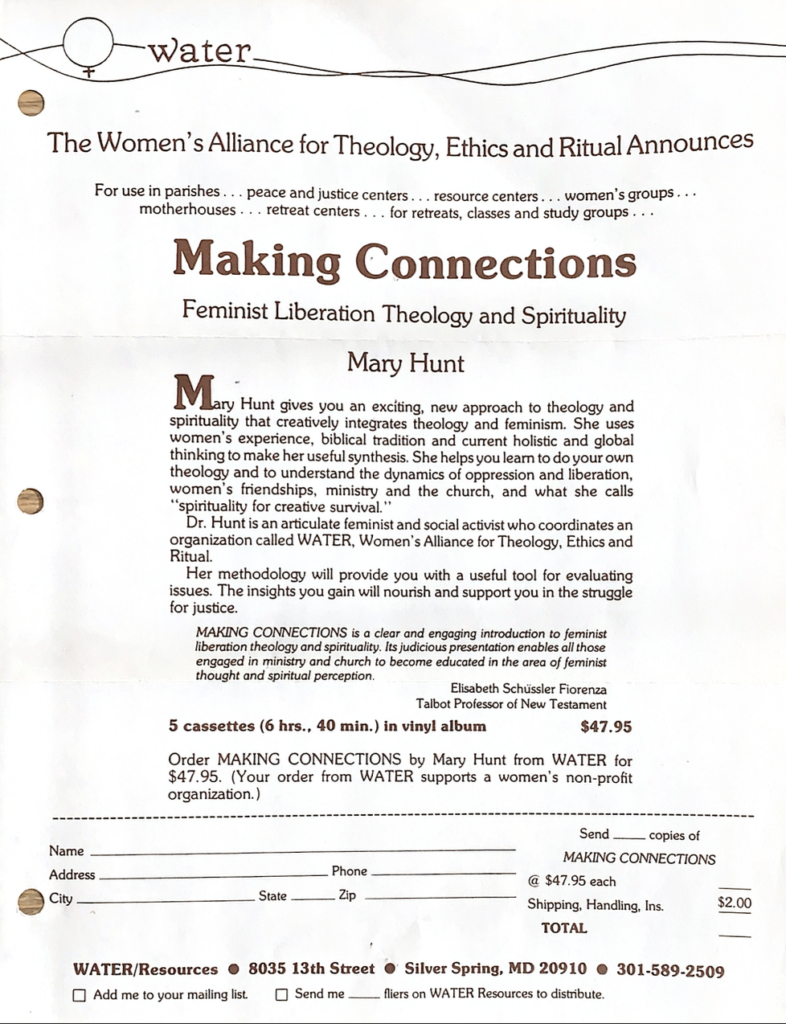
Flyer advertising a course in feminist theology from the Women’s Alliance for Theology, Ethics, and Ritual (WATER).4 For more information about WATER, see the “Theological Networks” page.
One of aspect of feminist theology that stands out in Special Collections is its flexibility. It was rarely confined to academia, and theologians enthusiastically applied their work to more tangible forms of religious activism.5 Most feminist theologians were also vocal activists, focused on issues like women’s ordination in Christianity, queer rights, and normalizing discussions of sex and sexuality.
Theological resources were in high demand for use by clergywomen, as they worked to build a place for themselves in traditionally male leadership structures. See Women’s Ministry and Leadership for more.
- Sketch of TOP Advisory Meeting by Sylvia Gilman, nd., Theological Opportunities Program records, Sophia Smith Collection, SSC-MS-00567, Smith College Special Collections, Northampton, Massachusetts. ↩︎
- Rita Gross, Feminism and Religion (Beacon Press, 1996), 42. ↩︎
- Mary J. Henold, Catholic and Feminist: The Surprising History of the American Catholic Feminist Movement (University of North Carolina Press, 2008), 15. ↩︎
- Flyer, nd., Women’s Alliance for Theology, Ethics and Ritual Records, Sophia Smith Collection, SSC-MS-00530, Smith College Special Collections, Northampton, Massachusetts. ↩︎
- Henold, Catholic and Feminist, 67. ↩︎