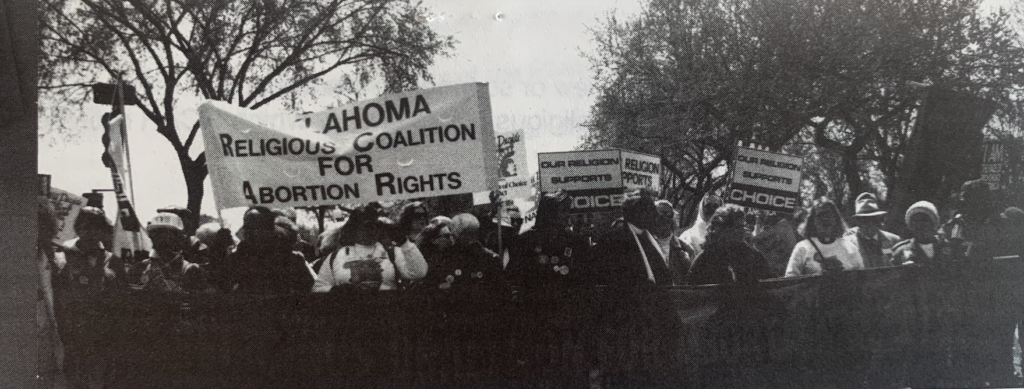
Members of the Religious Coalition for Abortion Rights at the March for Women’s Lives in Washington, D.C. in April 1992.1
The separation between the broader, “secular” feminist movement of the 20th century and the religious feminist movement was by no means rigid. Instead, they were two reciprocal spheres of a much broader, interconnected movement. Broader feminist ideas and concepts influenced spiritual and religious activists, and religious activists’ faith also shaped the ideas and strategies of the broader movement.
Some scholars have rejected the term “secular” entirely when discussing the broader American feminist movement. Historian Mary Henold argued that labeling the movement as such implies that all of the national and local leadership were nonreligious, when in reality the two spheres heavily blended together.2 Some activists publicly emphasized a religious approach to broader issues, like religious reproductive rights advocates. Others did not, but still applied a religious framework to their activism. Many Jewish feminists, for example, did not disclose their religious identities publicly because of concerns about antisemitism, but their faith and cultural experiences shaped their approach to political issues.3
This site employs the term broader feminist movement to distinguish between the broader movement and the one within religious spaces and communities.
There are two issues that best exemplify the overlap between these sections of the feminist movement during the late 20th century in Special Collections: reproductive rights and LGBTQ+ equality. Many materials related to the intersection of progressive politics and religion fall into one of these categories, but not all.
Other topics of interest present in Special Collections include religious organizations or individuals focused on suffrage/voting rights, early birth control, incarceration, and marriage.
- RCAR Report, 1993, Women’s Interfaith Institute records, Sophia Smith Collection, SSC-MS-00734, Smith College Special Collections, Northampton, Massachusetts. ↩︎
- Mary J. Henold, Catholic and Feminist: The Surprising History of the American Catholic Feminist Movement (University of North Carolina Press, 2008), 8. ↩︎
- Joyce Antler, Jewish Radical Feminism: Voices from the Women’s Liberation Movement (NYU Press, 2018), 6. ↩︎