Special Collections holds materials related to at least eight explicitly feminist religious leaders, across several different institutional and non-institutional faiths. These leaders include Episcopal priests, founders of spiritual communes, ministers, and a New Age priestess. As the broader religious feminist movement grew throughout the late twentieth century, the number of feminist congregational leaders naturally expanded as well. Materials in the archive document this expansion, and offer insights into their work, the challenges they faced, and the issues they addressed.
Many collections relate to individuals who prioritized feminist theology or practices in their leadership (rather than religious leaders who happened to be women). Special Collections holds information on both individual leaders and the resources and networks they utilized. There are also extensive materials related to women’s ordination.
To see a larger list of materials in Special Collections related to this topic, see Collections at Smith. For further reading, see Secondary Sources.
Individual Leaders
Among the feminist religious leaders featured in Special Collections, many were Episcopal priests. The Episcopal Church, the American member of the worldwide Anglican communion, has ordained women since 1974 and has generally been regarded as relatively progressive in its theology since the late twentieth century.1
Ruth Tiffany Barnhouse, for instance, was a complex figure whose notes and publications offer valuable insights into women’s leadership within a Christian Church. Unlike many religious feminists, she separated the issue of women’s rights from other social justice movements. Instead, she aligned herself with the subsection of the feminist movement that saw collaborating with LGBTQ rights activists as a mistake.2 These stances are not reflected in the papers of other feminist Episcopal priests in Special Collections, but they shaped Barnhouse’s work and her push for women’s participation in Christian life.
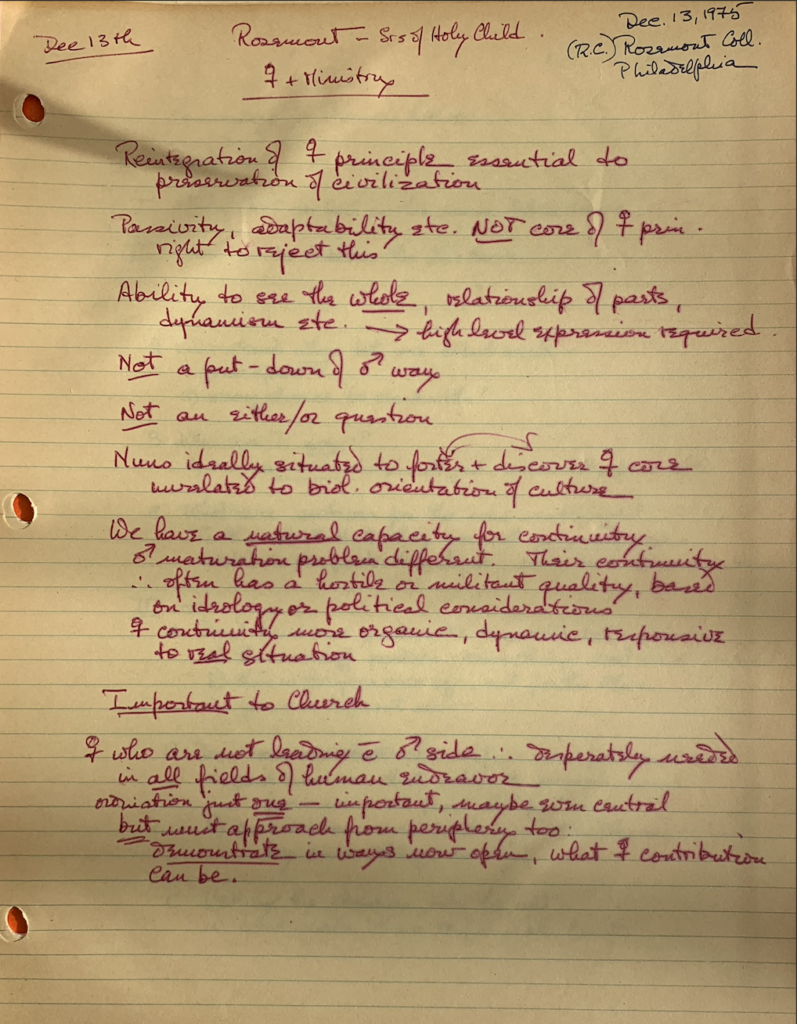
Throughout her career, she used many of her publications to call for greater equality for women in religious spaces. She also conducted extensive research into how religious life differed for men and women, and gave numerous sermons about gender and the Church.
Other religious leaders in Special Collections rejected traditional institutional religion, and focused on leading alternative faith communities. These practices were overwhelmingly syncretic, as individuals blended various traditional and new belief systems. The New Age movement, in particular, was an especially strong source of inspiration and rituals for feminist spirituality.4
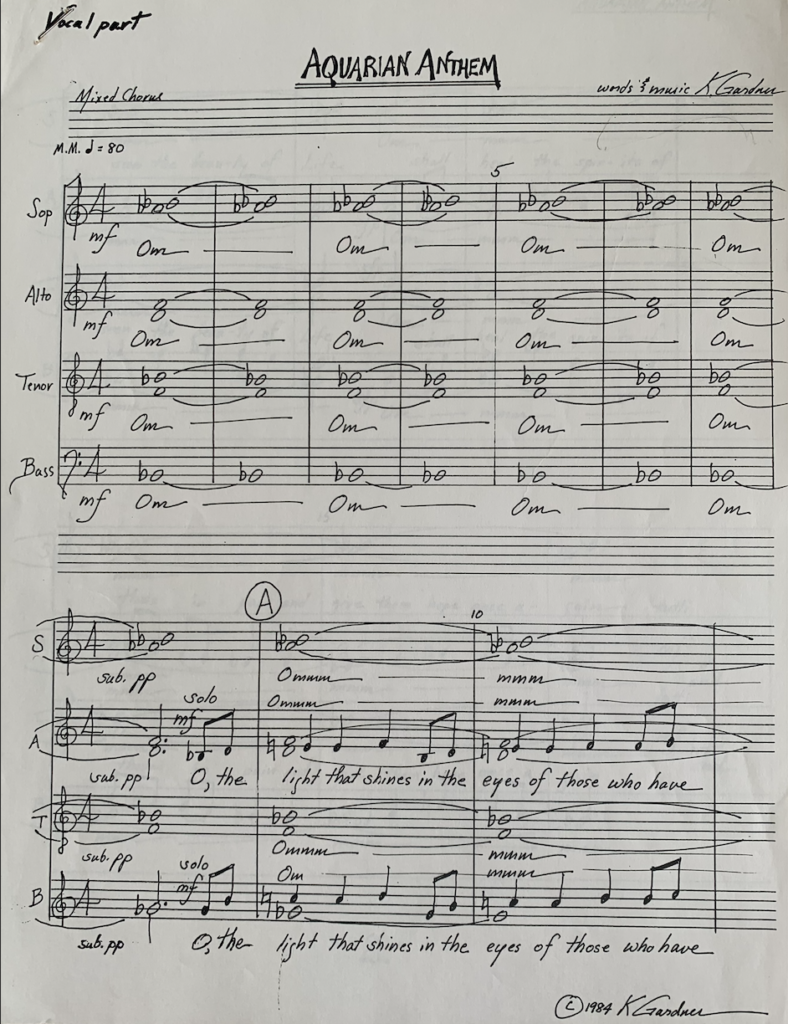
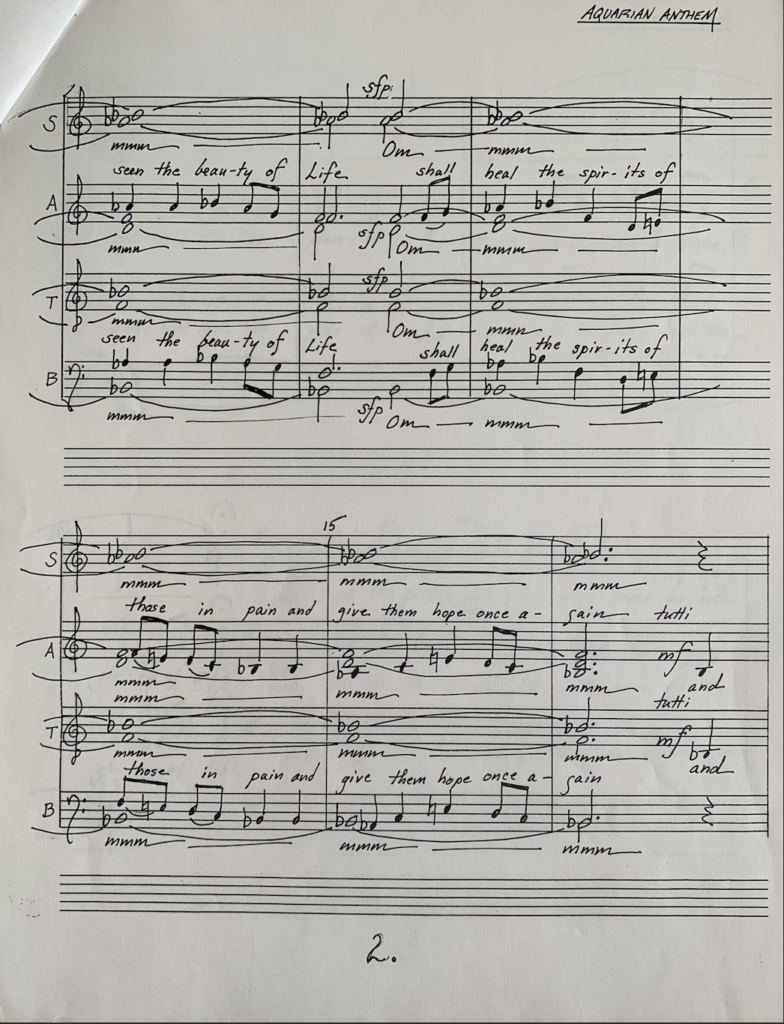
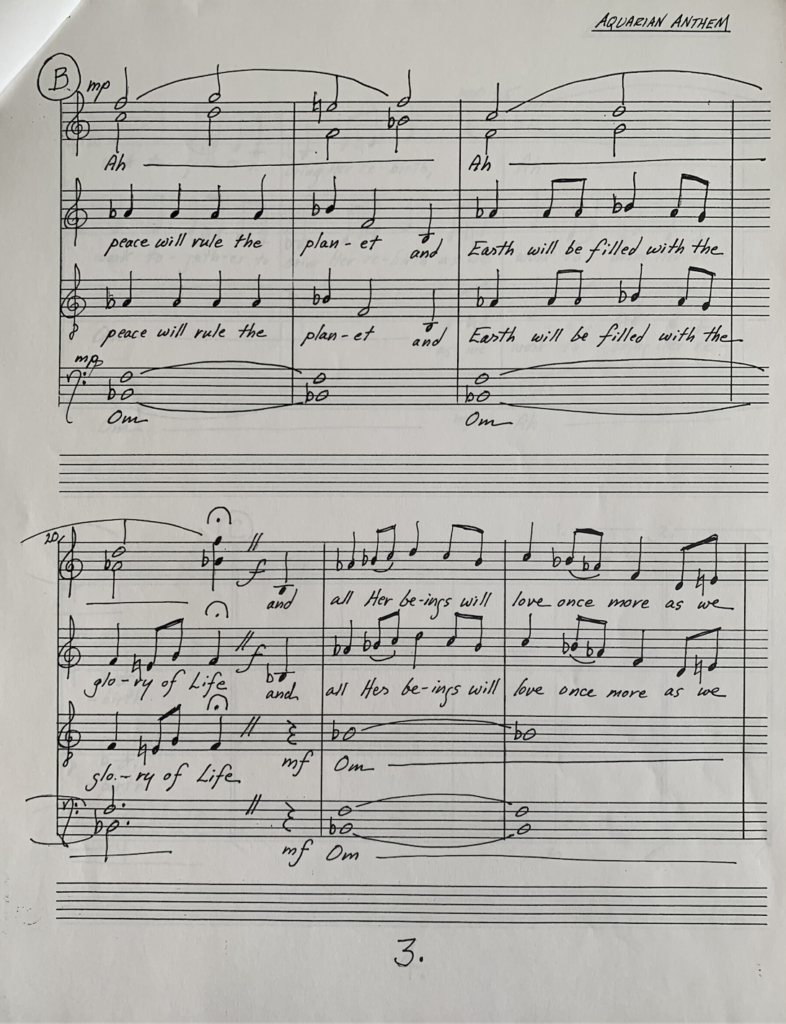
Kay Gardner was ordained as a priestess by the Irish Fellowship of Isis in 1998, which honors the goddess Isis. In the United States, she founded the Temple of the Feminine Divine and the Isium Musicum, an ordination program.5
Gardner’s work also emphasized music as a spiritual practice. As a professional musician, she created New Age musical workshops and services to allow others to participate in her beliefs. Gardner also formed Women With Wings, a sacred singing circle. Her papers highlight a non-traditional path to feminist religious leadership, as well as the development of anti-institutional spiritual communities.
Other notable feminist leaders with materials in Special Collections include:
- Diana Beech, an Episcopal priest
- Jane Garrett, an Episcopal priest
- Kit Wang, an Episcopal priest
- Andrea Ayvazian, a Protestant pastor and former chaplain of Mount Holyoke College
- Teresina R. Havens, a Quaker activist and founder of the Temenos spiritual retreat in Shutesbury, Massachusetts
- Margaret Brackenbury Crook, a minister of the Unitarian and Liberal Christian Churches
Resources and Networks
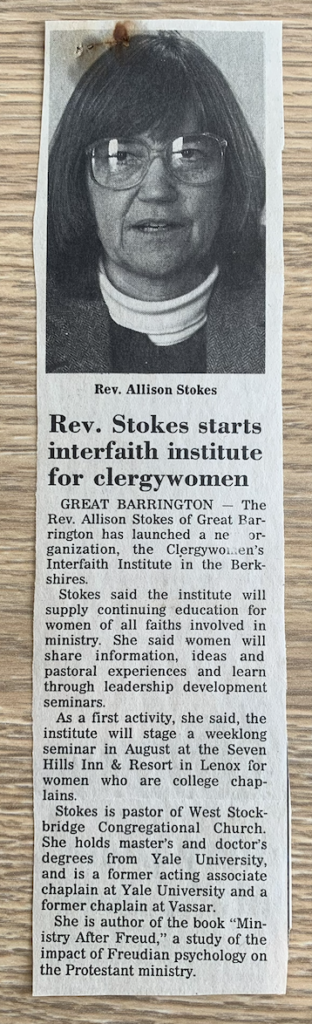
A clipping from The Berkshire Eagle, February 27, 1993.7
To support their work and build connections, many feminist leaders founded or joined formal organizations. These organizations provided liturgical resources, tools for continuing education, and social support. Many, but not all, of these networks were interfaith and emphasized connection across religious lines.
In Western Massachusetts, one of the most significant organizations was the Women’s Interfaith Institute. Founded in 1992 by Rev. Allison Stokes, a Unitarian pastor, the Institute sponsored annual festivals, hosted lectures, and created an archive and lending library featuring information about women’s ministry in the region.8 Ultimately, their goal was to form a supportive network of clergywomen in the area, and provide opportunities for leadership development.
On the national level, the Women’s Alliance for Theology, Ethics, and Ritual (WATER) offered vital resources for feminist congregational leaders of multiple faiths. Created in 1983 by theologians Mary E. Hunt and Diane L. Neu, WATER functioned primarily as an education center. They focused on developing feminist theological materials, and their programs provided key resources for leaders to use in their own practices and communities. WATER supported the Women-Church movement, for example, and created liturgical guides for communities to use in their worship.9
The existence of these organizations and networks were just as important for the growth of feminist leadership initiatives as the leaders themselves. They brought individuals together, and gave them crucial tools for redefining American religious life. For more information on both of these organizations’ work, see the Feminist Theology pages.
- Mary Schjonberg, “Interactive timeline of the history of women’s ordination,” Episcopal News Service, July 28, 2014, https://episcopalnewsservice.org/2014/07/28/ordination-timeline/. ↩︎
- Ruth Tiffany Barnhouse papers, Sophia Smith Collection, Smith College Special Collections, Northampton, Massachusetts. https://findingaids.smith.edu/repositories/2/resources/1057 Accessed April 28, 2026. ↩︎
- Research notes, nd., Ruth Tiffany Barnhouse papers, Sophia Smith Collection, SSC-MS-00202, Smith College Special Collections, Northampton, Massachusetts. ↩︎
- Cynthia Eller, Living in the Lap of the Goddess: The Feminist Spirituality Movement in America (Beacon Press, 1993), 63-64. ↩︎
- Kay Gardner papers, Sophia Smith Collection, SSC-MS-00523, Smith College Special Collections, Northampton, Massachusetts. https://findingaids.smith.edu/repositories/2/resources/1127 Accessed April 28, 2026. ↩︎
- Music Sheets, nd., Kay Gardner papers, Sophia Smith Collection, SSC-MS-00523, Smith College Special Collections, Northampton, Massachusetts. ↩︎
- Berkshire Eagle Clipping, 1993, Women’s Interfaith Institute records, Sophia Smith Collection, SSC-MS-00734, Smith College Special Collections, Northampton, Massachusetts. ↩︎
- The Women’s Times Resource Guide, nd., Women’s Interfaith Institute records, Sophia Smith Collection, SSC-MS-00734, Smith College Special Collections, Northampton, Massachusetts. ↩︎
- Women’s Alliance for Theology, Ethics and Ritual Records, Sophia Smith Collection, Smith College, Northampton, Mass. https://findingaids.smith.edu/repositories/2/resources/860 Accessed April 28, 2026. ↩︎