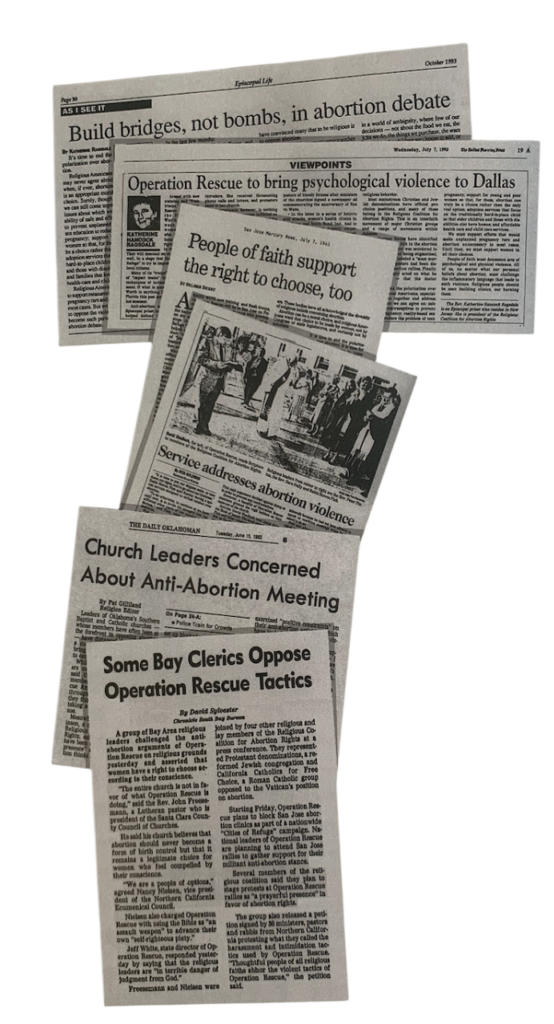
“The religious majority stands for freedom of conscience.”
Religious Coalition for Abortion Rights of Massachusetts letter, 1992.2
Religious activists were heavily involved in the movement for reproductive rights throughout the second half of the twentieth century, both before and after the landmark 1973 Supreme Court ruling in Roe v. Wade that widely expanded access to abortion. By the late ‘60s and early ‘70s, bodily autonomy and reproductive healthcare had become a central platform of the broader feminist movement. Abortion rights activists adopted a framework of feminist thought, and groups formed at every level—national, state, local, and community—to advocate for reproductive rights.3
This issue emerged as a priority in faith spaces, too, and a wide array of religious activists and organizations participated in this subsection of the movement. Special Collection holds information about national organizations, their collaboration, and pro-choice religious movements at Smith.
National Organizations
One of the most widely known religious reproductive rights organizations featured in Special Collections is the aptly-named Religious Coalition for Reproductive Choice (RCRC), which was called the Religious Coalition for Abortion Rights until 1993. Across several collections, the archive holds a large amount of material related to the organization, including its publications, correspondence, and information about its Massachusetts branch.
RCRC focused on keeping access to abortion legal, and spent most of its existence countering religiously-based attempts to overturn Roe v. Wade. Their work emphasized advocacy, public policy initiatives, education, and network building.4
The RCRC operated as a national interfaith alliance, with members and leaders from a wide variety of denominations. Some of the most represented faiths included mainline Protestant Christianity, Judaism, and non-institutional spirituality. With slogans like, “pro-faith, pro-family, pro-choice,” they seamlessly blended their commitments to religious values and reproductive healthcare.
Throughout the past 50 years, RCRC collaborated directly with religious leaders to create programs focused on reproductive healthcare. Many of these are described in materials within Special Collections. One prominent example is Clergy for Choice, a national network of leaders dedicated to reproductive choice. Members of this program testified in Congress and state legislatures, volunteered at reproductive healthcare clinics, spoke publicly about abortion access, and counseled individuals in need of reproductive healthcare support.5
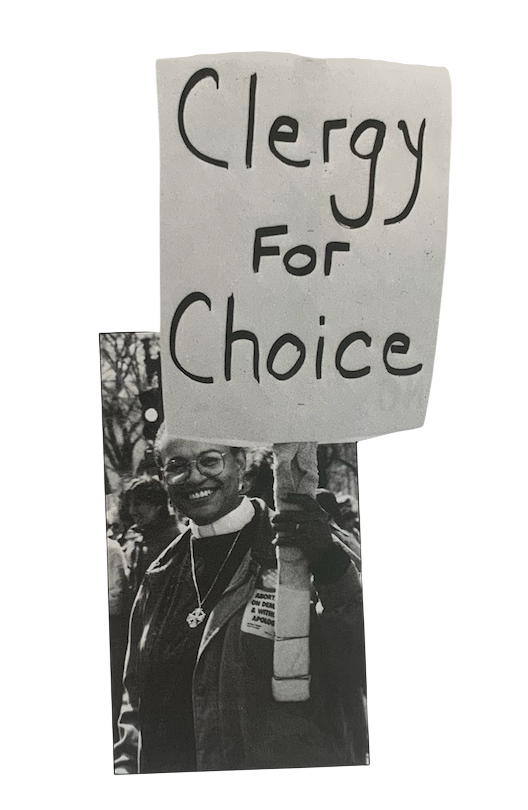
While RCRC built interfaith networks of reproductive rights activists, some organizations focused on advocating for abortion access within a particular denomination. Catholics for Choice (formerly Catholics for a Free Choice) was established in 1973 by Catholic feminist Patricia McQuillan, along with several other volunteers she’d worked with at the National Organization of Women.6 Special Collections holds the organization’s archival records, and regularly receives new accessions.
Like the RCRC, Catholics for Choice focused on countering the religious right’s anti-abortion rhetoric. They prioritized both lobbying efforts and direct opposition to the Catholic Church’s stance on abortion. Beyond dismantling religious barriers to reproductive healthcare, the organization also grew to focus on the separation of church and state, safe and accessible contraception, and women’s ordination.
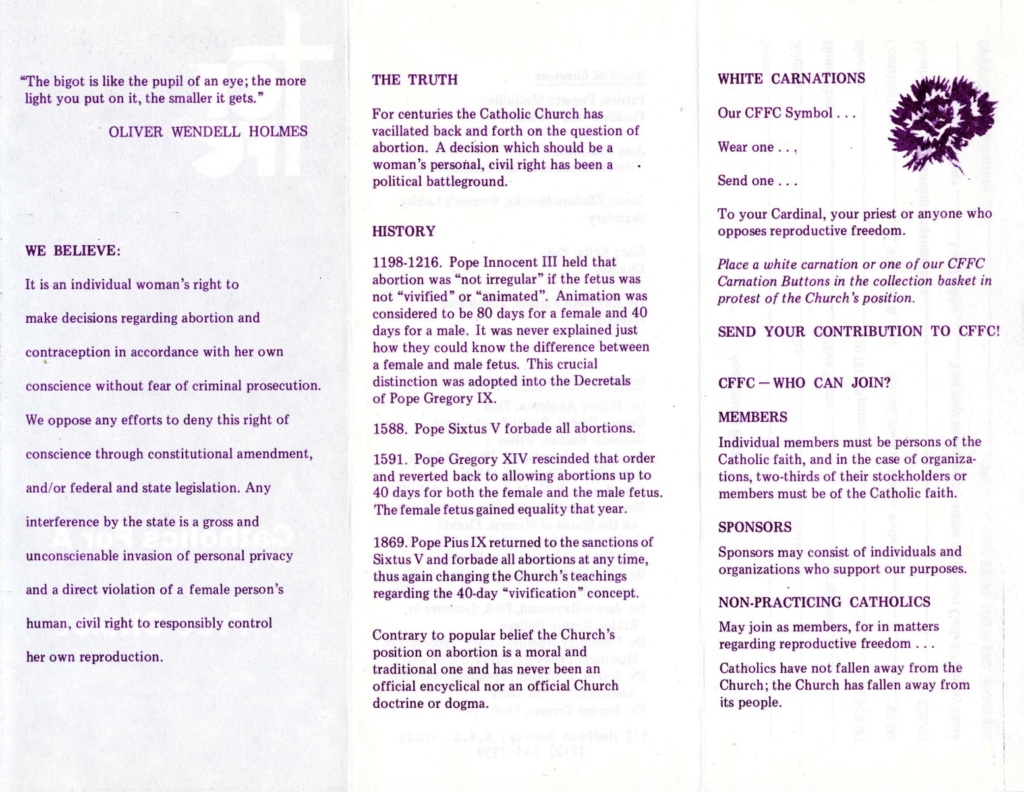
By grounding themselves in Catholicism, CFC was able to challenge the Church’s patriarchal norms from within the same faith. Early publications highlight the role of feminist theology in shaping the organization’s mission, as they re-interpreted scripture to construct a progressive understanding of their religion. This understanding then shaped their approach to pro-choice advocacy.
Collaboration between Organizations
What stands out most about the religious reproductive rights organizations whose records are held in Special Collections is their near-constant collaboration. Organizers built wide coalitions, and established networks of advocacy to achieve their goals.
One motivator of collaboration may be a little unexpected: Pope John Paul II.
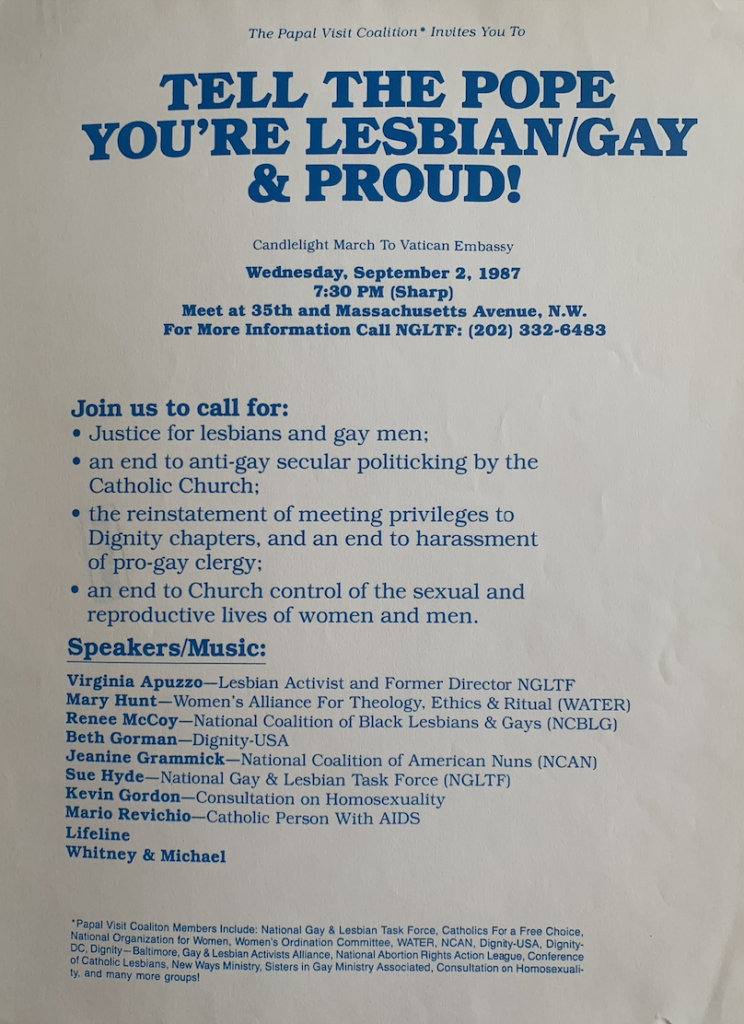
In 1987, the Pope embarked on a tour of the United States. At all of his stops, both secular and religious activists used his presence as an opportunity to protest what they saw as the Church’s heavily conservative social policies. This was not the first trip he had made to the country, and each time religious feminists had rejected his political messages.8
As this trip approached, progressive religious associations—including Catholics for Choice—joined forces to create a Papal Visit Coalition. Some groups, like CFC, focused on reproductive rights. Others focused on women’s equality more broadly, LGBTQ+ rights, feminist theology, and a myriad of other issues. Many organizations, but not all, were religious.
The Coalition held rallies, organized petition drives, set up billboards, and published newspaper columns across the country to call for change within the Church. Although these mobilization efforts did not change the Church’s official stance on queer rights, women’s equality, or reproductive healthcare, they demonstrate the powerful networks formed by these organizations during this time period.
Providing Access to Reproductive Healthcare at Smith
Although many of the materials related to religious reproductive healthcare advocacy in Special Collections relate to state or national organizations, individuals on Smith’s campus also played important roles.
Rev. Richard Unsworth served as a Professor of Religion and College Chaplain from 1954 to 1963, and then again from 1967 to 1980. Throughout his time at Smith, he witnessed the physical and emotional harm caused by a lack of access to reproductive care, including the suicides of several students.10 In 1968, he started a chapter of the Clergy Consultation Service (CCS) in Western Massachusetts, just a year after the original branch in New York was established.11 The CCS provided individuals in need of reproductive care with referrals to abortion services and providers, and pressed for legal and social change.
In Western Mass and across the country, chapters of the Clergy Consultation Service made 100,000 referrals to abortion providers during the six years they were active. By the time the Supreme Court released the Roe v. Wade decision in 1973, the CCS comprised roughly 40 chapters with 2,000 clergy offering their services.12
Although Unsworth’s papers are housed in Special Collections, there are no mentions of his work with the CCS. In general, there are few materials documenting the specific work of the network. To avoid prosecution and protect the individuals they counseled, clergy were instructed not to write anything down. Throughout the years they were active, they conducted their work “openly but cautiously.”13
After abortion was legalized with the Roe decision, the CCS continued their work, albeit in a different form. They became the Religious Coalition for Abortion Rights, and changed their name in 1993 to the Religious Coalition for Reproductive Choice. Today, they are still active as the Religious Community for Reproductive Choice.14
For more collections related to the religious reproductive rights movement, see Collections at Smith. For further reading, see Secondary Sources.
- RCRC Annual Report, 2004, Saralee Hamilton Papers, Sophia Smith Collection, SSC-MS-00629, Smith College Special Collections, Northampton, Massachusetts. ↩︎
- Letter to Allison Stokes, 1992, Women’s Interfaith Institute records, Sophia Smith Collection, SSC-MS-00734, Smith College Special Collections, Northampton, Massachusetts. ↩︎
- Leslie J. Reagan, When Abortion Was a Crime: Women, Medicine, and Law in the United States, 1867-1973 (University of California Press, 2022), 232-233. ↩︎
- RCRC Annual Report, 2004, Saralee Hamilton Papers, Sophia Smith Collection, SSC-MS-00629, Smith College Special Collections, Northampton, Massachusetts. ↩︎
- Ibid. ↩︎
- Patricia Miller, Good Catholics: The Battle Over Abortion in the Catholic Church (University of California Press, 2014), 66-67. ↩︎
- Brochure, 1974, Catholics for Choice records, Sophia Smith Collection, SSC-MS-00742, Smith College Special Collections, Northampton, Massachusetts. ↩︎
- Miller, Good Catholics, 89. ↩︎
- Papal Visit Coalition Flyer, The Washington Times, 1987, Catholics for Choice records, Sophia Smith Collection, SSC-MS-00742, Smith College Special Collections, Northampton, Massachusetts ↩︎
- David Cline, Creating Choice: A Community Responds to the Need for Birth Abortion and Control, 1961-1973 (Palgrave Macmillan, 2008), 125-126. ↩︎
- Ibid., 115 ↩︎
- David Cline, “Surprising Allies: The Struggle Over Birth Control and Abortion in 1960s Massachusetts,” Historical Journal of Massachusetts 47, no. 2 (2019): 62, EBSCOhost. ↩︎
- Ibid., 59. ↩︎
- “Who We Are,” Religious Community for Reproductive Choice, accessed April 14, 2026, https://www.rcrc.org/about/. ↩︎