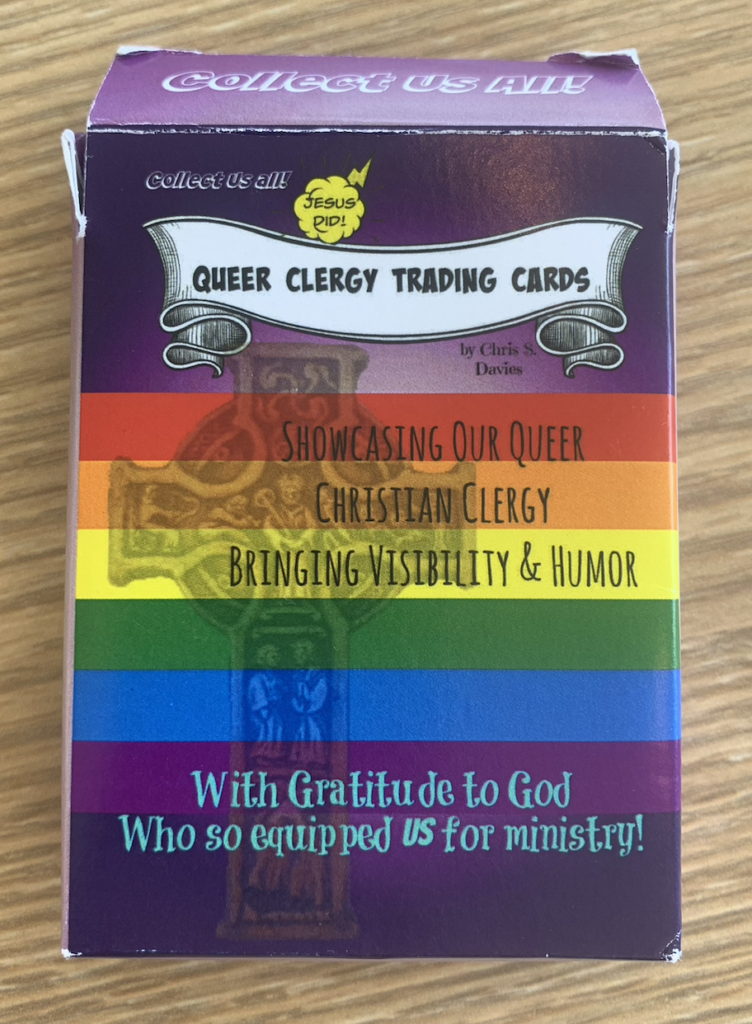
As the modern LGBTQ rights movement developed throughout the second half of the twentieth century, laypeople and faith leaders participated in both the “broader” struggle for queer equality and fought for rights within their religious communities.
While many LGBTQ activists rejected religious faith and institutions as inherently opposed to queer freedom and expression, others saw them as entirely compatible. In turn, many progressive religious groups and leaders from several different traditions embraced LGBTQ rights as a crucial social justice mission. The link between religious groups and the fight for queer rights has been present in the movement for over 60 years. Throughout the 1960s, for example, organizations like Women of Reform Judaism, the Council on Religion and the Homosexual, and the Kalos Society all worked to support gay equality through a religious framework.
Special Collections holds a variety of materials related to the religious dimensions of the queer rights movement, including publications, notes, and other materials from both national organizations and individual activists/researchers.
Individual and Organizational Advocacy
Throughout the ‘60s and ‘70s, religious queer activists founded several organizations to advocate for gay rights in hostile institutions. To push for equality in Catholic spaces, for example, lay-led groups DignityUSA and New Ways Ministry offered support to queer individuals and advocated for inclusive practices within the Church.2
The work of individual thinkers was also vital for the development of a religious LGBTQ rights movement. Jewish theologian Judith Plaskow focused on gay, lesbian, bisexual, and transgender experiences of religious life throughout the ‘90s. Her work challenged what she saw as the patriarchal heteronormativity of traditional Judaism, and fashioned a “woman-centered spirituality” that she understood as a more authentic expression of faith.3
The internal politics of religious institutions also dramatically impacted the queer struggle for equality. Special Collections contains a wealth of materials related to the discussions and debates of religious figures surrounding same-sex marriage and religious participation, especially within the Episcopal Church. Rev. Jane Garrett, for instance, conducted extensive research on queer religious life and the Church’s evolving positions on it. She captured the theological, political, and bureaucratic processes that led to the Episcopal Church’s eventual affirmation of queer relationships and identities.
These materials offer valuable insight into the gradual change within institutional religions, as well as the value of individuals’ contributions to the broader movement. For more collections related to religion and LGBTQ rights, see the Collections at Smith page. For further reading, see Secondary Sources.
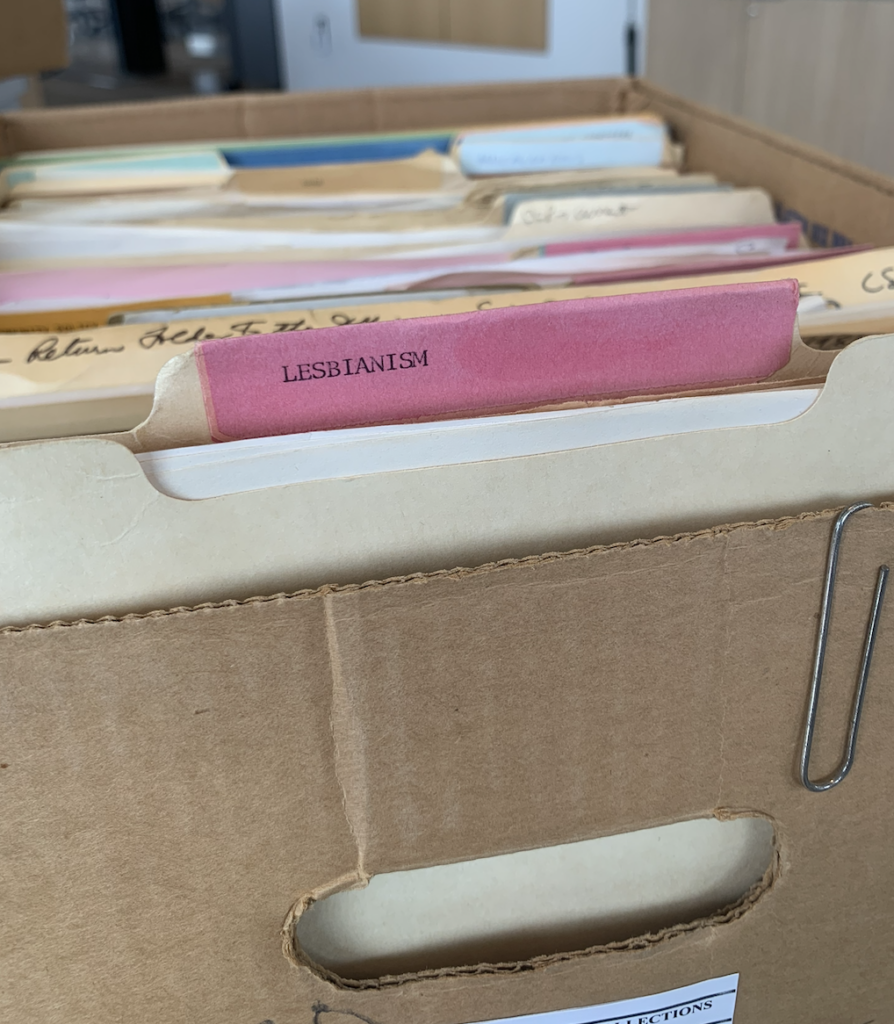
Image of the “Lesbianism” file in Smith’s College Archive, focused on the intersection of lesbian identities and religious practice on campus. It highlights both anti-gay religious opposition to queer rights as well as a variety of religious leaders’ support for queer students at Smith.
The “Lesbian Controversy” at Smith College
The link between religious life and the gay rights movement is especially strong in Smith’s history.
In the Spring of 1978, Smith’s student body voted against funding the newly-chartered Lesbian Alliance, denying them legitimacy as a full student organization on campus. In response, members of Jewish, Catholic, and Protestant student religious groups published a letter in the Sophian—Smith’s student newspaper—supporting the Alliance and advocating for their right to receive funding.
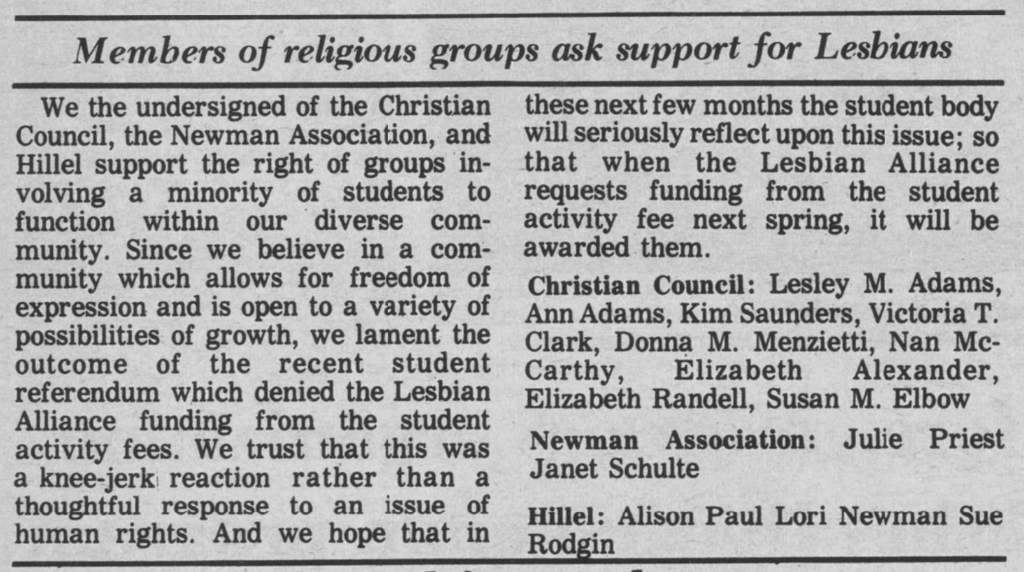
This ignited a fierce debate, which played out in the pages of the Sophian for the next three months. The authors of the original letter faced backlash from an anti-gay religious student, who explained her Biblical motivation for opposing queer rights.
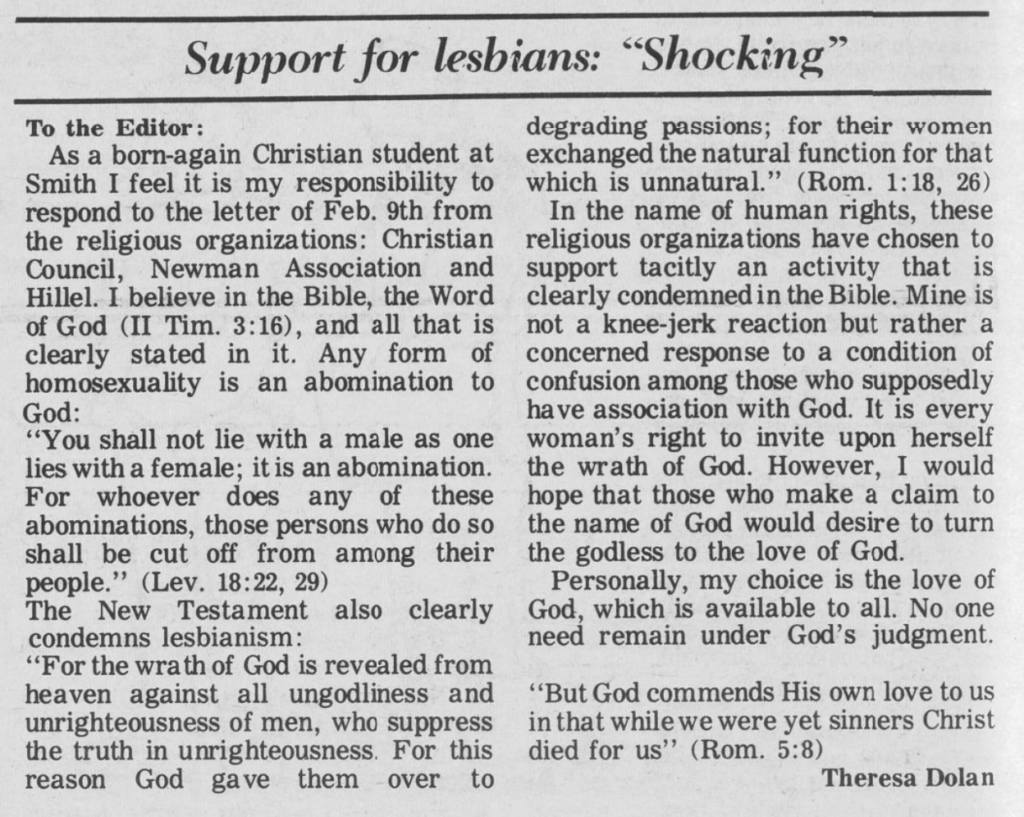
In response to Dolan’s letter, other students wrote to the Sophian expressing their disagreement and support for the Lesbian Alliance. They specifically critiqued Dolan’s literal reading of scripture, and argued for an alternative understanding of the Bible that was more attuned to modern times and needs. This reflects a much wider trend present in progressive theology, including feminist theology, queer theology, and liberation theology.
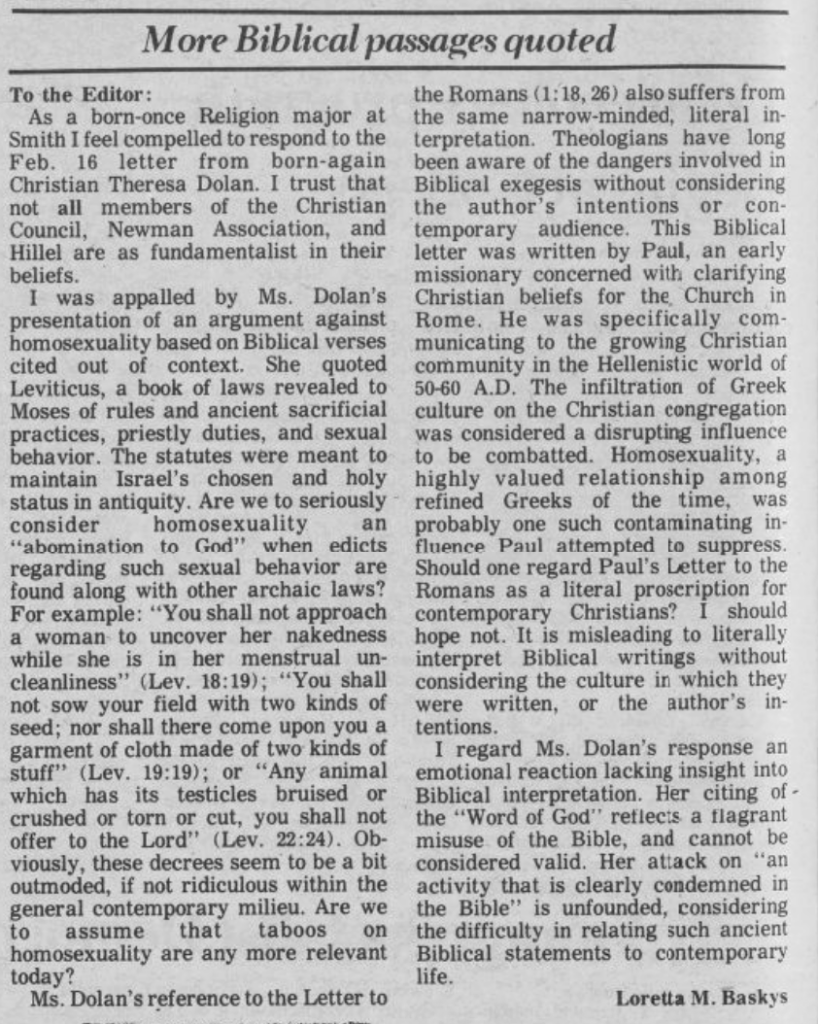
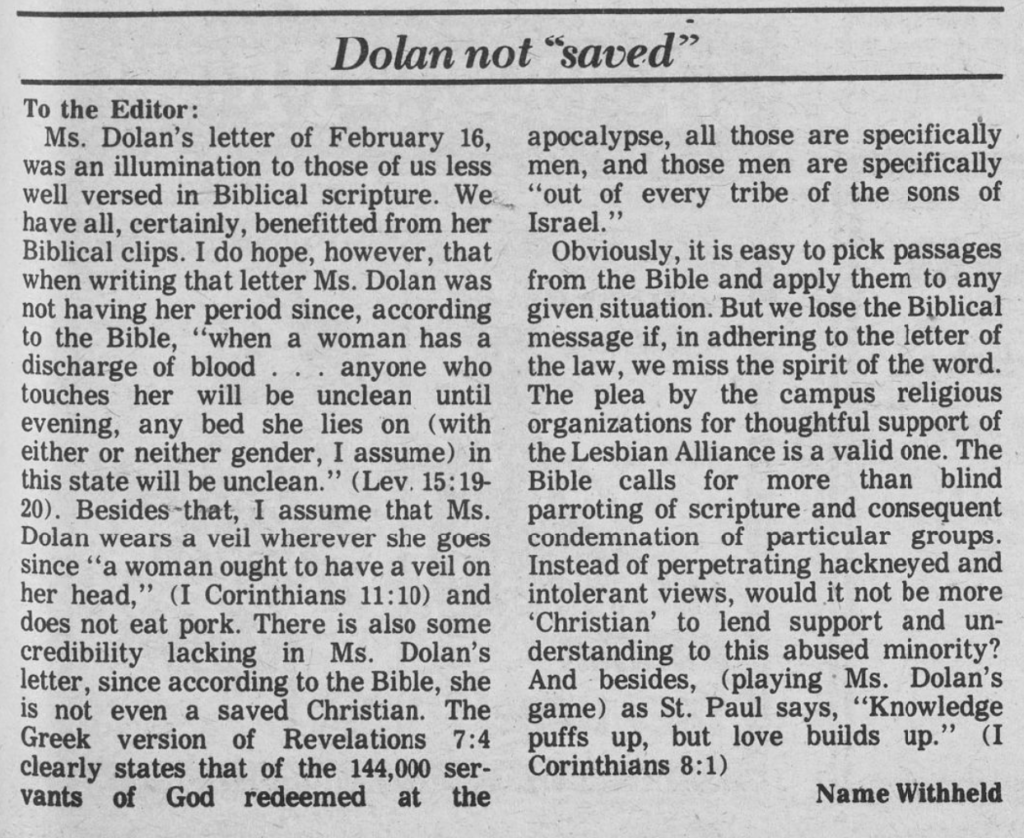
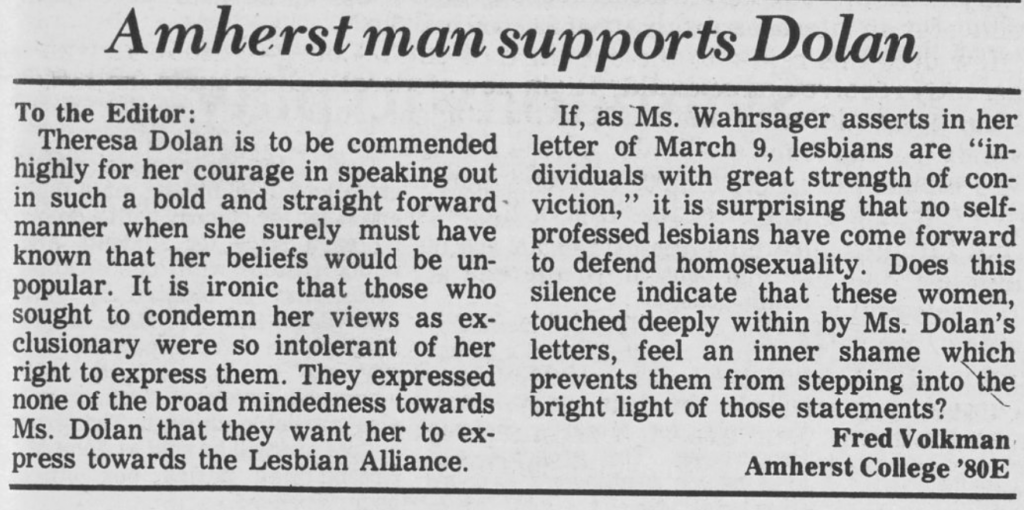
This debate spread beyond campus, and generated discussion among local residents and students at nearby schools. The next month, an Amherst student weighed in:
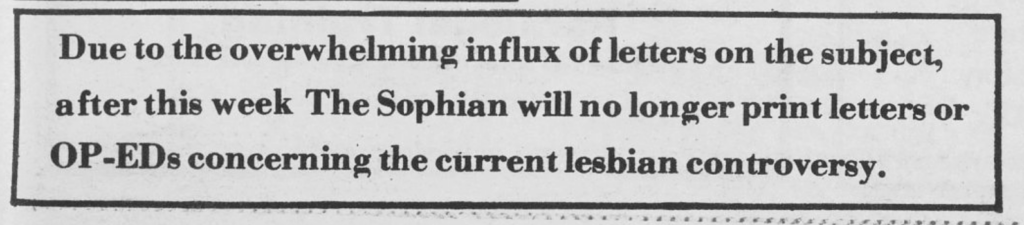
In March, after almost 15 letters to the editor, the Sophian announced they would not publish anything else related to the topic.
Although this controversy captures just one brief moment in Smith’s history, it illuminates the tension on campus in the late twentieth century. It also reveals the complex relationships between faith groups and LGBTQ advocates, and highlights one way that religious groups offered support to queer activists and communities.
- Card Deck, 2010s, Rev. Dr. Chris Davies queer clergy trading cards and related material, Sophia Smith Collection of Women’s History, SSC-MS-00848, Smith College Special Collections, Northampton, Massachusetts. ↩︎
- Pamphlets, nd., Helen Hills Hills Chapel collection, College Archives, CA-MS-01111, Smith College Special Collections, Northampton, Massachusetts. ↩︎
- Joyce Antler, Jewish Radical Feminism: Voices from the Women’s Liberation Movement (NYU Press, 2018), 228. ↩︎
- Sophian Volume 26, no. 13, 1978, Student publications and student publications records, College Archives, CA-MS-01049, Smith College Special Collections, Northampton, Massachusetts. ↩︎
- Sophian Volume 26, no. 14, 1978, Student publications and student publications records, College Archives, CA-MS-01049, Smith College Special Collections, Northampton, Massachusetts. ↩︎
- Sophian Volume 26, no. 15, 1978, Student publications and student publications records, College Archives, CA-MS-01049, Smith College Special Collections, Northampton, Massachusetts. ↩︎
- Ibid. ↩︎
- Sophian Volume 26, no. 18, 1978, Student publications and student publications records, College Archives, CA-MS-01049, Smith College Special Collections, Northampton, Massachusetts. ↩︎
- Ibid. ↩︎