Water Inquiry Teacher Group

Invitation to Join!
Water Inquiry Teacher Group 2015-’16
Open to K-6 teachers in all grade levels and disciplines


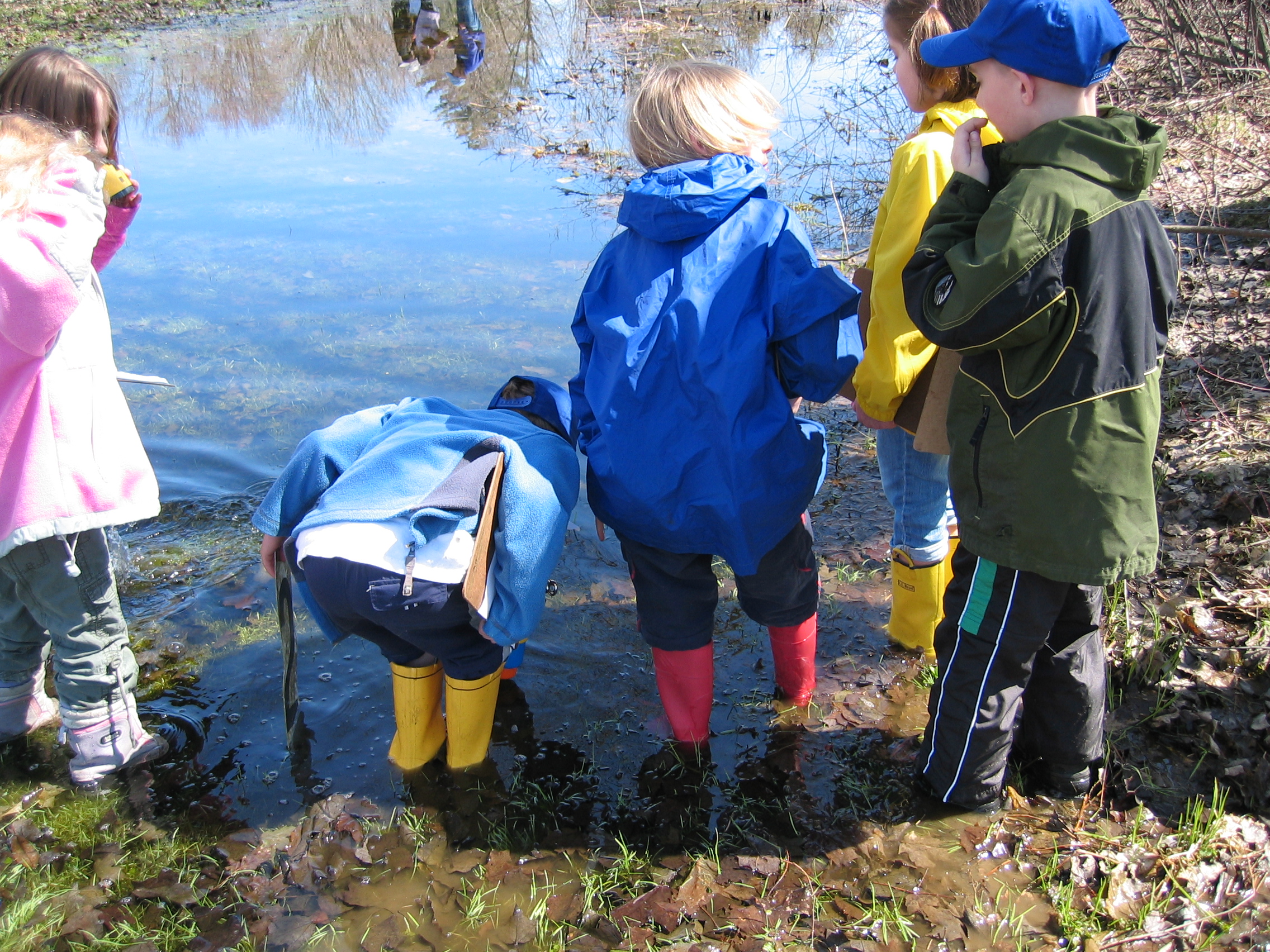
Why Water Inquiry?rsz_img_3241 (1)

  • Project Based Learning
  • Schoolyard & Local Investigations
  • Next Generation Science Standards
  • Literacy and Arts-Integration

Why Join?

  • Professional learning community
  • Honoraria and PDPs
  • Roundtables with refreshments
  • Smith College student and faculty support

What’s the Commitment?

  • Attend July 1 Workshop:  Field Trip and Project Launch
  • Participate in 4 out of 6 Roundtables  (2-hour sessions Sep-May)
  • Please reply by May 18

IMG_3244Interested to find out more?  

Student Contact:
Allyson Ciccarone aciccarone@smith.edu

Faculty Contact:
Carol Berner cberner@smith.edu


Snowflakes and Snowscapes

Looking Closely at Snow

IMG_0379

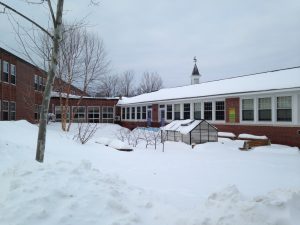
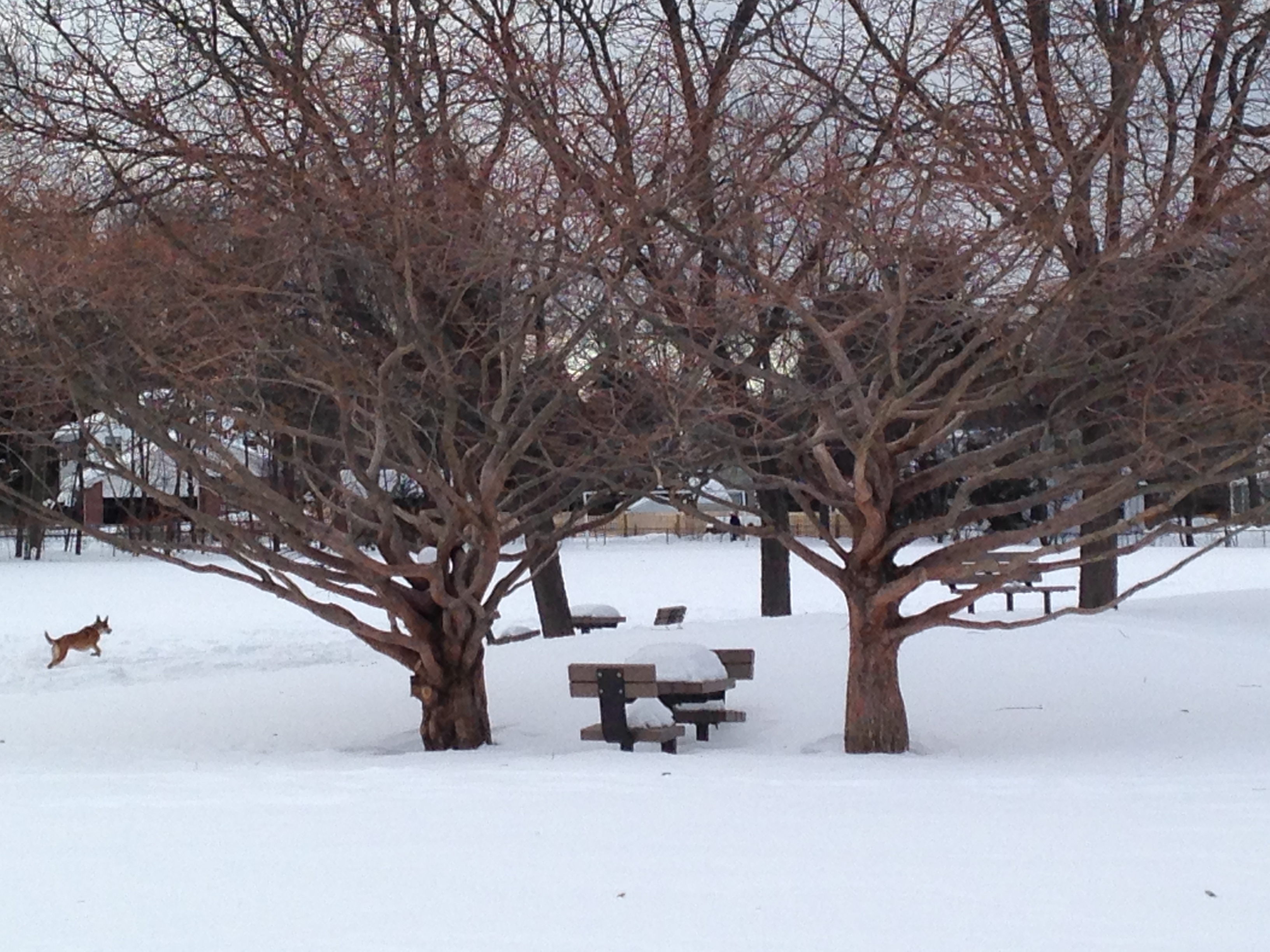
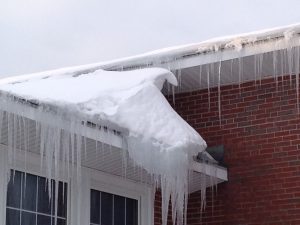
This inquiry does not even require you to leave the classroom! Instead, students gather around the window and use Visual Thinking Strategies to talk about what they see in the snowy school yard.  This questioning strategy also works well when students discover interesting ice or snow formations on the school  grounds: they can take a picture, or bring the class outside, to examine their discovery.

Here are a few examples of questions that can be explored with careful and close observation:

OBSERVATION

What do you see?  Take a visual inventory of details that stand out to you.

  • Where do you notice more or less snow?
  • What do you notice about what the snow looks like in different places? What words would you use to describe it? (Fluffy, clumpy, bumpy, smooth?)
  • What do you think the snow feels like in different places? What makes you say that?

INTERPRETATION

What is happening in this winter landscape?

  • Where is the snow and what is it doing?
  • What patterns can you discover?  What surprises you?
  • Where does the snow come from? Where will the snow go?

BUILDING A NARRATIVE

What story does this winter landscape tell?

  • What can you tell about snow and winter on the school grounds?
  • What parts of the story do you still wonder about?
  • How much water is on the playground? How could you find out?

 What are your students noticing or wondering about water in winter?  Please comment or send a photo, video, notes or audio recording of their ideas.

IMG_0377


SnowflakesWilsonBentley

Looking Even Closer at Snow

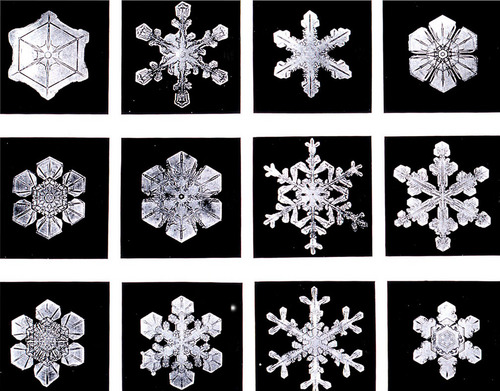
If you want to look even closer at types of water without leaving the classroom, you can also try using Visual Thinking Strategies with up-close photographs by Snowflake Bentley. Bentley was a farmer from Vermont who perfected the art of snowflake photography. Examples of his pictures are below.

  • What shapes do you see in the snowflakes?
  • Are there any similarities between the snowflakes?
  • How do you think Bentley was able to photograph the snowflakes so closely?
  • How would YOU photograph a snowflake?


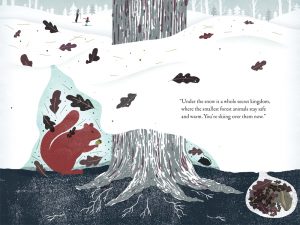
Do You Wonder What’s Going on Under the Snow?

Over-and-Under-Snow Kate Messner
Over and Under the Snow, by Kate Messner

Check out these beautiful
non-fiction picture books!


– Ally, Carol, Catherine, Hannah


Winter Water Inquiries

JSS 2-17-15
Jackson Street School, February 17, 2015

Hello everyone! My name is Catherine Bradley, and I recently joined the water inquiry team. I am a sophomore at Smith College, majoring in history with a minor in education, and I am very excited to begin working on this project.

Over the winter break, I took a week-long interterm course co-taught by Professor Berner at Smith’s MacLeish Field Station in Whately, MA. The course, titled “Interpreting the New England Landscape,” encouraged us to interact with our natural surroundings in many different ways.  Inspired by the week, we developed two snow themed adventures, perfect for this time of year.

How Cold is Snow?

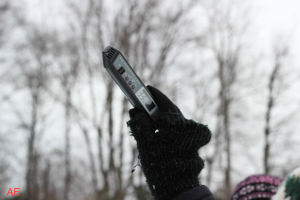
In our first snow inquiry, students bundle up and head outside, armed with easy-to-read tube thermometers. With these thermometers, students can measure the temperature of the air, the snow, and the ground underneath (a little digging may be required here!).  Try this in a few different spots on the school grounds:  in the sun and the shade; near the school building; near rocky outcroppings; around the playground.

img_6616new
A student checking the temperature in the air to compare to the temperature in and under the snow.


  • What’s do you notice about the temperatures?
  • Can you find any patterns in temperature? Any surprises?
  • If you were a small animal, like a mouse or a vole, where would you go? Why?


What Happens to Water in Winter?
Make some class predictions before going outside:

  • Where will you look for ice around the school grounds?
  • Where will you look for liquid water?
  • Do you think ice floats or sinks in water? What makes you say that?
  • Imagine–if ice sank in water what would change?
  • Which do you think is colder: ice or the water under the ice? How could we find this out?

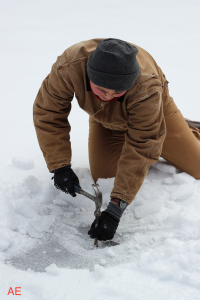
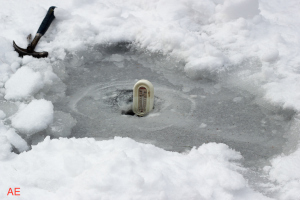
Are there icicles on your building or frozen water on your school grounds?  Take students out to investigate places where ice forms:  Where do you see ice? What’s going on in these places?  If you’re lucky enough to be near a pond or running stream, take the temperature of the air above the ice and the water below the ice (you may want to tie a string to the thermometer if the water is deep). To dig a hole in thicker ice, try using a screwdriver and hammer, or a hand-held ice augur.

img_6657new
Annie Ames, ’15 cracking a layer of ice at the vernal pool.
  • How cold is the air above the ice? How cold is the water below?
  • Where do you think fish and frogs go in the winter?
  • Imagine–what is it like underneath the ice?

img_6666new


Why aren’t we skating at the bottom of the pond?

Curious about winter water and how it impacts pond life? Check out this piece from Vermont Public Radio: Exploring above and below the ice


 Please comment!

What are your students noticing and wondering about snow, ice and where water goes in winter? What snow-related activities incite the most curiosity? And look for the next blog with a winter inquiry that does not even require leaving the classroom!

– Ally, Catherine, Carol and Hannah

Beginning Water Inquiries

Welcome to the Investigating Water Blog, home to all things regarding our water inquiry. Inquiry based learning takes a big question and converts it into a problem for students to solve. Our ‘big question’ – where does water go? – is one that many classrooms have engaged with over the past few months. In this initial blog post, our investigating water team focuses on the beginnings of water studies in five classrooms.

These posts showcase how teachers guide students in building scientific knowledge in active and engaging ways. We hope to encourage dialogue across classrooms, to invigorate ideas and to keep improving our conversations about water. Through collaboration, each classroom can advance their understanding of how water works and how ideas work.
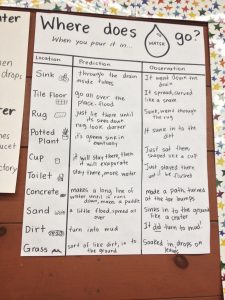
IMG_6834

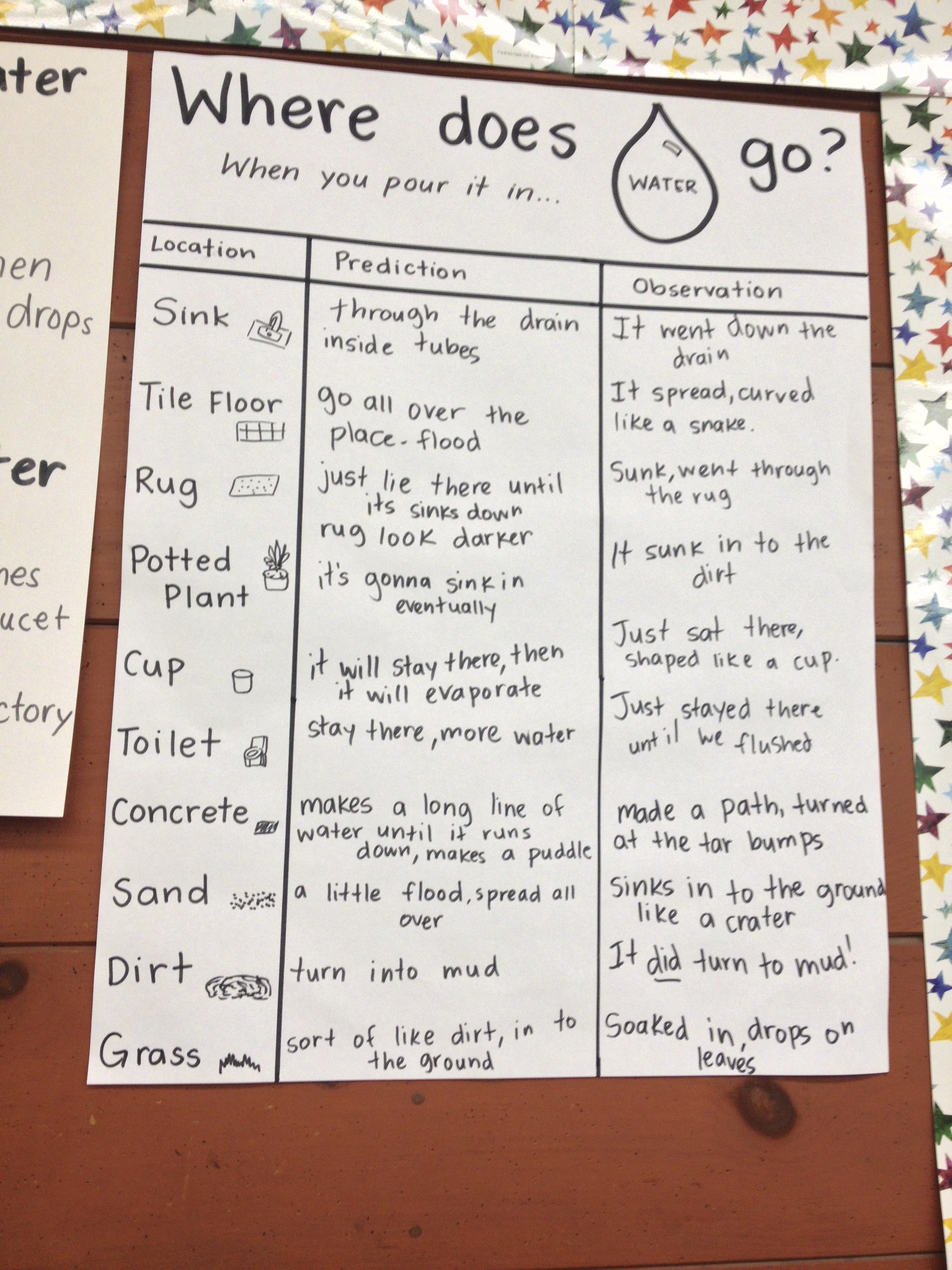
Katy Butler’s first grade class at Jackson Street School opened their study of water through multiple avenues. While reading water-related books such as Thomas Locker’s Water Dance, students became interested in the question of where water goes. The quest for an answer resulted in the experiment pictured above, where students watched Ms. Butler pour water on a number of surfaces in various locations. Differences between predictions and observations, as well as individual experiments, provoked questions. When water was poured on a yellow carpet, for example, students wondered whether the water droplets changed color to match the surface below.

Book_Henry_Works

At the Smith College Campus School, Robbie Murphy launched her second grade class’ investigation using the lens of a natural scientist.  The book Henry Works by D. B. Johnson, which tells the tale of a bear modeled after Henry Thoreau, provided an opportunity to discuss the value of making observations. The story opens on a “misty, muzzling morning,” prompting a later discussion about where rain comes from. Students created a series of beginning ideas, among them the intriguing concept that “water has a life cycle”.

On the pine trees it gets stuck on the needles and on the other trees, it gets

stuck on the leaves and fills it up like a cup. Then, when the sun comes out, it evaporates??

Jan Szymaszek started a conversation about water with her third graders at the Campus School after being caught in the rain at recess.  Jan noted that students were “really engaged” in the discussion about water flow on the sloping school grounds.  Sharing observations about where water collected, they began to ask questions about where water goes when it is no longer visible. Does it go into the reservoir? The sewers? Does it become drinking water or does it go where the toilet water goes? Jan plans to take students out during a hard rain and refine the framing question, observing “where does the water go when it is raining?”.
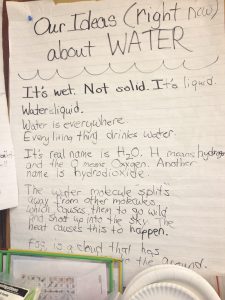
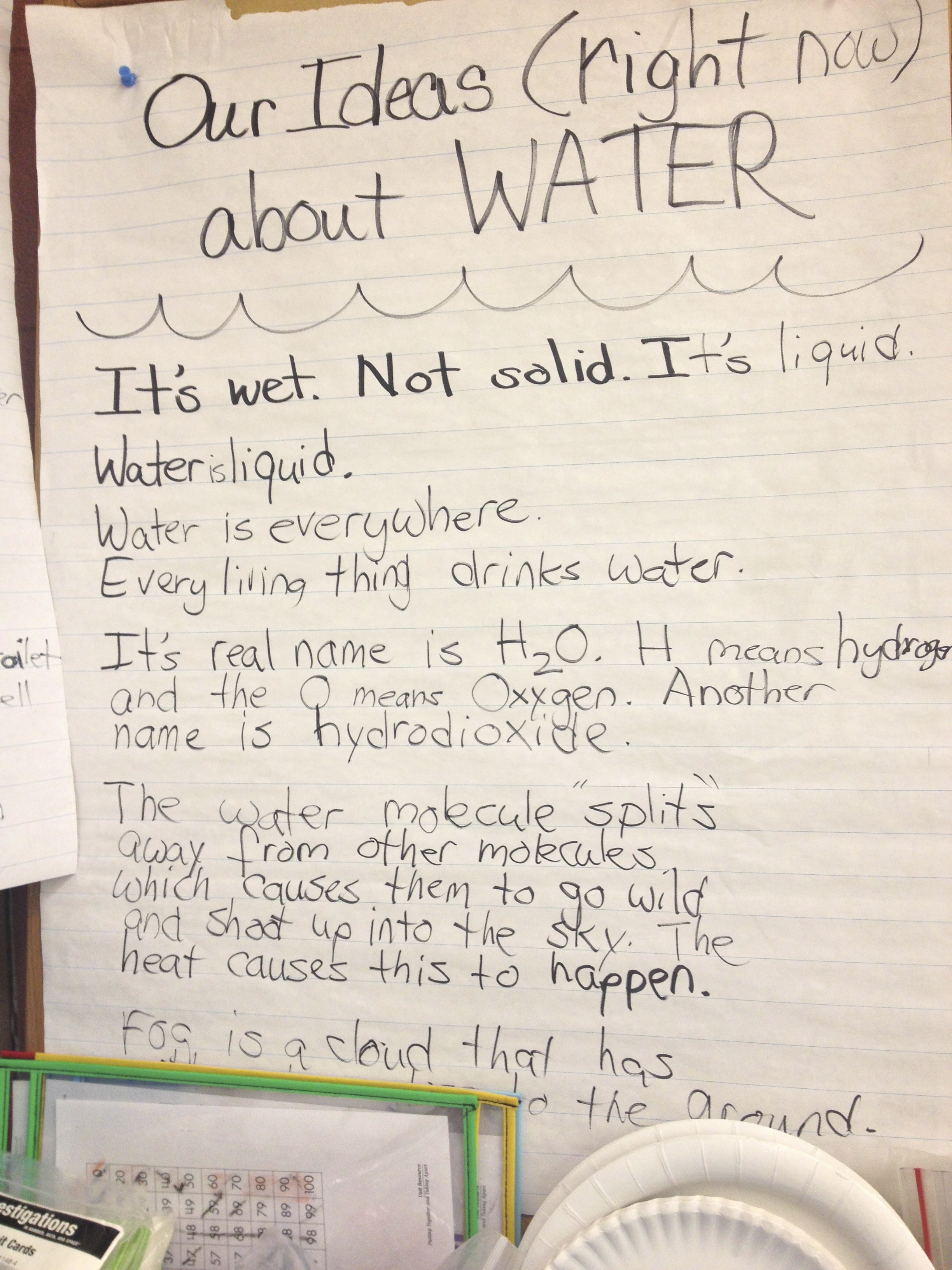
IMG_6956Kathie Bredin set out to discover her fourth grade students’ ideas about water with an eye to sustaining inquiry over time. The inquiry began in her classroom at Jackson Street School with a discussion about water, a resource that was all around them, but often went unnoticed.  The inclusion of “(right now)” in the title gives an expectation for a continuous building on student ideas.
Screen Shot 2014-12-16 at 12.31.17 PM

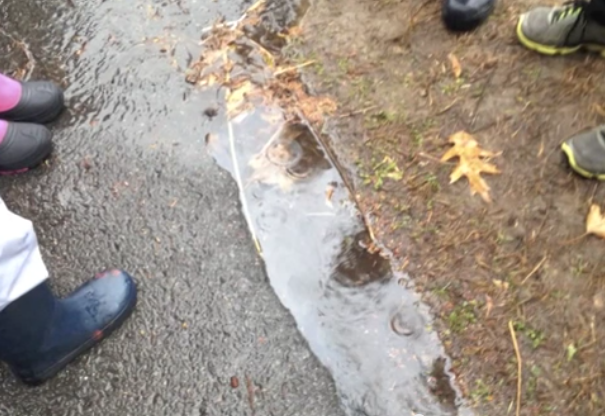
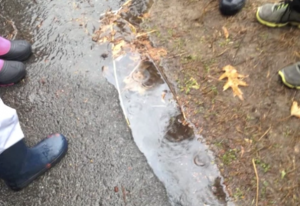
Renee Bachman, a third grade teacher at Leeds Elementary School, decided to take her students outside one rainy day and observe water. While sloshing through massive puddles and watching water pouring into storm drains, students determined that water went towards the “lower ground”. Renee also took her students outside after the downpour. As they were discussing evaporation, students wondered if oil went through the water cycle, and, if so, if it was converted into water. We look forward to hearing more student thoughts on the role of oil, a topic brought forward by both Renee’s and Kathie’s students.

As teachers begin classroom inquiries, our team is struck by the multiple points of entry for inspiring students’ imaginations and encouraging their questions about “where does water go?” Many teachers choose to use literature to incite creative questions about water and nature, while other openings involve experimentation and outdoor observation. We notice that teachers pay careful attention to questions about water that seem to catalyze students’ curiosity. For example, Kathie and Renee use video to document their students’ observation of oil slicks on the pavement and their questions about how oil behaves differently than water. We hope to track these student inquiries over the year to learn how their questions and ideas develop.

Our blog will update frequently, showcasing new aspects of water inquiries across schools and putting teachers in dialogue with each other. To engage in this learning community, we encourage you to offer commentary, share what’s going on in your water inquiries, pose questions, and let us know how we can be a resource for you and your students.

We’re eager to hear about how you investigate snow on the school grounds!

In the meantime, happy holidays from the water team.


 Ally, Carol and Hannah