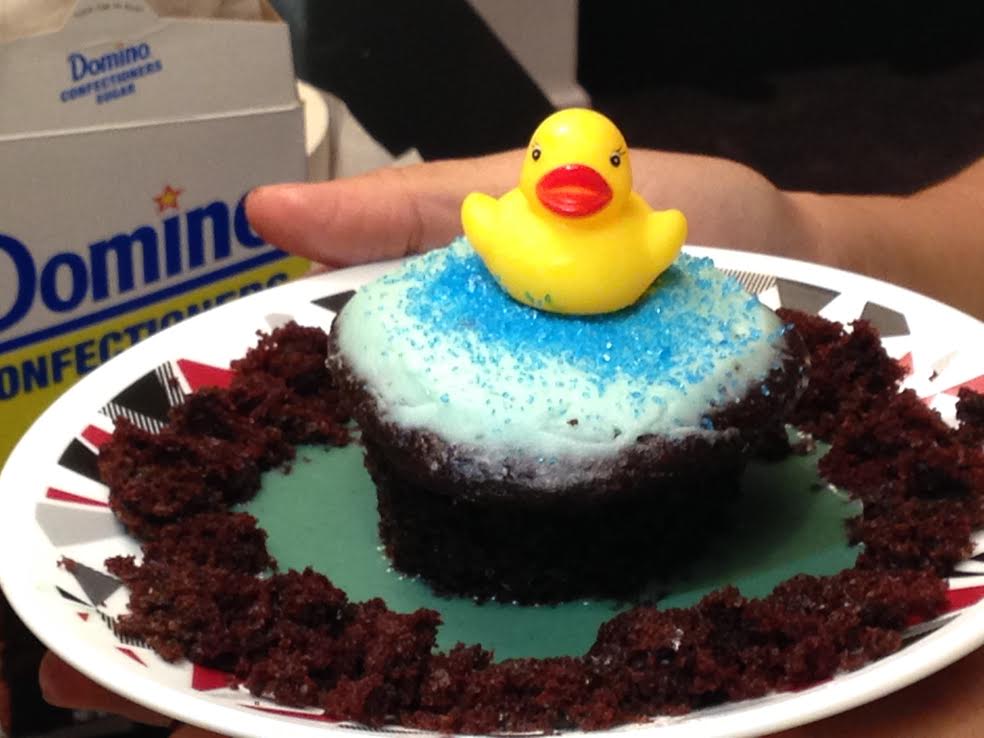
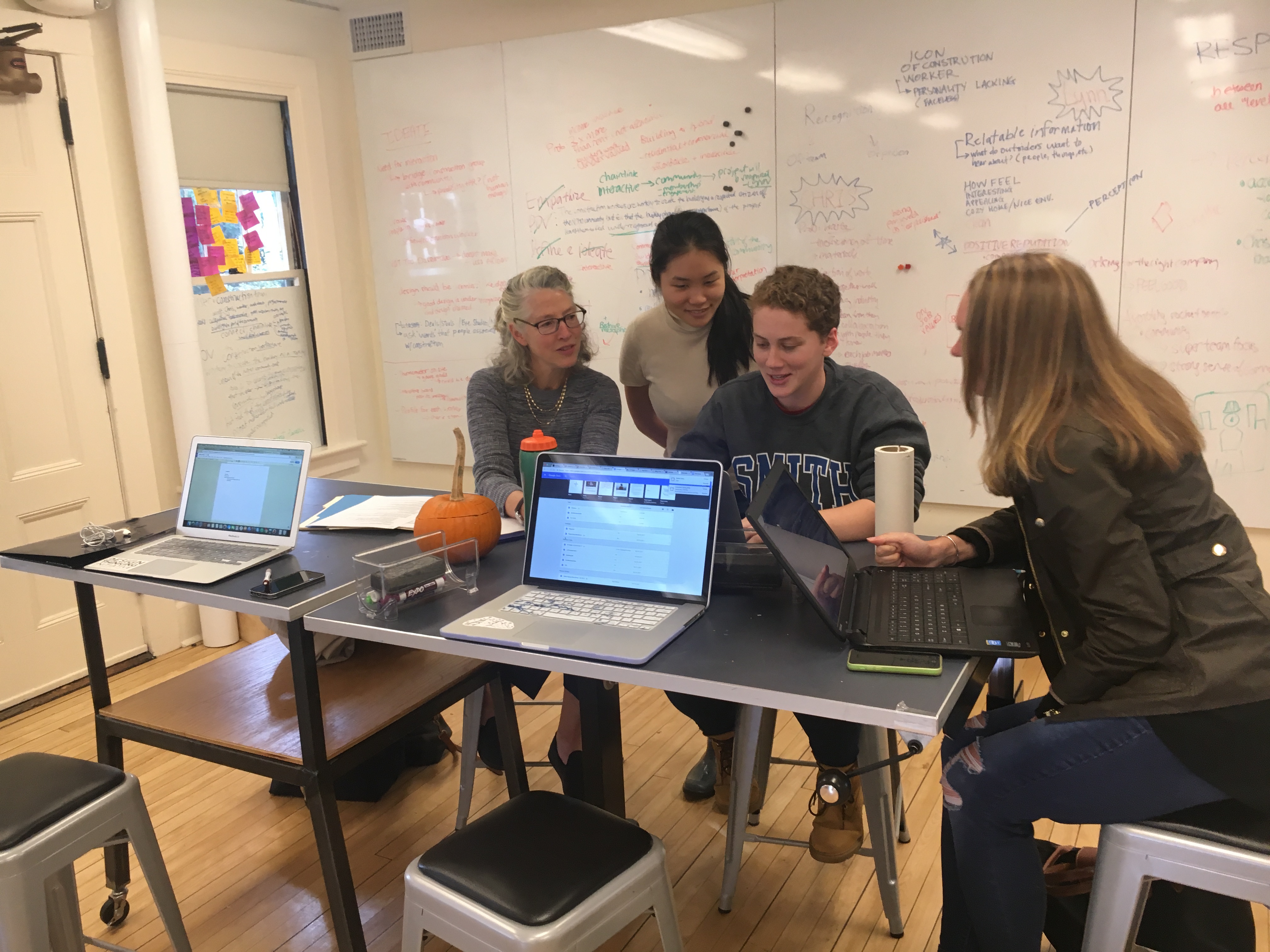
“Flood cupcakes” were enjoyed by Water Inquiry researchers at their recent meeting!
Welcome, Water Inquirers, to the end of another year!
As you grade your final papers, we hope you’ll lend an ear.
It’s been a productive fall in our “thinking lab” near Capen.
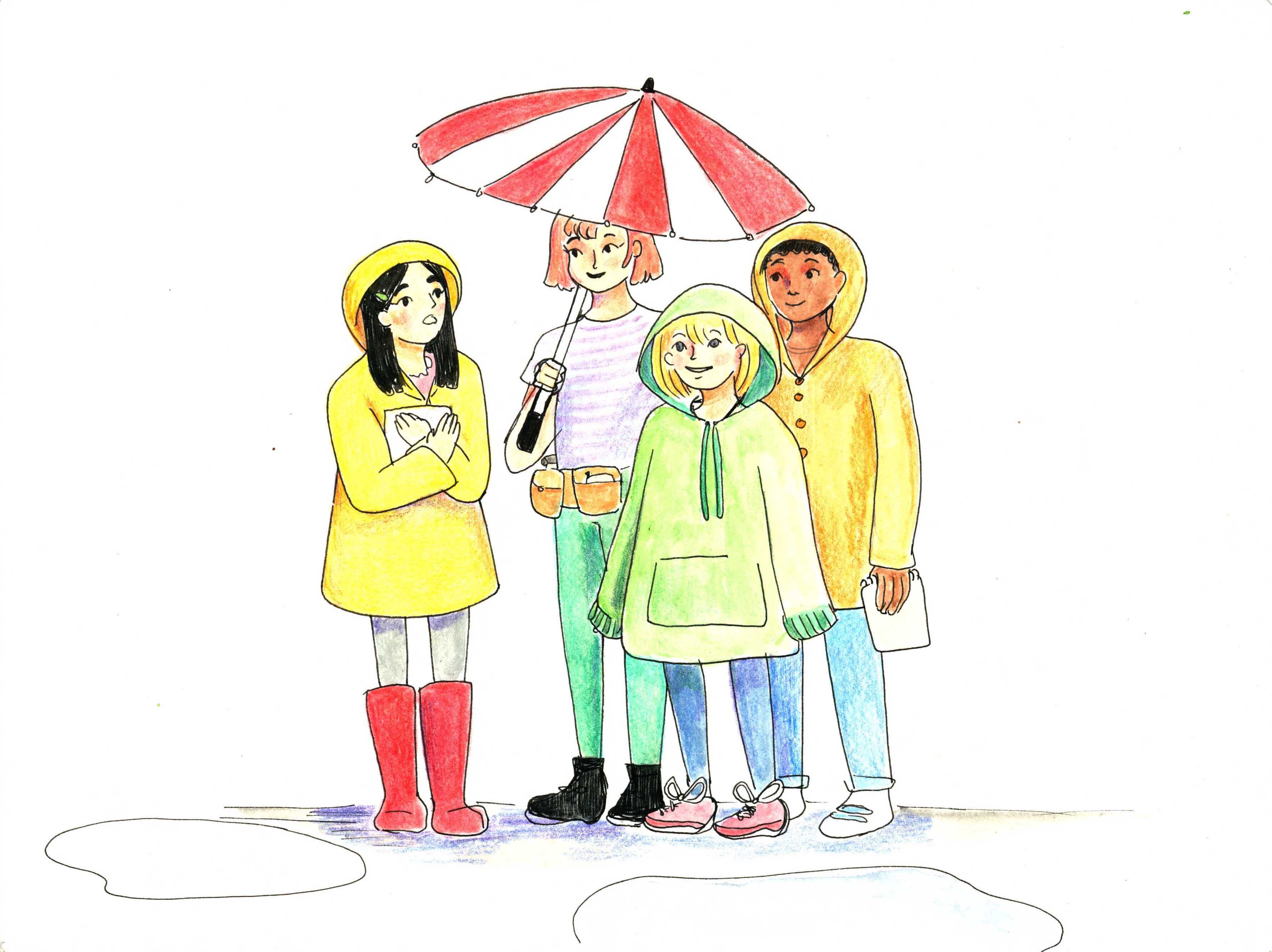
Inquiry, Inc. characters had lots of puddles to play in.
Carlos asked his questions; Lee had lots of fun.
But we can’t tell you why, for the story has just begun!
Back in late October, we presented you with a clue.
And though it was quite telling, its relevance we did eschew.
But now it’s time for another hint, as the first snow falls and vacation draws near.
If you play close attention, the theme of our upcoming story should ring clear:
On a cold winter’s eve, Water Inquiry did gather
In the apartment of Pinn, where blue frosting she did lather
Upon some “flood cupcakes,” with rubber duckies and all–
An edible depiction of the narrative we crafted this fall.
“What happens when there is too much water?” our characters ask with concern
As rain pools in important places, lending opportunities to think and to learn.
While our first tale chronicled ducklings as they traveled underground,
Our new tale presents a different problem about water that surrounds.
From drain to rain
And rain to drain
Our characters brought their knowledge.
But “What about water that doesn’t disappear?” is a question that stumped students in college.
So that is the plight that characters now explore
In an exciting new story that surely will not bore.
Your students will get to end the tale *
Before packing their work into a box and sending it through the mail.
We eagerly await their problem-solving,
Their questions and hypotheses ever-evolving.
Goodbye for now, and we will see you after the break,
Ready to share our story about a field that turns into a lake!
‘Till next time,
The Water Inquiry Team
*stay tuned for details about the “Unfinished Story Box” writing challenge that will invite your students to create and share original endings for the next Inquiry, Inc. water investigation.
Written by Brittany Collins on behalf of Water Inquiry
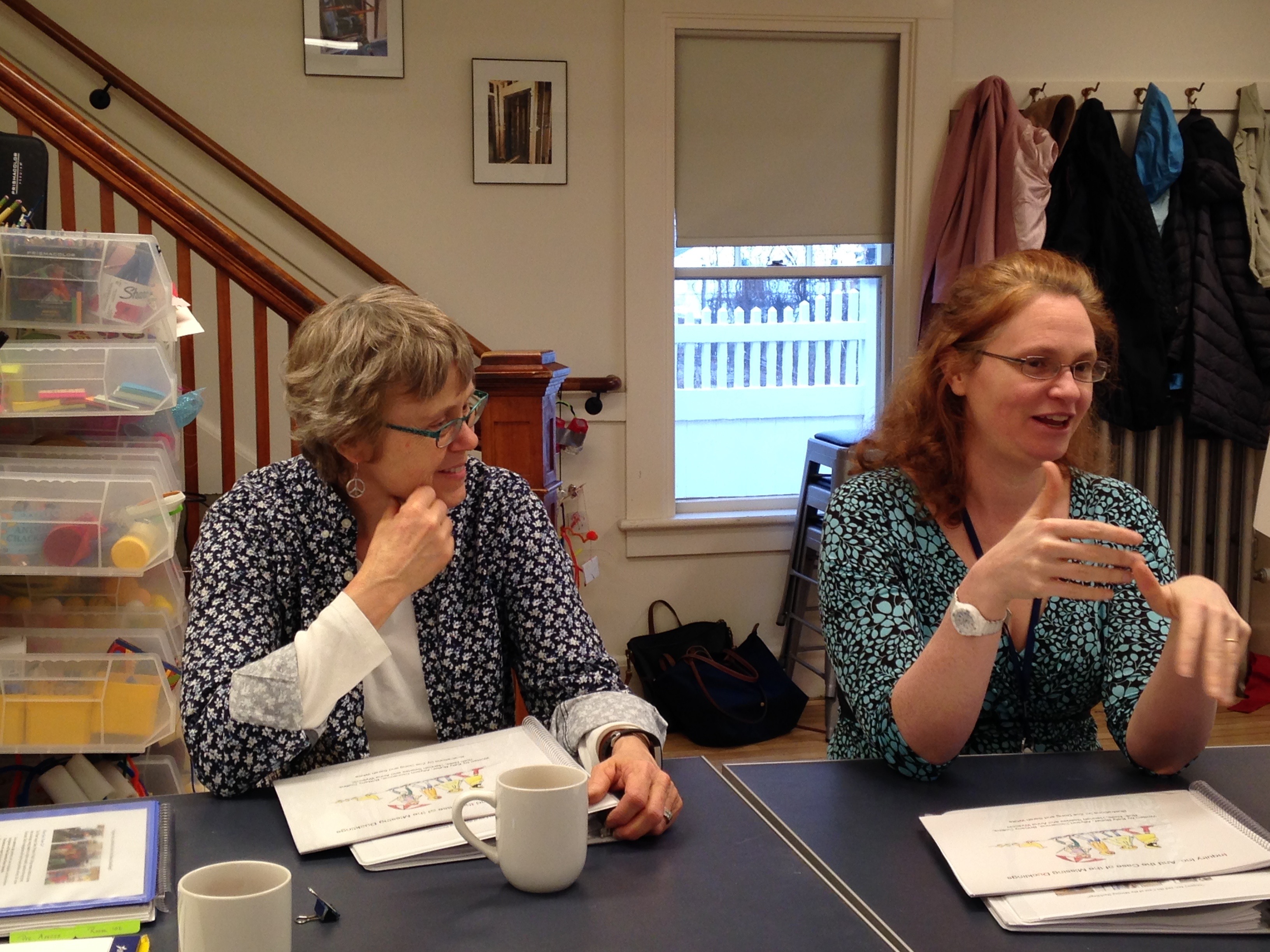
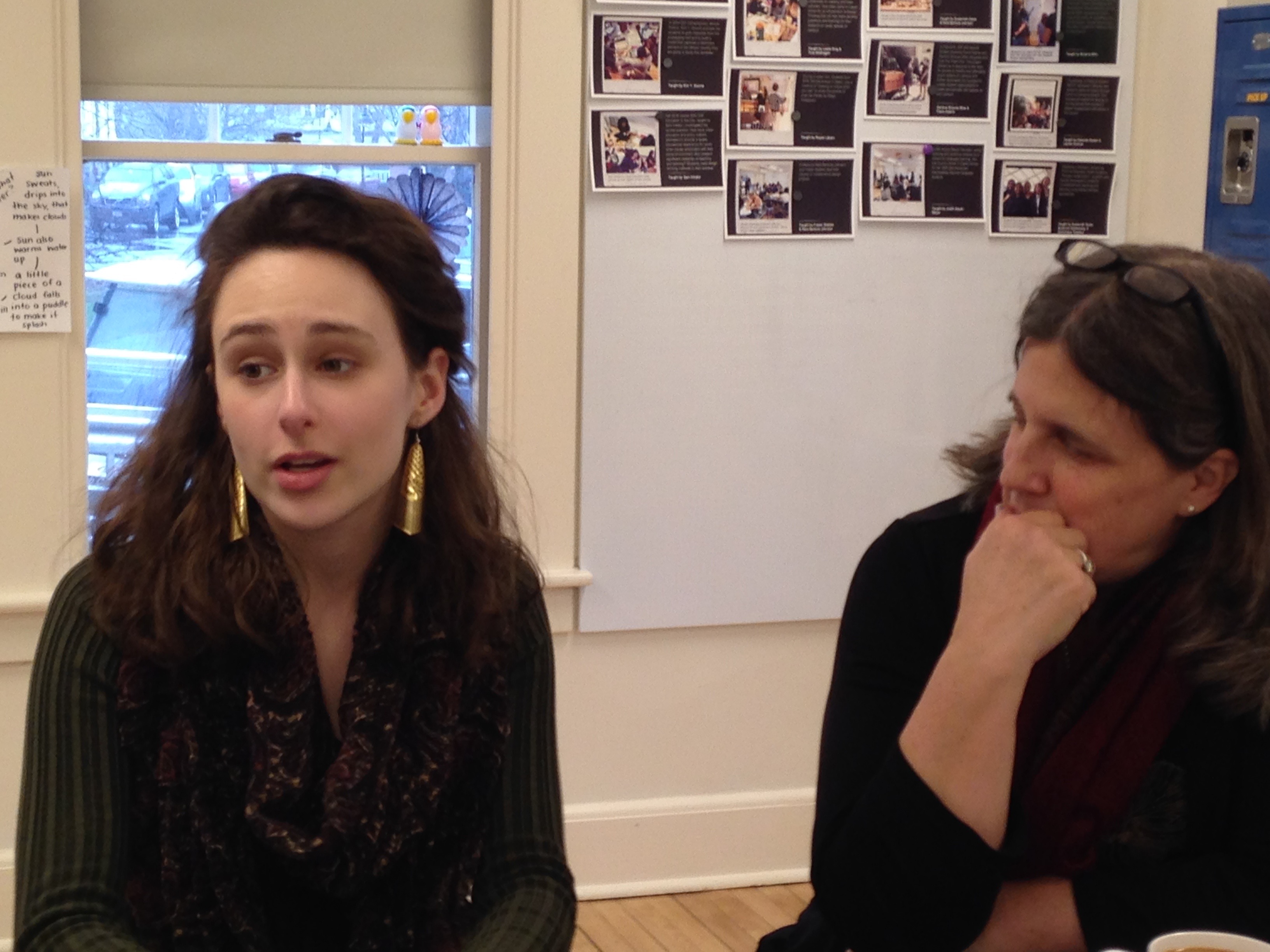
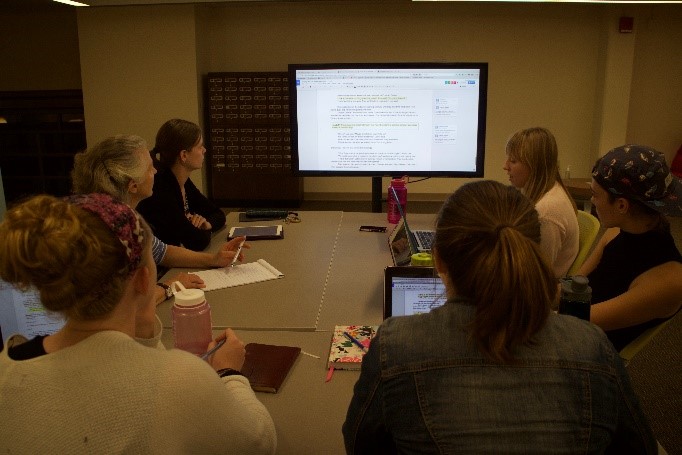
As we gathered in late September to commence our first meeting of the 2017-18 Water Inquiry Story Project, much excitement was felt among old and new members alike. New members were eager to join a story-creating research group, and veteran members were enthusiastic to start anew, having had such success with last year’s Inquiry, Inc. pilot story. With the new school year came our new working space, the Capen Annex Design Thinking Lab.
One of our main tasks was to decide our next course of action: write a new story, create a new format, do more research, widen our perimeters, etc. After a couple of weeks spent thinking, reflecting, and discussing, some of our amazing team members discovered and brainstormed a fabulous new vision: Inquiry, Inc. will appear in a story that your very own students can finish!
Inspired by the YA Unfinished Storybook Project, our next Inquiry, Inc. story will be formatted in an innovative and exciting way. Participating classrooms will receive an unfinished story featuring the familiar characters of Inquiry, Inc., along with a decorated “secret mission” story box in which to submit their original endings. In a letter to students, Inquiry, Inc. will ask for help with their newest problem. They NEED their friends’ — your students’ — expertise and fresh ideas. We will introduce the drama of a compelling local water problem; model the first steps of inquiry; then hand the problem-solving off to students, asking them to finish our story in a way that helps Inquiry Inc. “save the day”, as shouted in their jingle.
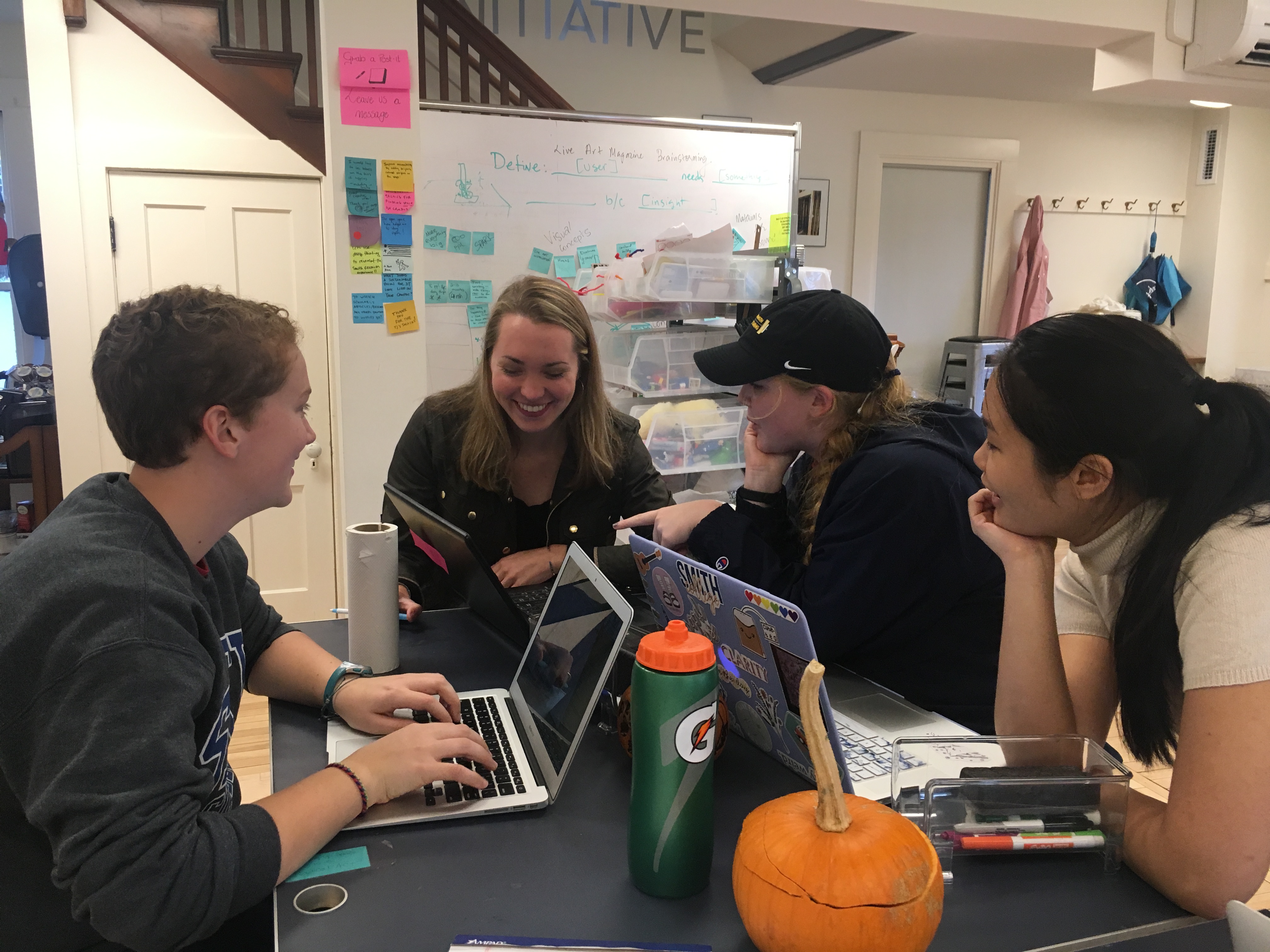
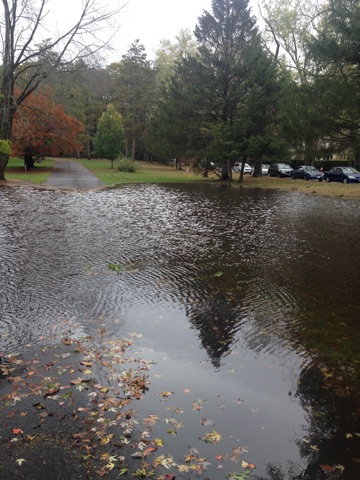
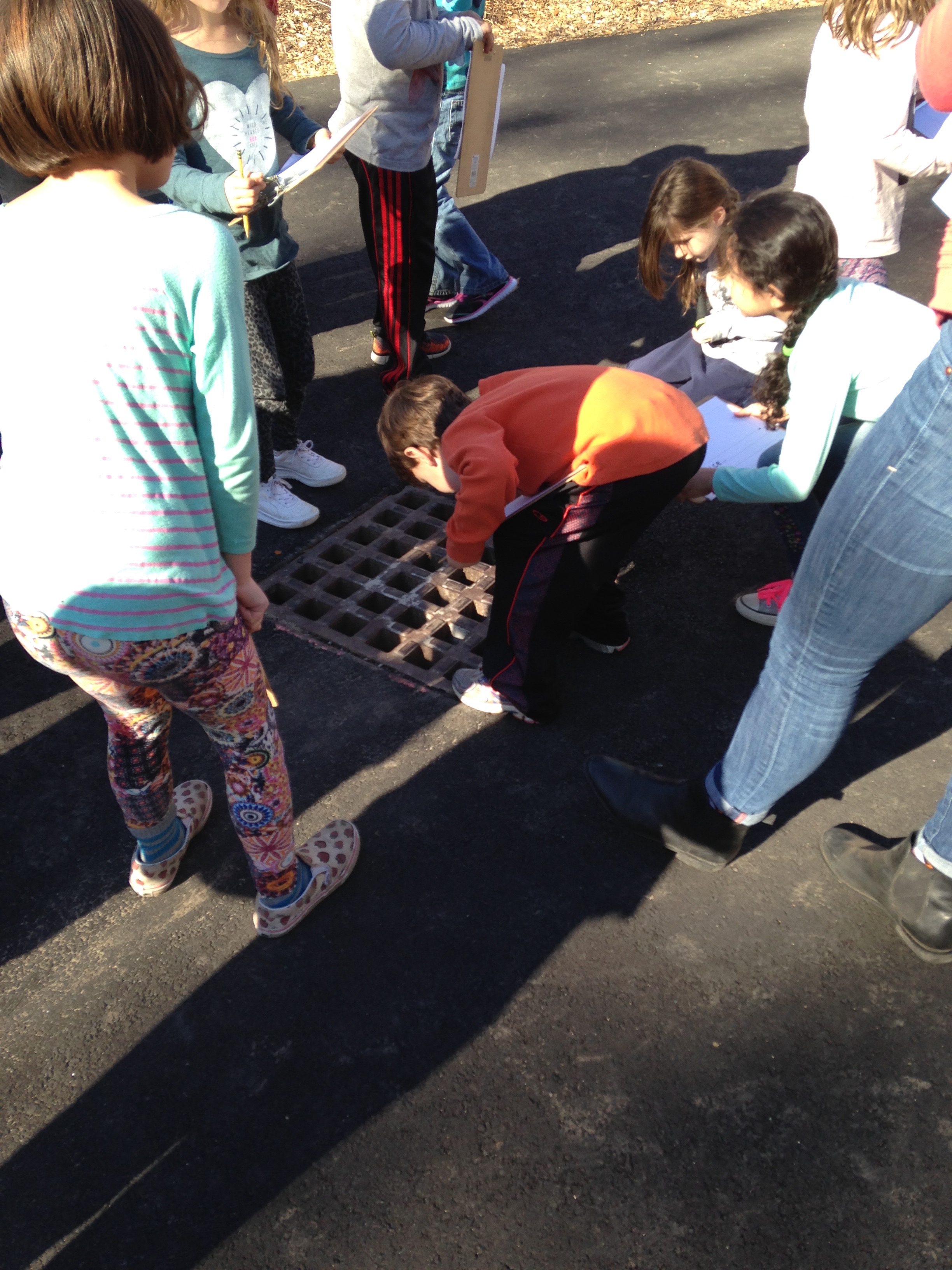
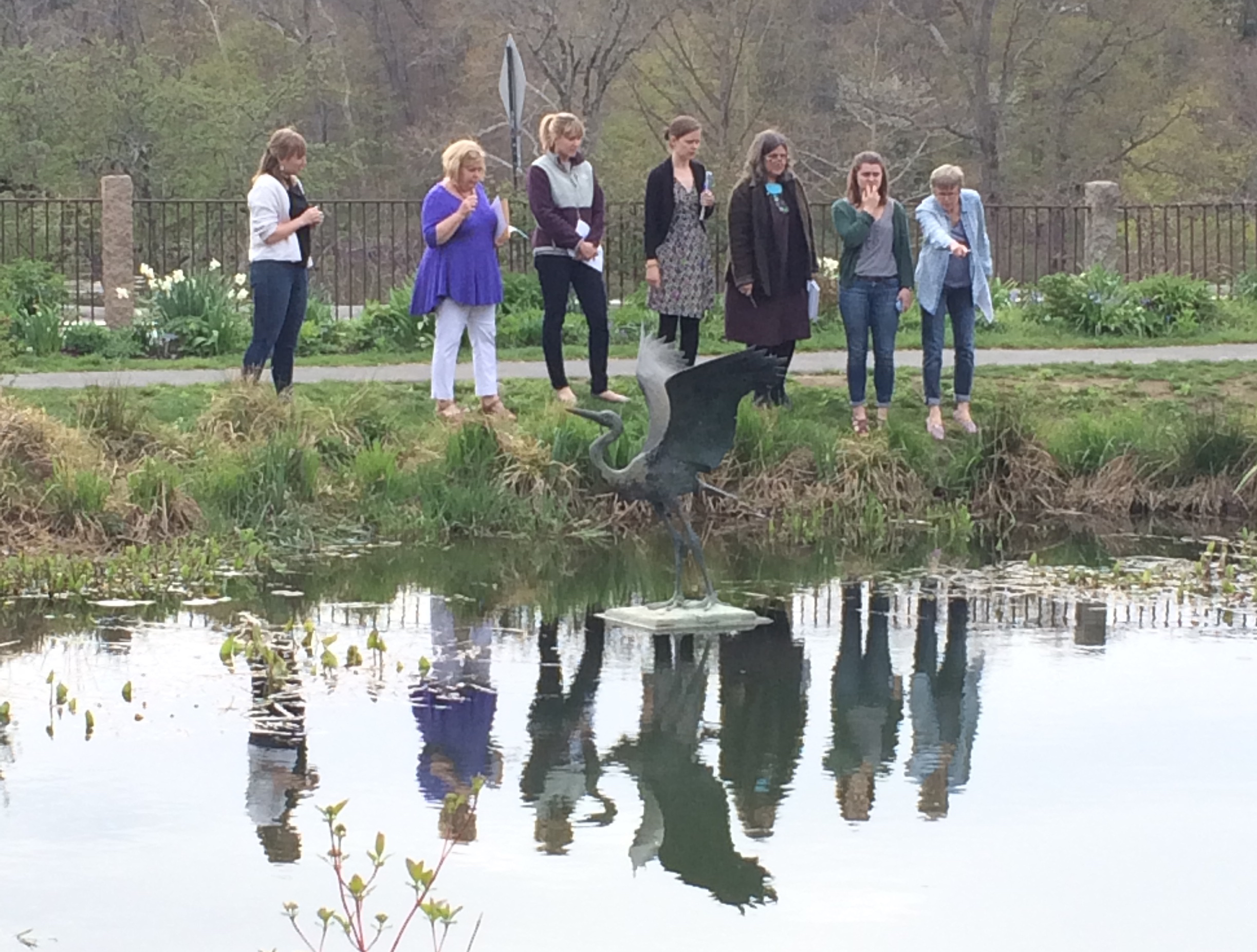
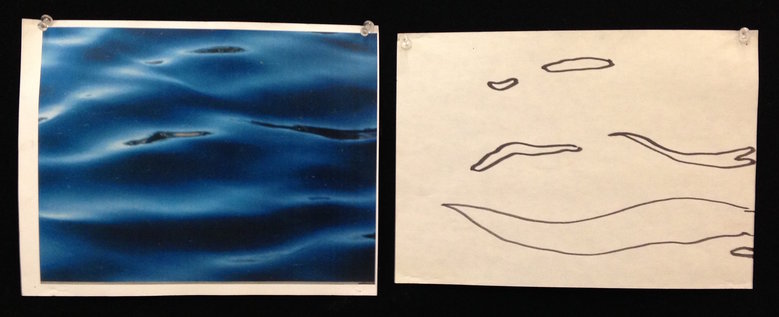
This new format rings true with the purpose of our Water Inquiry Project: learning through inquiry and interacting with the local environment. We would love to provide you with more information, but that would defeat the purpose of this Top Secret Mission, wouldn’t it? We can give you a little clue as to what we were talking about in our meeting pictured above, though; we were busy deciding what problem Inquiry, Inc. would solve next… and the hint is that we saw a lot of it while walking in a nearby park:
OK, enough secrets given away for one day! Stay tuned for updates and releases.
Thank you for keeping up with our project, we really appreciate your support and can’t wait to have Inquiry Inc. arrive in your classrooms! If you’re interested in participating in this project or would like to find out more, please e-mail Carol Berner or post a comment or question.
In the meantime, it is my pleasure to introduce the members of the 2017-18 Water Inquiry team:
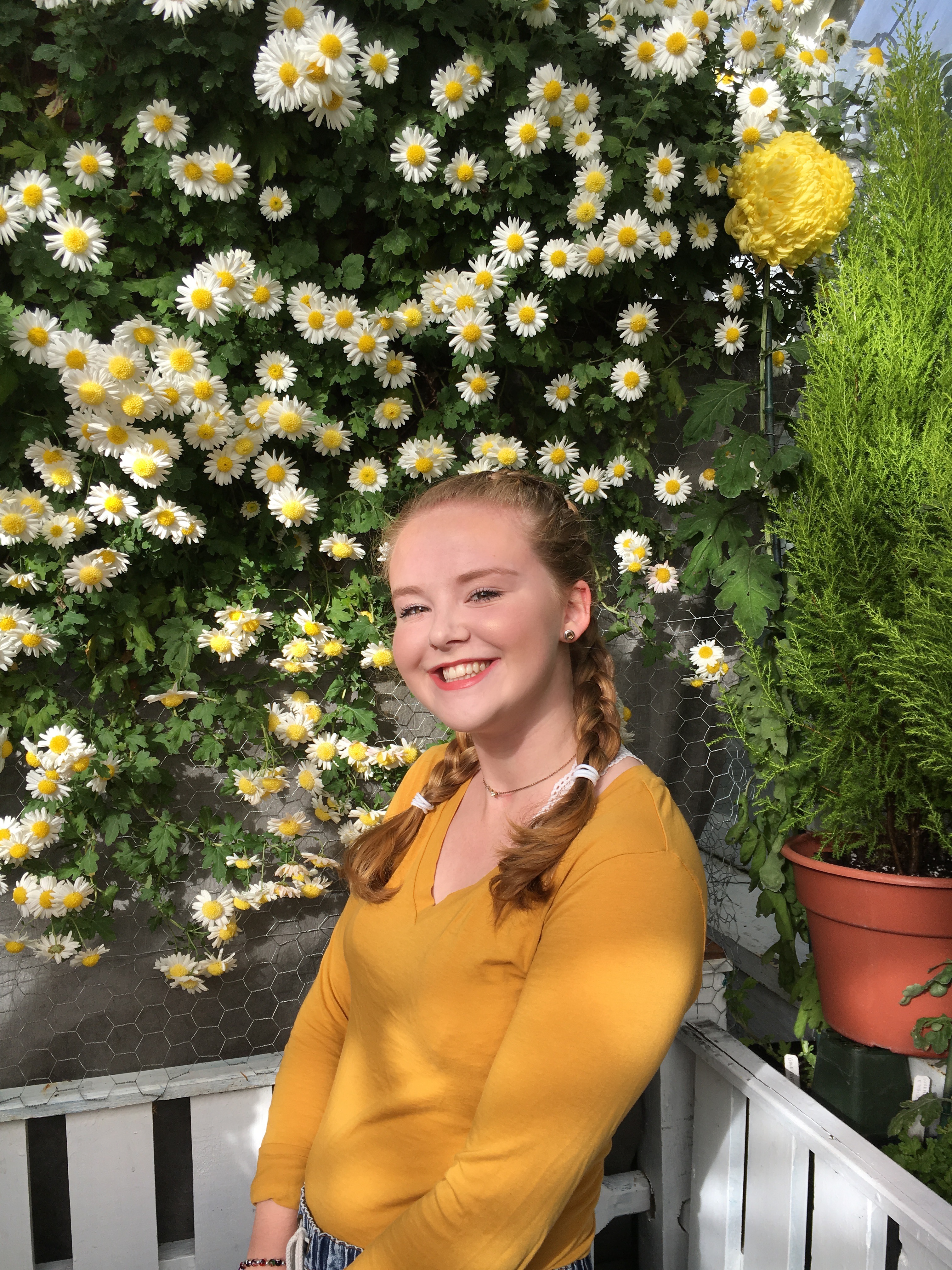
Brittany Collins joined the Water Inquiry Project in 2016. She is interested in narrative learning, story-form thinking, and the integration of story in STEM curricula. Brittany attended the Smith College Campus School and has enjoyed returning as a classroom aide, dance teacher, and (now) a marketing and writing intern, as well as water researcher. A native of the Pioneer Valley, Brittany grew up exploring the outdoors– hiking, fishing, swimming, ice skating. She brings to Water Inquiry a desire to foster in students a love of the “inner” world of books and the “outer” world of their communities and environments, worlds that she views as reciprocal and connected.
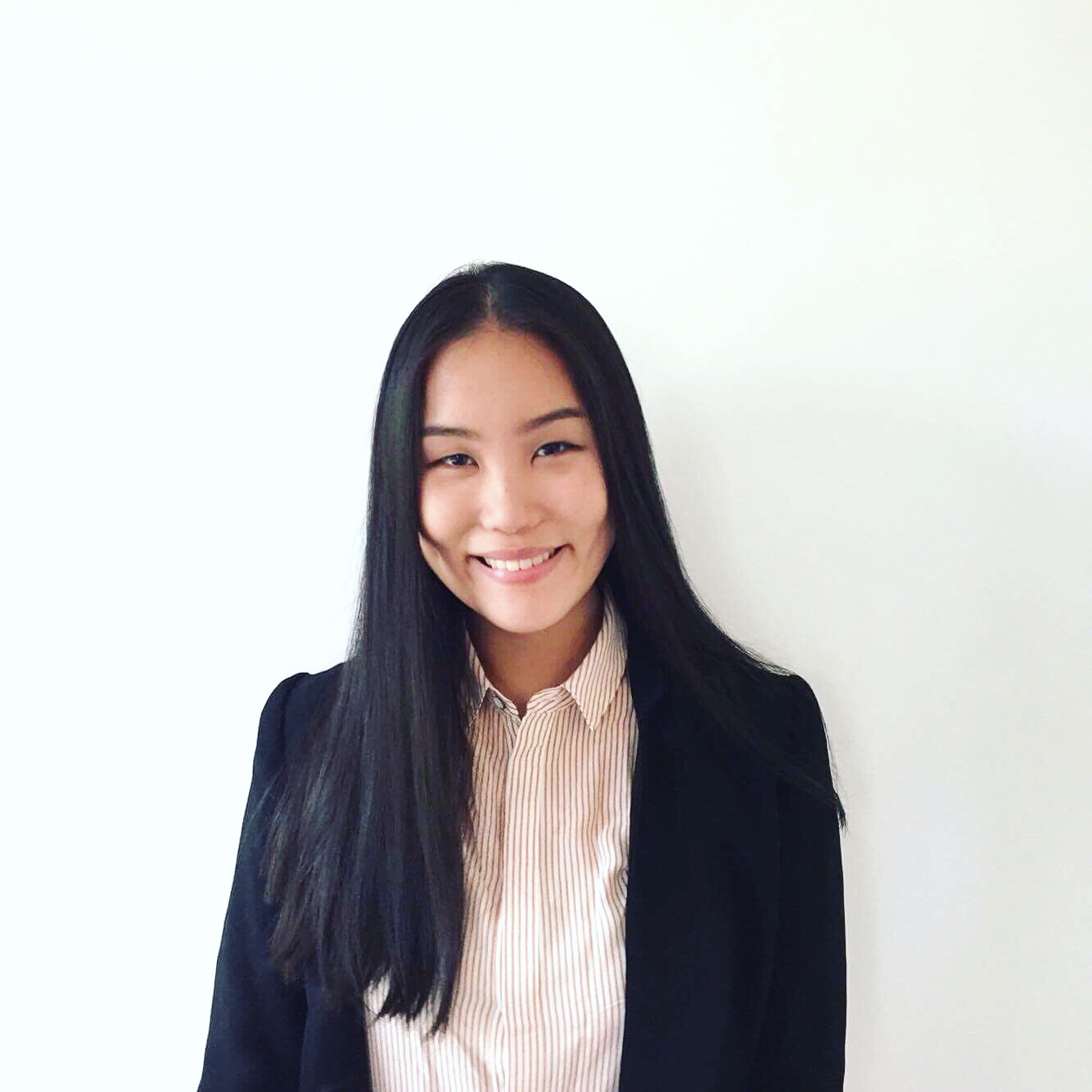
Pinn Janvatanavit is a senior at Smith College from Bangkok, Thailand. She is majoring in education and minoring in studio art. Pinn loves to bake, sing and dance in her free time. This is her first year joining the Water Inquiry Project and she is mostly looking forward to helping out with the illustration and story planning processes.
Meghan Johnson is a junior Environmental Science & Policy and Education & Child Study double major at Smith College. In environmental science, Meghan focuses on marine ecology and is fascinated by issues such as clean water and rising seas. In addition to studying all about the oceans, Meghan enjoys spending time backpacking, swimming, scouting, and appreciating nature. Since the spring of 2017, Meghan has enjoyed working on the Water Inquiry project to educate children about the inquiry process and environmental issues happening all around them. Meghan is excited to see the Water Inquiry project grow!
Ruth Neils is an Education and Environmental Science double major and a current Junior at Smith College. Originally from Grand Rapids, Michigan, Ruth grew up surrounded by the Great Lakes, spending much of her childhood exploring the water and nature around her. Ruth enjoys being outdoors hiking, swimming, and traveling, all of which she has had the privilege of doing during her time abroad in New Zealand for the fall semester of 2017. The Water Inquiry Project perfectly combines Ruth’s interests in the environment and education fostering scientific investigation and discovery through engagement with the natural world. Ruth has enjoyed being part of the evolution and growth of the Water Inquiry Project over the past two years and is excited to continue working on the project to see the new directions it will take in the future.
Hannah Searles is a senior education and psychology double major who has been working on the water project in one form or the other since her first year. She is interested in elementary education and learning about creative ways to incorporate story and science in the classroom. In her spare time, she spends extra time in the water on the diving team at Smith.
An Easthampton, MA native, Lily Sun studies Psychology at Trinity College. With her interests in Psychology, she has had research experience in the field. She enjoys working with kids and is excited to join the Smith community as a Water inquiry researcher. In her free time, she enjoys dancing, playing her violin, knitting, and reading.
Anna Wysocki is a sophomore who is currently undeclared, but plans on declaring a major in Government and is still pursuing numerous fields she wishes to minor in, from Public Policy to Environmental Science and Policy. Growing up in upstate New York, in a town called Hoosick Falls, Anna has an interesting experience with water that drove her initial interests in this project. Her town’s water supply was discovered to have been poisoned by a pollutant called PFOA just a couple years ago, which is known to be linked with serious health consequences. She joined the Water Inquiry Project in 2016 hoping to reveal water in its many forms and promote water safety and knowledge through the story-writing process. She loved her last year working on the project and is excited to introduce the project in a new light this year. Anna is also a member of the lacrosse team at Smith, a Head of New Students in her house, and is a Gold Key tour guide.
And last but not least, our fearless faculty leader Carol Berner!
Written by Anna Wysocki on behalf of the Water Inquiry team.
Over the next two weeks, several local water-related events may spark your curiosity: whether you’re interested in how water gets clean; how public artwork impacts water policy; or how you and your class might participate in a river clean-up. Water seems a crucial topic given the devastation caused by recent hurricanes; supplementing conversations about extreme weather with opportunities to learn about local water allows students and educators to learn more about this natural resource, whose everyday intricacies are equally astounding as its sheer power in the midst of a storm.
What discourses and projects are you and your students tackling? What are your students’ curiosities, concerns, and questions? As the Water Inquiry team gets back to work this fall, please keep us posted on your interests so that we can stay current, too.
Documentary: HERE’S TO FLINT
September 13, 2017 Forbes Library, 20 West St, Northampton 6:30 pm to 8:30 pm “Here’s to Flint,” a documentary by the ACLU Michigan, examines what led up to the poisoning of the largely African American city, and, on a larger scale, how lack of funding in infrastructure poses risks to the entire country. Speakers to kick off the post-film discussion include: Mary Ann Babinski, Westfield City Councilor, who will talk about water safety problems closer to home with activists from Westfield Residents Advocating for Themselves (WRAFT); and David Ahlfeld, Prof. of Civil and Environmental Engineering at UMass Amherst. A link to the Facebook event page: More…
Connecticut River Conservancy invites you to three events that address the question, “How do our rivers stay clean and healthy?” Science and engineering practices, community art, and an annual river clean-up afford insight into the multidisciplinary approaches community members use when tackling this unifying problem.
Springfield Wastewater Treatment Tour, Agawam, MA Thursday, September 14
5:45 – 7:45pm What happens to water when it goes down the drain? How does it get cleaned? We’ll join SUEZ Water Environmental Services, Inc. and Springfield Water and Sewer Commission for an informative tour of the Springfield Regional Wastewater Treatment Facility and learn about the process of cleaning wastewater for public health. RSVP REQUIRED
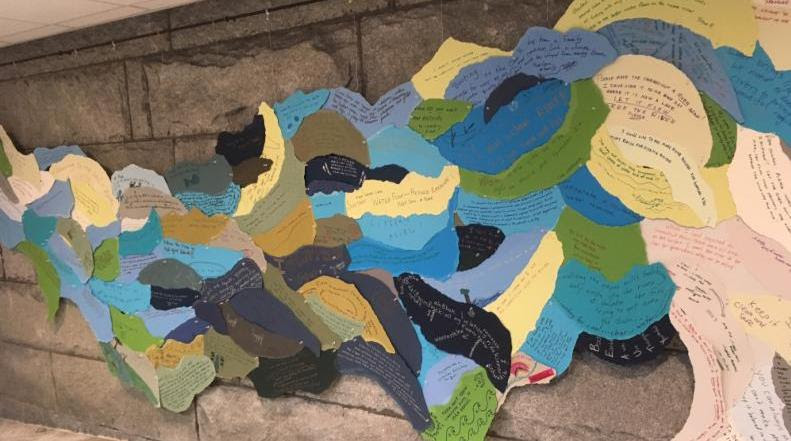
The Power of Water / The Power of Words Reception Saturday, September 16, 1 – 3pm Great Falls Discovery Center 2 Avenue ATurners Falls, MA Join us for a celebratory reception of the powerful, collective art installation of The Power of Water / The Power of Words at the Great Falls Discovery Center. This beautiful art sculpture serves a powerful public policy purpose.
Source to Sea Cleanup Friday & Saturday, September 22 & 23 VT, NH, MA & CT This annual trash cleanup allows us to connect with our community members and rivers– in 4 states! Learn more or sign up at www.ctriver.org/cleanup.
Welcome to a new school year! Students are trickling onto the Smith campus, and we are excited to resume our Water Inquiry meetings in September. Inquiry Inc. characters spent the summer relaxing after their hard work saving ducklings in our first interactive storybook and are ready for their next adventure; this fall, they will set to work solving a brand-new water problem, and we can’t wait to share their happenings with you!
The summer months allowed us to give the Water Inquiry website some “TLC.” We hope that you will investigate our updated resources, including:
Our “About” page featuring teachers’ and children’s insights about “Why Water?” and how we work to improve ideas.
An “Interactive Stories” page comprising a slideshow of local classrooms piloting our interactive story (see below); followed by downloadable PDF’s of Inquiry Inc. and the Case of the Missing Ducklings illustrated storyand Educator Toolkit; a link to Pedro’s Coral Reef Adventures, a water conservation tale created by children in Belize working with Smith college students this summer; and a review of literature that informs our storytelling work. **Keep an eye on this page! We hope to offer a flippable, digital version of Inquiry Inc and the Case of the Missing Ducklings for projection in your classrooms!**
A “Schoolyard Investigations” page with downloadable PDFs of our learning adventures, as well as teacher resources for teaching and learning about water in the classroom (mapping, thinking strategies, water vocabulary, etc.)
As always, the Water Inquiry team invites all forms of collaboration; please contact Carol Berner at cberner@smith.edu to let us know what additional resources you would like to see on this platform, to join our Water Inquiry efforts, or to pilot our story and unit in your classroom.
We are heartened by the energy of teachers, students, and community members engaged in Water Inquiry and are excited by all that the coming year will bring. Best wishes to you all as you welcome new students into your classrooms– may you enjoy a year of growth and inquiry.
Sincerely, Brittany Collins on behalf of the Water Inquiry team
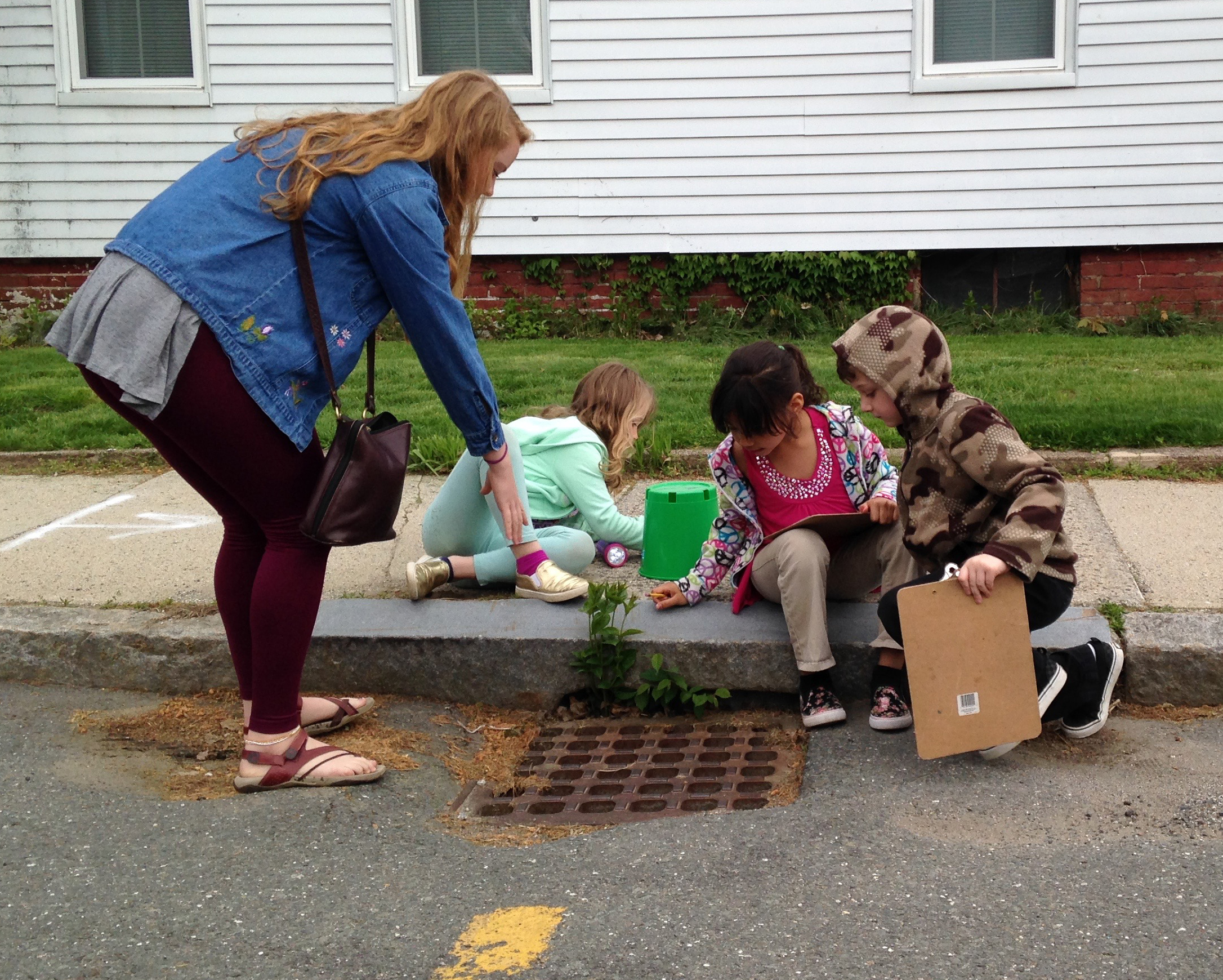
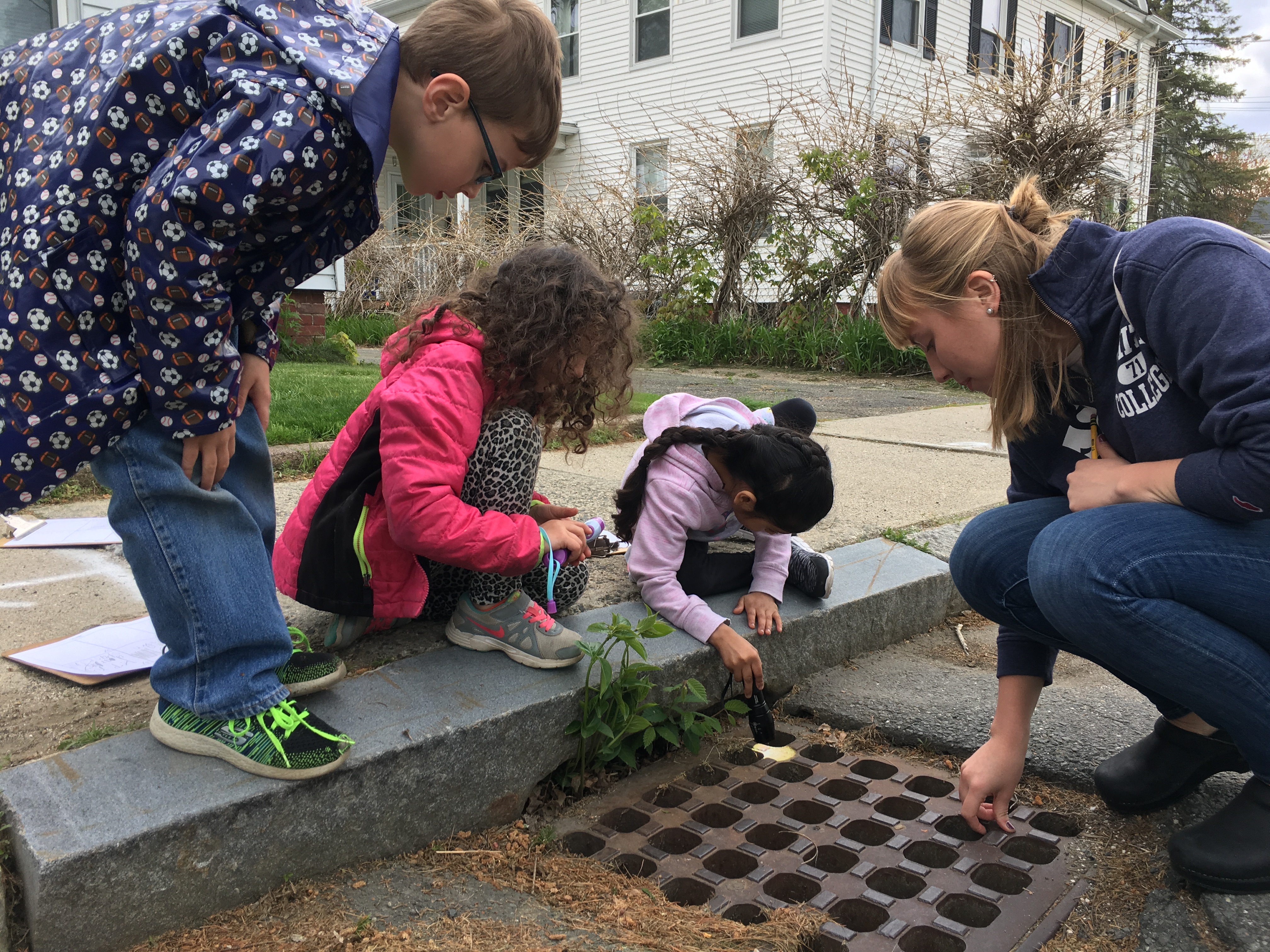
Water Inquiry Researcher Anna Wysocki ‘21 explores storm drains with first graders.
First grade students in the classrooms of Margaret Betts and Martha Morgan considered this question during a recent pilot of Inquiry Inc. and the Case of the Missing Ducklings at Maple Street School in Easthampton, MA. “Talking about something and seeing what you can do,” one student offered, while others noticed the words “inquire, wonder, investigate” written on a group chart in their classroom. “Can water run out? Is all water the same? Where does water come from? Where does water go?” These guiding questions encouraged students to view an integral resource in new and exciting ways. As they walked around their block to scout for storm drains, first graders were riveted by the facts and mysteries of the everyday wonder that is water, revealing anew the powers of place-based and narrative learning.
These inquisitive scientists were the first in their town to interact with Inquiry Inc. and the Case of the Missing Ducklings story and unit materials, but they will not be the last; we are excited to announce that our unit was officially adopted into the Easthampton public school first-grade science curriculum! In celebration of this achievement, and with reverence for the organic discoveries of collaborative inquiry, we have created a compilation of reflections from members involved in piloting our story.
Water Inquiry Researcher Anna Wysocki ’20 connects the day to her personal experiences with water systems:
“We arrived at Maple Hill Elementary with open minds and eyes and were able to leave with full hearts. The children we worked with were so insightful and full of inquiry, and truly made this adventure so special.
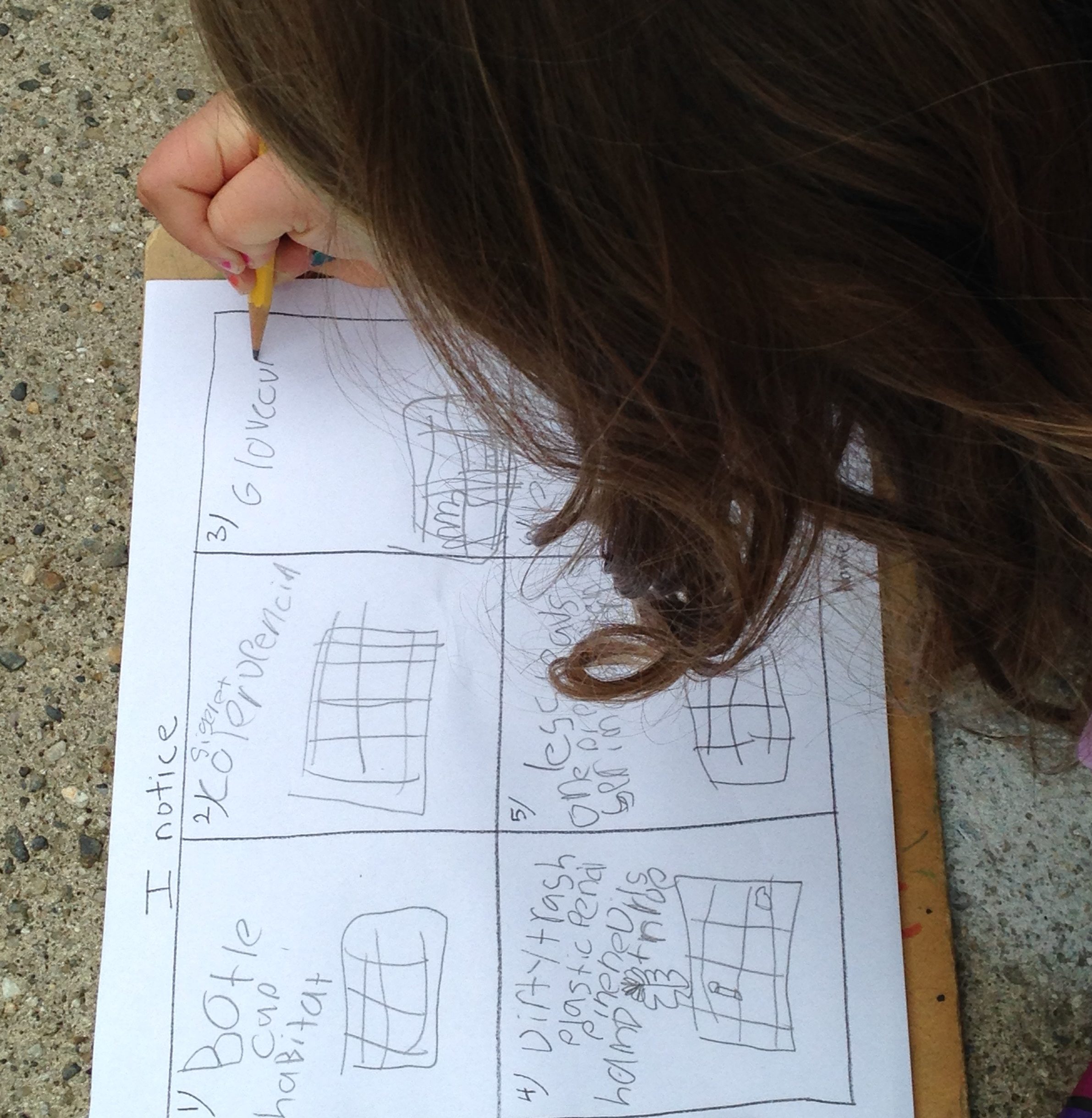
First grader making storm drain observations.
After briefing on the plan for the day with our wonderful host teachers, the students were split into groups of 3 or 4 so that they each had a chance to engage and discuss their observations. Then, we made our way outside with clipboards and pencils and flashlights to see what we could find out about how storm drains work. There were six stations of storm drains to observe, and at each there was something new to ask, to say, and to laugh about for the kids. Funnily enough, in the very beginning, as I was handing a pencil out to a student, it fell down the drain and floated in the water, just as takes place in the story.
“Look! There’s a mushroom!”
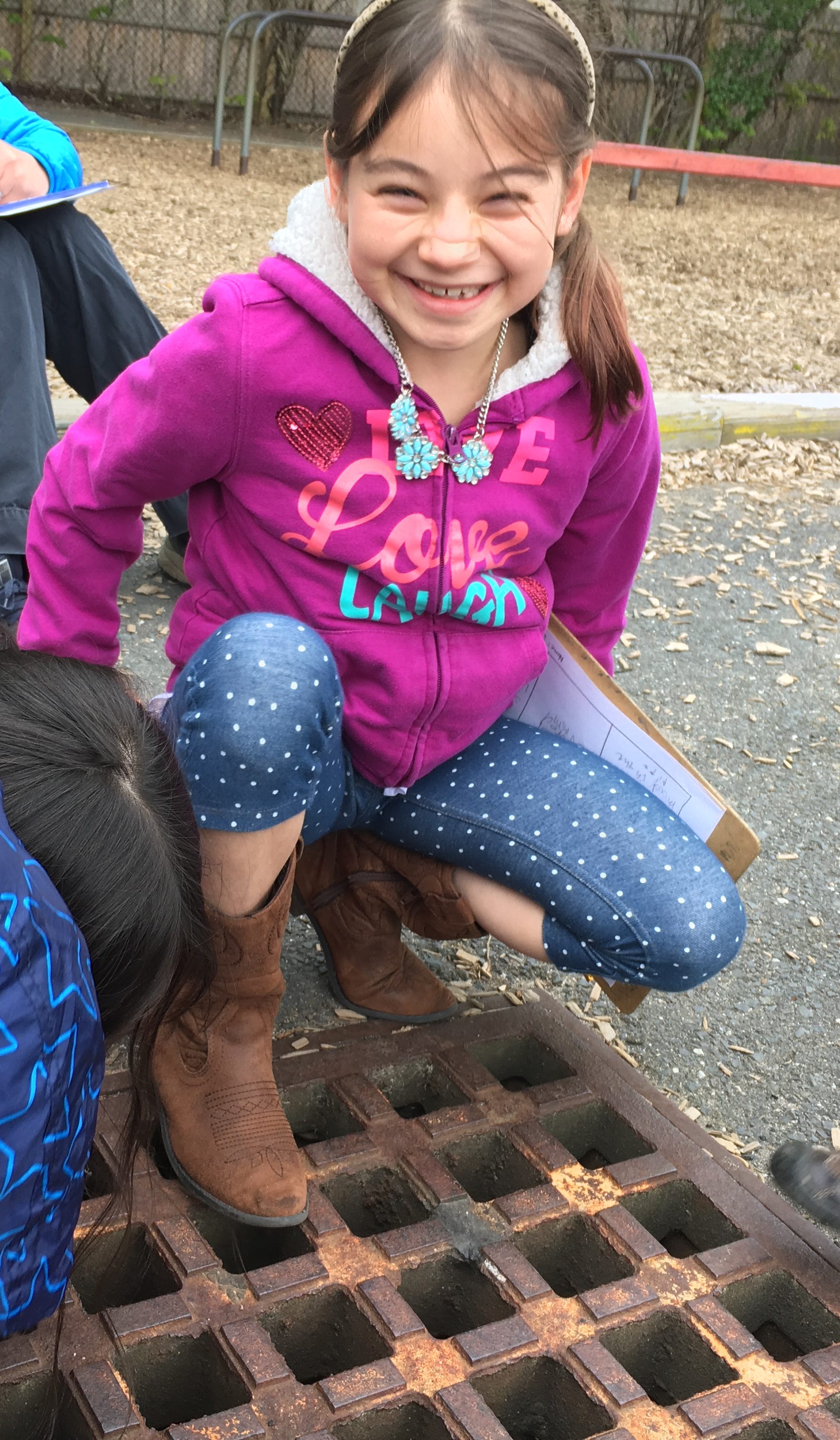
There were two moments that really stuck with me from the day. First was in the second group, when the four students were observing the storm drain located in their school playground and found a mushroom growing at the bottom of it. They found this to be hilarious and began making songs about the mushroom in the drain, singing for the rest of the time we were there.
Secondly, was once we were back inside and the teacher began reading the book. They approached a section of the story where the Inquiry Inc. “jingle” was to be said, and the whole class full of kids knew it and screamed it. It was amazing to look back to when we were writing those very lines and then now see them being memorized and cheered by people reading the book. It was really an amazing day. The children we worked with came up with so many brilliant questions and observations. It was a day that was truly benevolent to our research and to brightening our spirits.
For me, the water inquiry project was more than writing stories for children to be entertained by. Having grown up in Hoosick Falls, NY, where recently it was discovered that our very own drinking water supply is polluted by a toxic chemical called PFOA, this story was a chance to inform and make a positive difference on the way that people look at water and all that goes with it. This is just the beginning of our journey to informing kids about water safety, and this adventure is making the future look bright!”
Ruth Neils ’19 examines storm drain with students.
Pilot teacher Margaret Betts discusses her launch of Inquiry Inc. and the Case of the Missing Ducklings:
“The children were so excited to investigate the drains. They immediately took a personal interest in what would be in a drain and what might be good for the drain and bad for the drain. The activity really engaged active looking and wondering. When we returned to the classroom to reflect on our field trip everyone had something to say about what they noticed and wondered. It was a perfect way to engage children into the larger inquiry.”
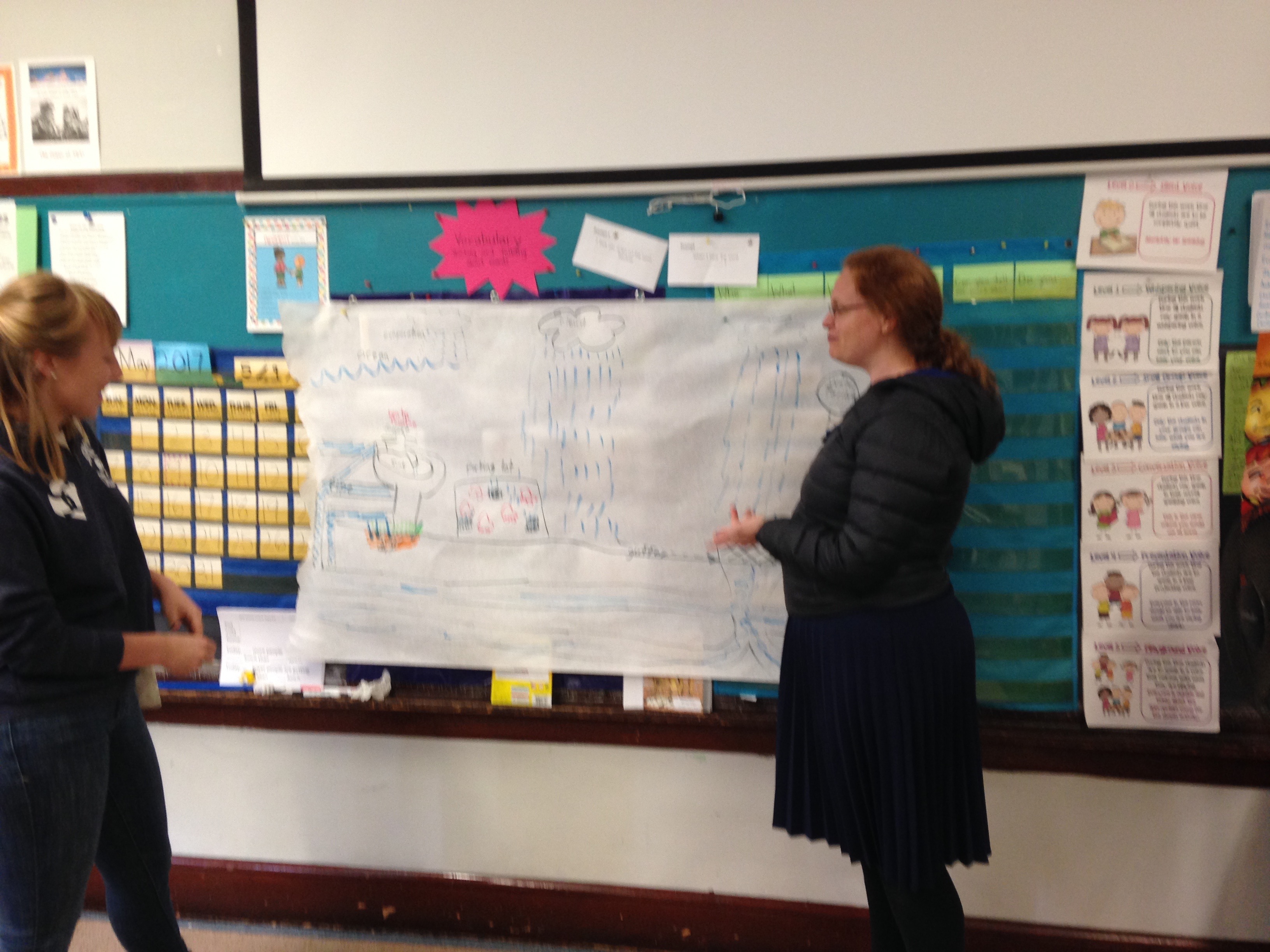
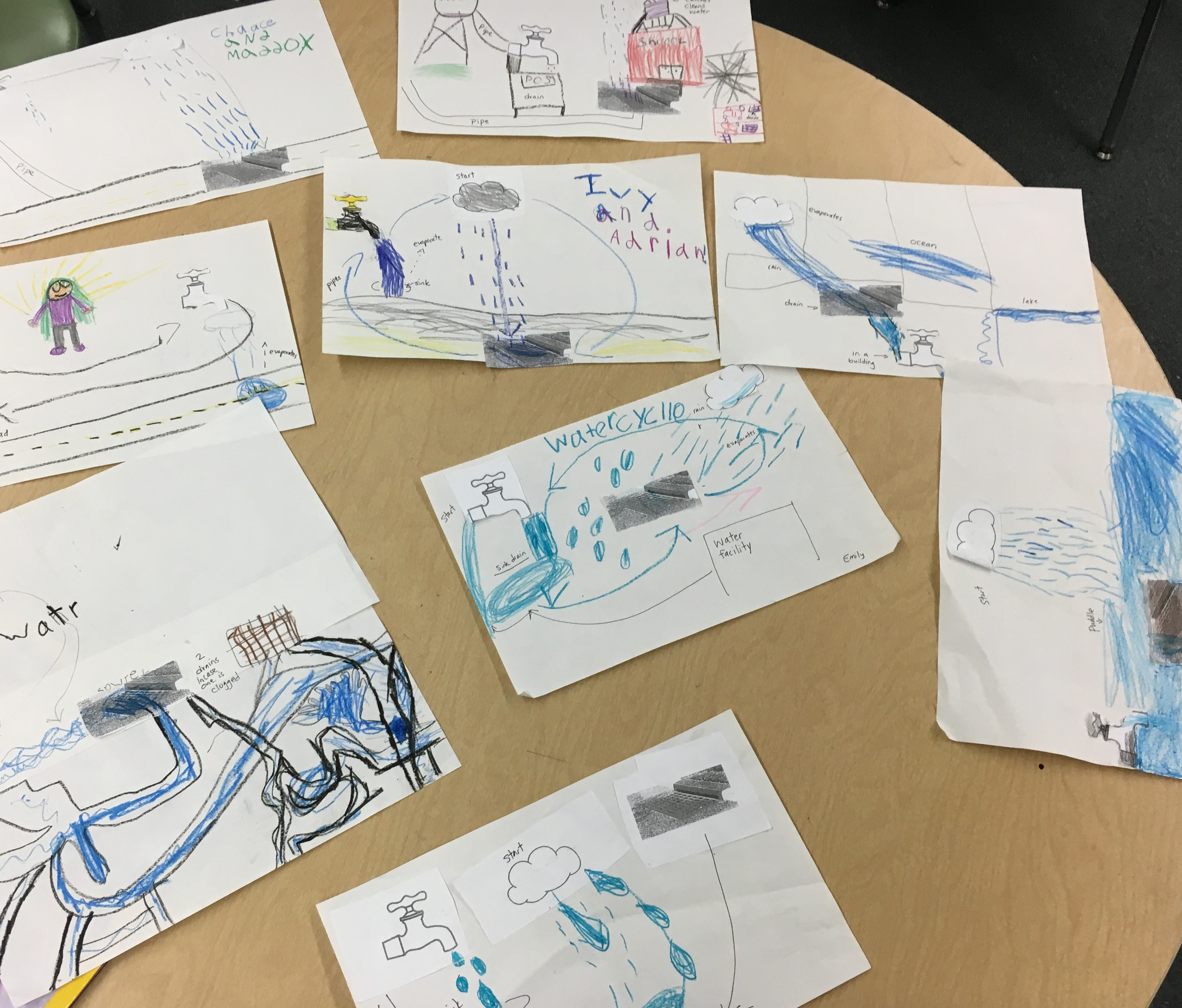
Margaret Betts (right) shows Ruth Neils ‘19 (left) student diagrams tracing the journey of water from cloud to faucet.
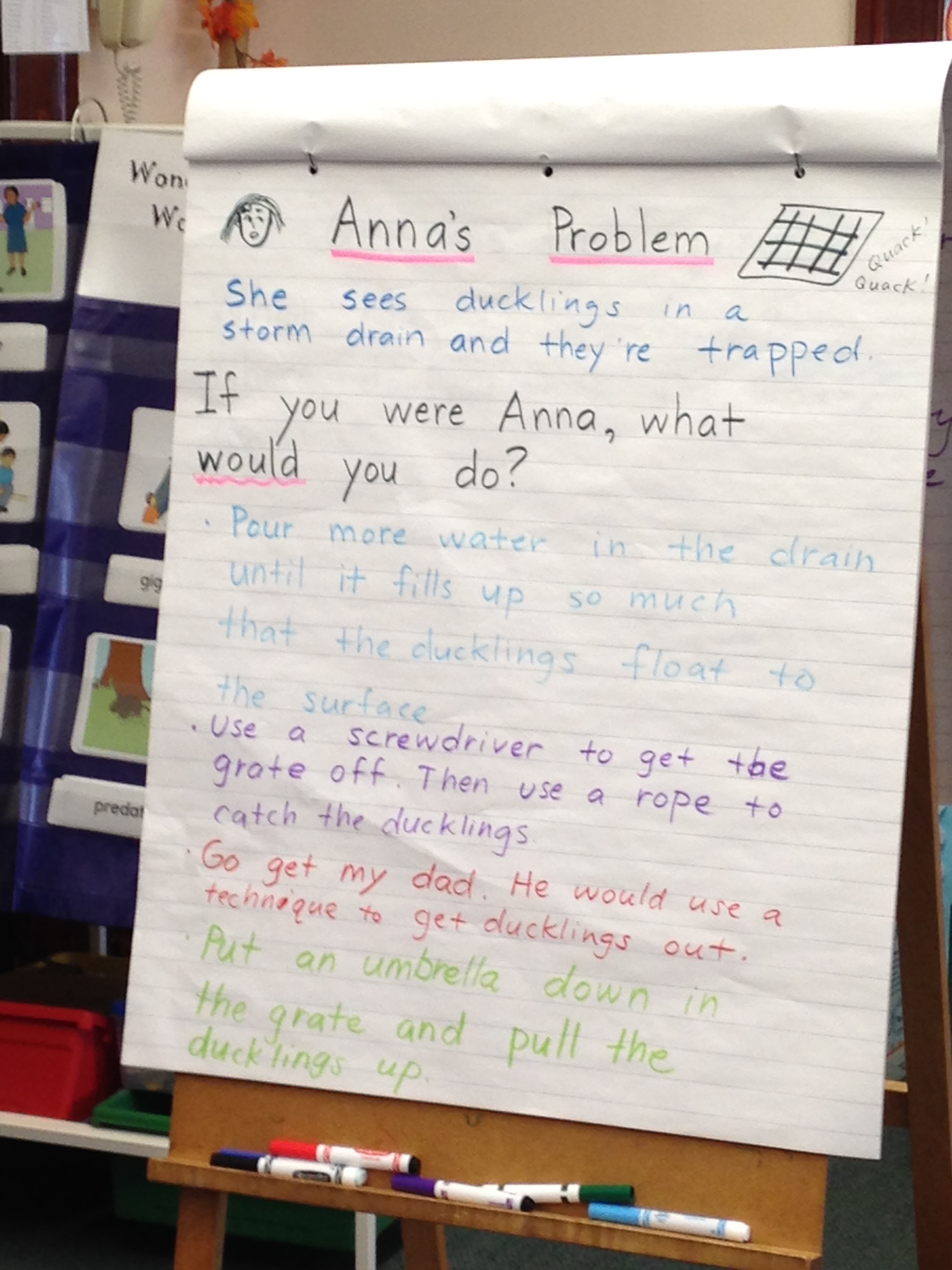
First graders began the pilot by identifying the story’s central problem (“She sees ducklings in a storm drain and they’re trapped”) and imagining real-world solutions:
Students’ ideas included:
“Pour more water in the drain until it fills up so much that the ducklings float to the surface.”
“Use a screwdriver to get the grate off. Then use a rope to catch the ducklings.”
“Go get my dad. He would use a technique to get ducklings out.”
“Put an umbrella down in the grate and pull the ducklings up.”
Concluding Reflections from Anna Wysocki ‘20
Our fun out-of-the-classroom adventure resulted in inquiry, creativity, and laughs from all participants. One of our main goals as a group is to allow the readers of our stories to gain new thought processes and techniques to use in real-world applications, encouraging them to realize the amazing impacts that they can have on any problem. As silly as saving ducks from a storm drain may sound in terms of implementation in everyday life, we were able to learn that such problems do happen, and that if you’ve “got a problem that won’t go away”, then a little bit of inquiry can “save the day!” In fact, a first grader brought to school breaking news that in our very own city of Northampton, some baby ducks fell into a storm drain and were trapped, leaving their mom above-ground in a panic. Local firefighters and passers-by used inquiry skills to save the ducks, just as Inquiry Inc. and these curious Maple School students could have done.
You never know when a little bit of inquiry can save the day!
Illustration by Zoe Dong ‘17, from Inquiry Inc. and the Case of the Missing Ducklings.
Written by Brittany Collins and Anna Wysocki on behalf of the Water Inquiry team.
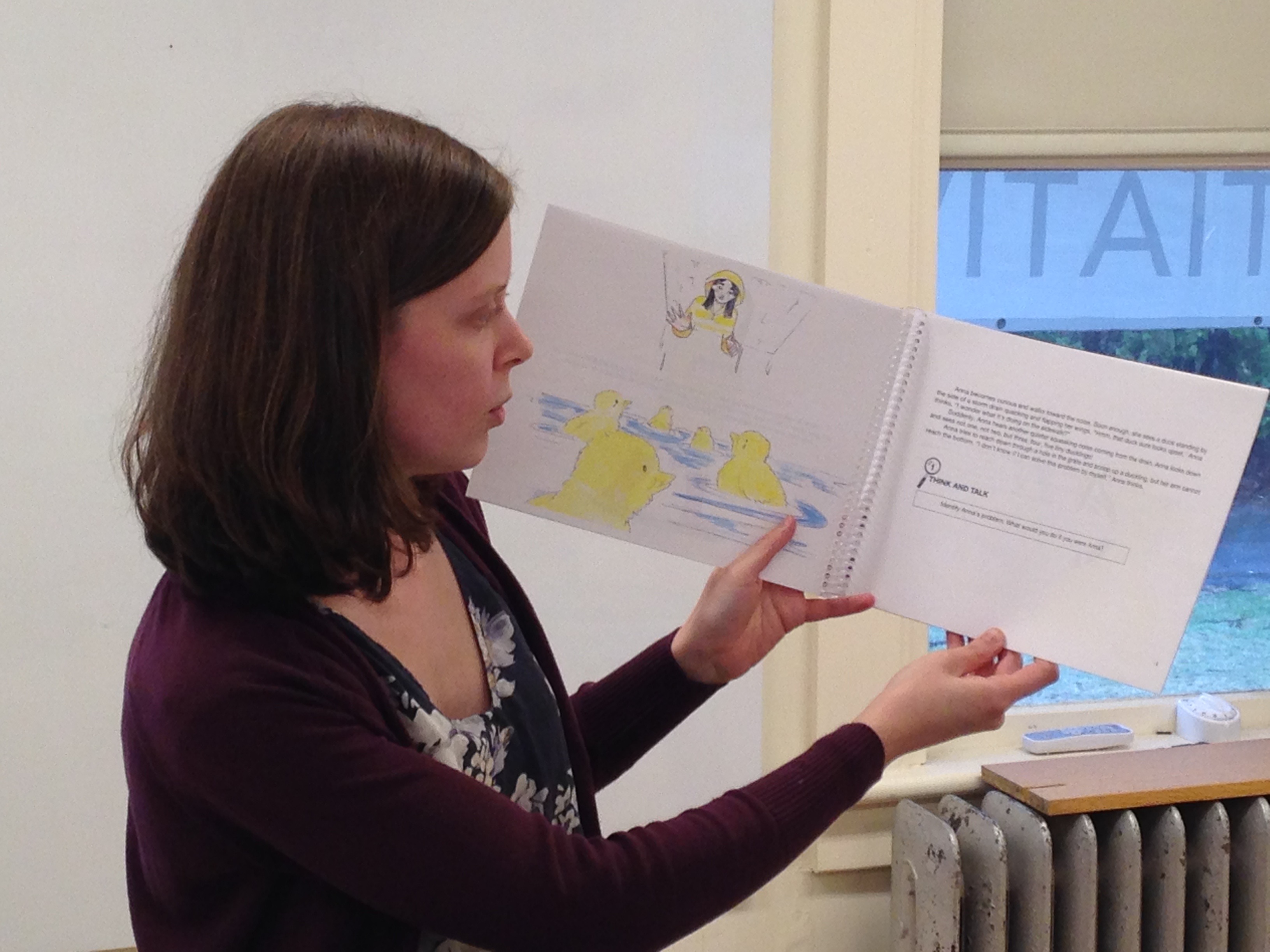
Katy Butler reads “Inquiry Inc and the Case of the Missing Ducklings” at the Water Story Teacher Workshop.
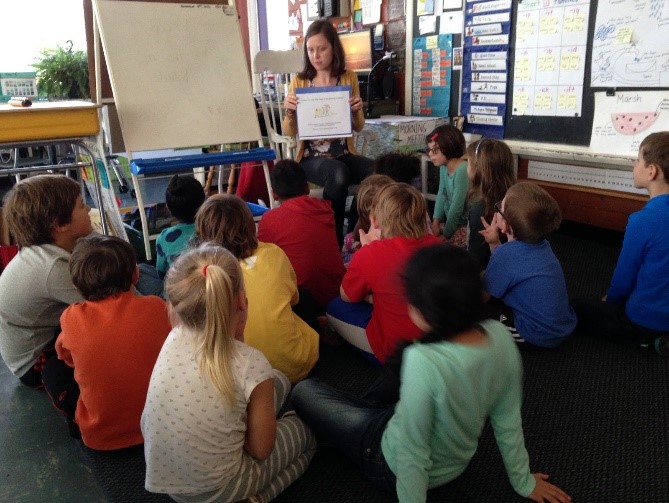
A heavy April downpour set the perfect tone for our first Water Inquiry Story Workshop, held in the Design Thinking Lab of Smith College. Skilled educators from four elementary schools cast dripping umbrellas aside before digging into the learning adventures of Inquiry Inc. and the Case of the MissingDucklings, our newly published storybook. Pilot teacher Katy Butler introduced the interactive text as she did with her first graders, saying: “It’s a picture book story with characters… the kind of story where we will stop and talk, stop and think, stop and go. You will get to do the activities.”
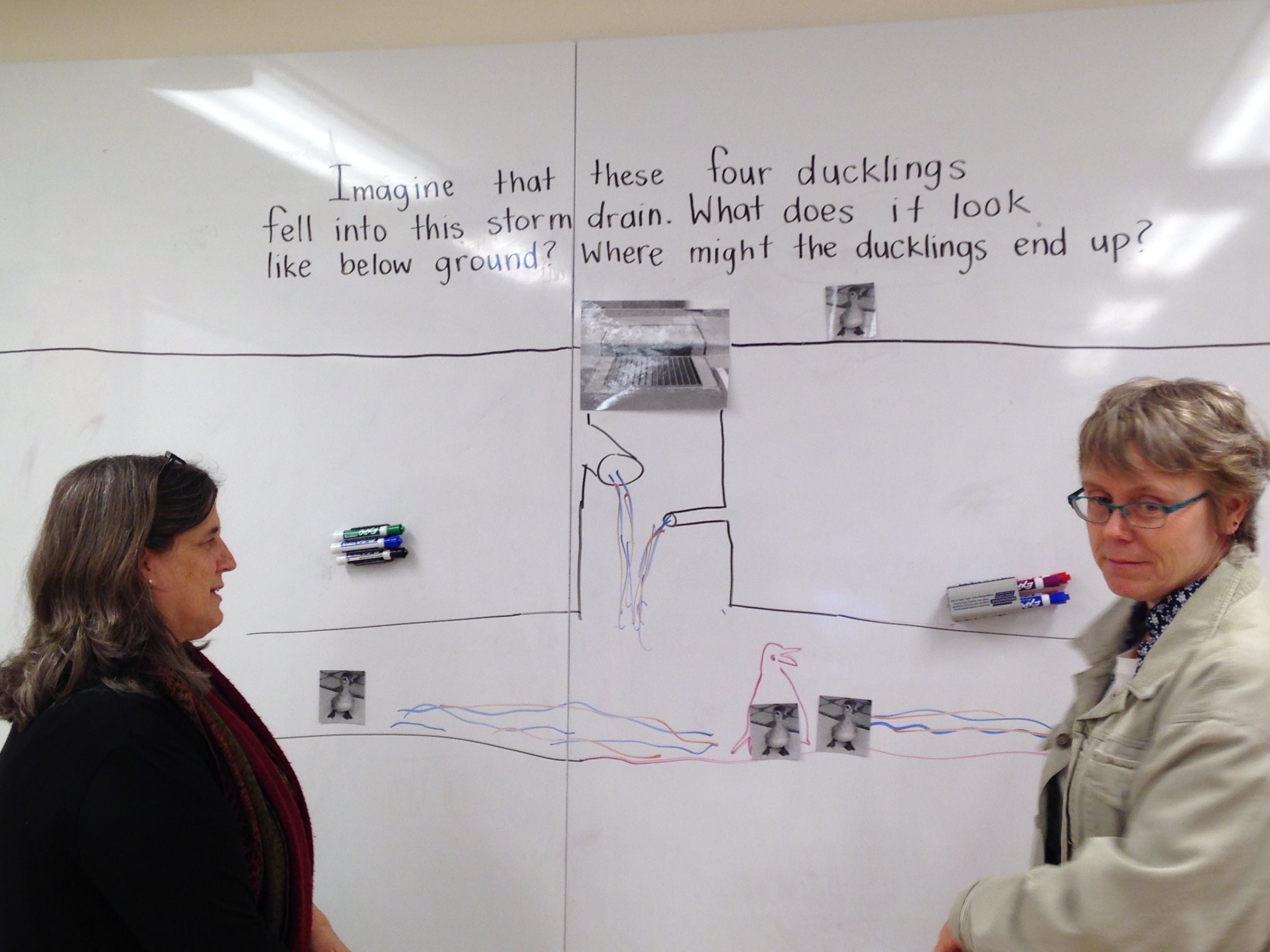
Teachers Jan Szymaszek, 3rd Grade Smith Campus School and Renee Bachman, 3rd Grade Leeds Elementary School, sketch their ideas about where the ducklings will go.
Teachers then had the opportunity to immerse themselves in the student mindset, studying images of storm drains and ducklings, discussing the questions: “Where do you think the water goes?” and “Where will the ducklings go?” before working together to show their ideas about drain design and water pathways. In his new book Wait, What? And Life’s Other Essential Questions, James E. Ryan– Dean of the Harvard Graduate School of Education– writes that, “Inquiry… should always precede advocacy,” and it was, indeed, this sense of participatory engagement that characterized teachers’ efforts to “think… talk… and go” in preparation for doing so with their students.
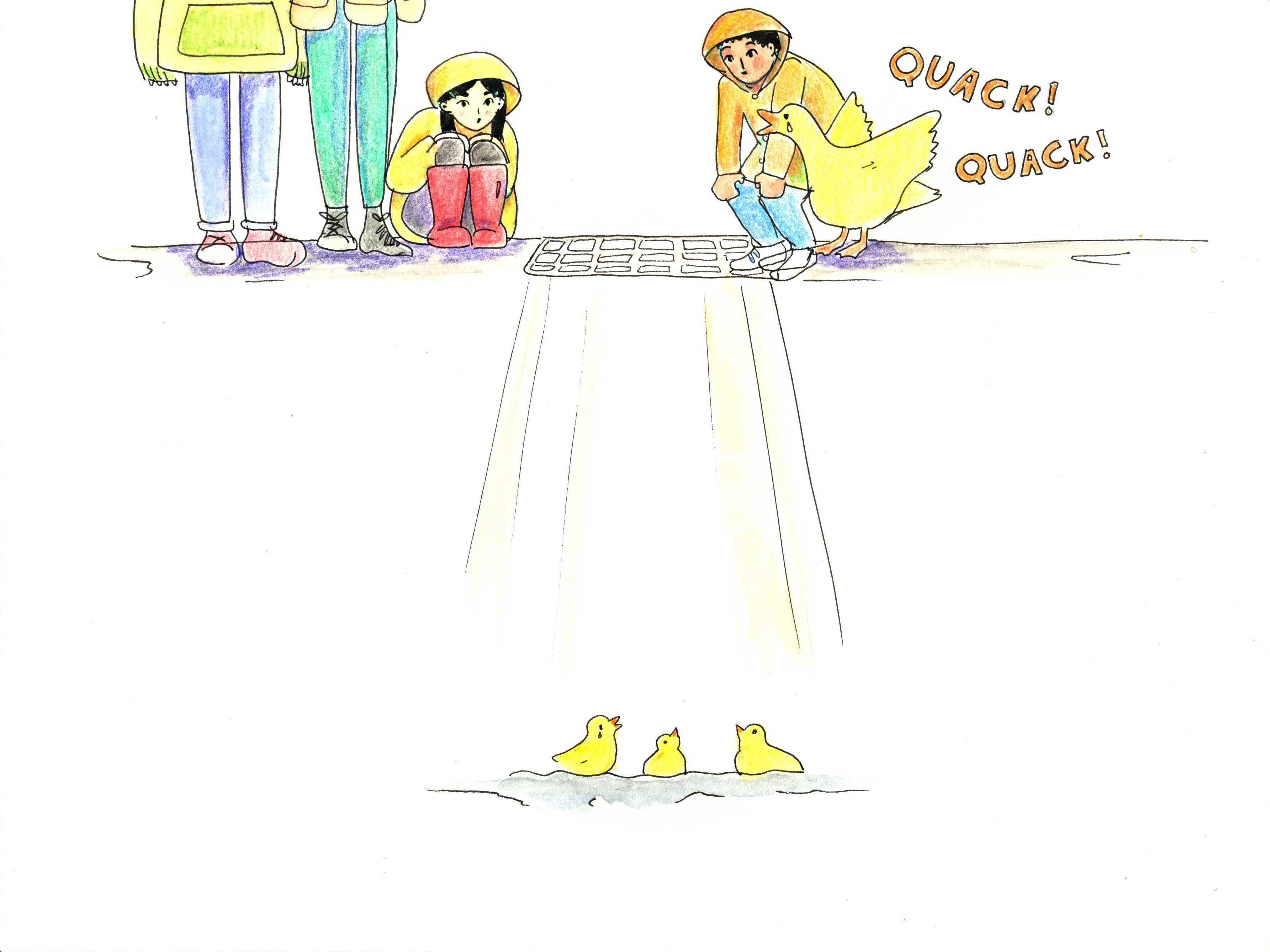
Illustration by Zoe Dong and Sarah White: story characters investigate how to rescue ducklings from the storm drain.
Opportunities for experimentation and exploration revealed the combined powers of STEM and story. “I love the pauses and premise of the problem” one educator noted, while another shared: “… there is so much that can benefit student writing. It will be powerful for [my students] to have the experience of doing the story activities… it will greatly help their reading and writing.”
Renee Bachman, 3rd grade Leeds Elementary and Margaret Betts, 1st grade Maple Elementary, envision how they will use the story in their classrooms.
The connective power of this Water Inquiry story was revealed, not only through educators’ energetic collaboration, but through the discussion of relational possibilities between the story and math or reading practices, engineering games, field trips– even fundraisers to support organizations that provide clean water in Haiti. Teachers discussed ways to use the story as a complement to inquiries unique to their classrooms, noting interests in environmental activism and the strengthening of connections to their local and global communities.
Allyson Ciccarone (’17), four-year water inquiry researcher, and Jan Szymaszek, share ideas and questions.
Inspired to revise their initial answers about the path of water (and fate of ducklings!), educators left the workshop with answers, ideas, and– most importantly– new questions with which to guide and challenge their students. With copies of the Water Inquiry picture book and activities binder in hand, they left the workshop with a new perspective of the world beneath their rain boots.
If you, too, would like to pilot Inquiry Inc. and the Case of the Missing Ducklings in your classroom, please contact Carol Berner at cberner@smith.edu. And, as always, stay tuned for more Water Inquiry updates. The fun has just begun!
Sincerely,
Brittany Collins writing for the Water Inquiry Story Group
Problem-solving jingle of Inquiry Inc. characters
Katy Butler
Allyson Ciccarone
Brittany Collins
Zoe Dong
Meghan Johnson
Ruth Neils
Hannah Searles
Sarah White
Anna Wysocki
Carol Berner & Al Rudnitsky
Members of Inquiry Inc. prepare to save ducklings. Illustration courtesy of Zoe Dong ‘18J and Sarah White ‘20
“I have too many ideas” was a pleasing lament to hear on an icy afternoon in mid-December. Nestled inside a first-grade classroom at Jackson Street Elementary School, Katy Butler (’12, MAT ’18), classroom teacher and Water Inquirer extraordinaire, guided her students through an exciting encounter with our interactive story, Inquiry, Inc. and the Case of the Missing Ducklings.
Collaboration was the modus operandi of our Water Inquiry team this semester. Together, we refined our duckling rescue story—from detailed illustrations courtesy of Zoe Dong ‘18J and Sarah White ‘20, to planful “hand-off” activities that allow students and teachers to “stop and think; stop and talk; stop and do” during their reading experience. We also conferred with community members to finalize our inaugural publication; to better understand the plight our fictional ducklings might face in the real world, for example, we spoke with Doug McDonald, Stormwater Manager of Northampton, about the design and function of catch basins in town, adapting our plot with his insights in mind.
First-graders explored storm drains on their playground, just like Inquiry Inc!
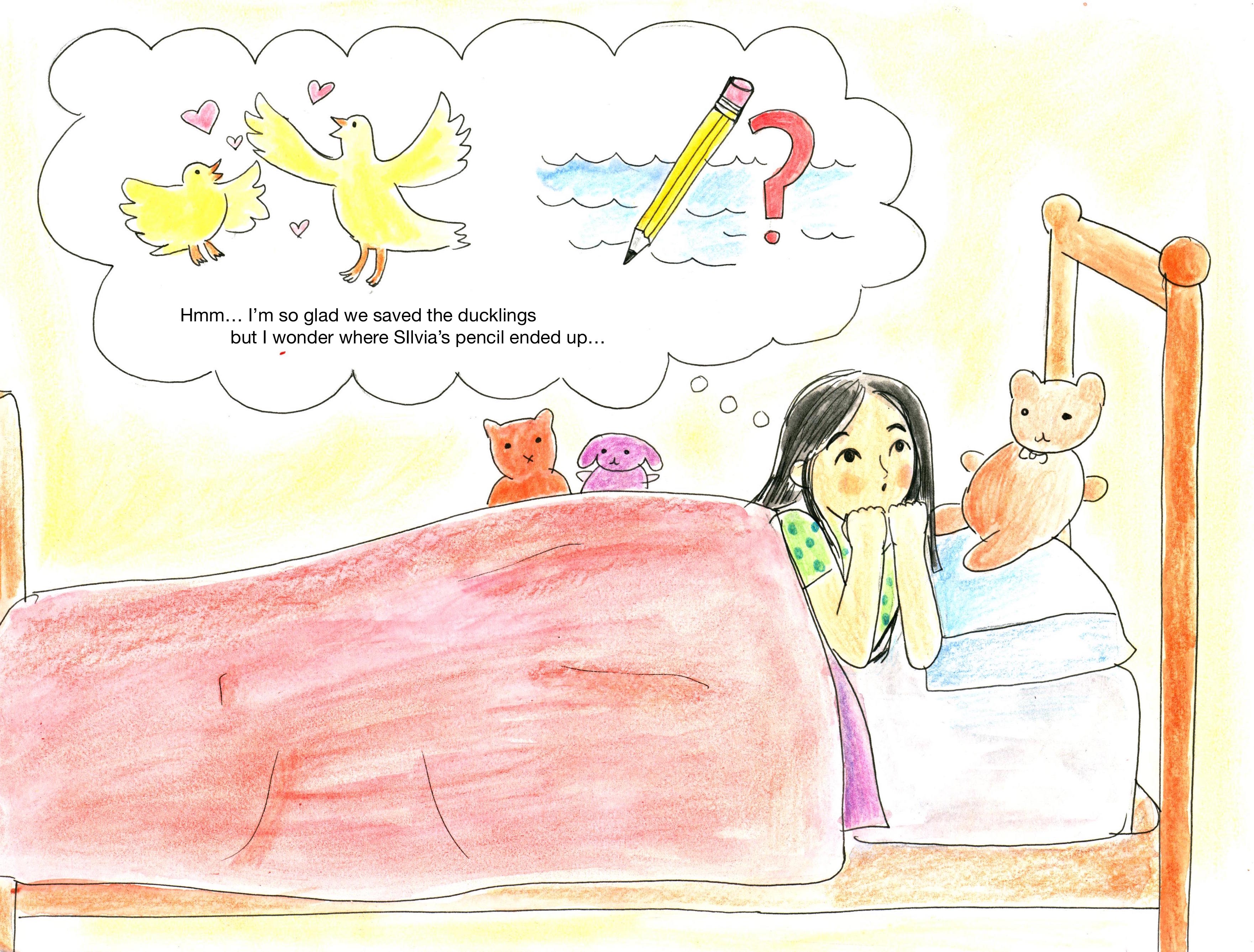
Rich collaboration continued when our story made its way into the hands and minds of first-grade readers. Spread across multiple thirty minute lessons, our piloting program introduced students to “Inquiry Inc.,” the cohort of characters that solves problems (with the help of young readers) throughout our text. After giggles were shared over the irony of “duct tape” being mentioned in a story about ducklings (“[that stuff is] not made out of ducks!”), readers brought wise analytical feedback to our work; upon studying an illustration of a duckling rescue conflict, one student suggested that “Anna [a main character] needs to get closer to the grate, lean down, and reach in,” an instructive comment that guided our artist’s revisions of the scene. Similarly, during a “stop and do” hand-off in which students searched their playground for storm drains, one unlucky group member lost her pencil down the grate of a catch basin! An apt accident for the task at hand, students were thrilled to contemplate this real-world dilemma. Speculating that “my shoe could not [fit down the drain], but my toe could,” they thought of other probable items subject to this perilous fall and predicted the fate of their lost writing utensil. Students’ enthusiasm inspired our authors to construct a surprise ending; you must read our story to see for yourself, but we’ll give you a hint (shh!), the pencil makes a cameo.
Katy Butler ’12 MAT ’18 read our story to her first-grade class.
There are few contexts in which organic exchanges can occur between authors, artists, and readers in the way that our team had the privilege of experiencing this term; our colleagues more than our students, first graders brought honest feedback to our conceptual work, and we integrated their feedback into our final product: a story that extends beyond its pages by asking readers to explore the outdoors, ask probing questions, build, create, and collaborate.
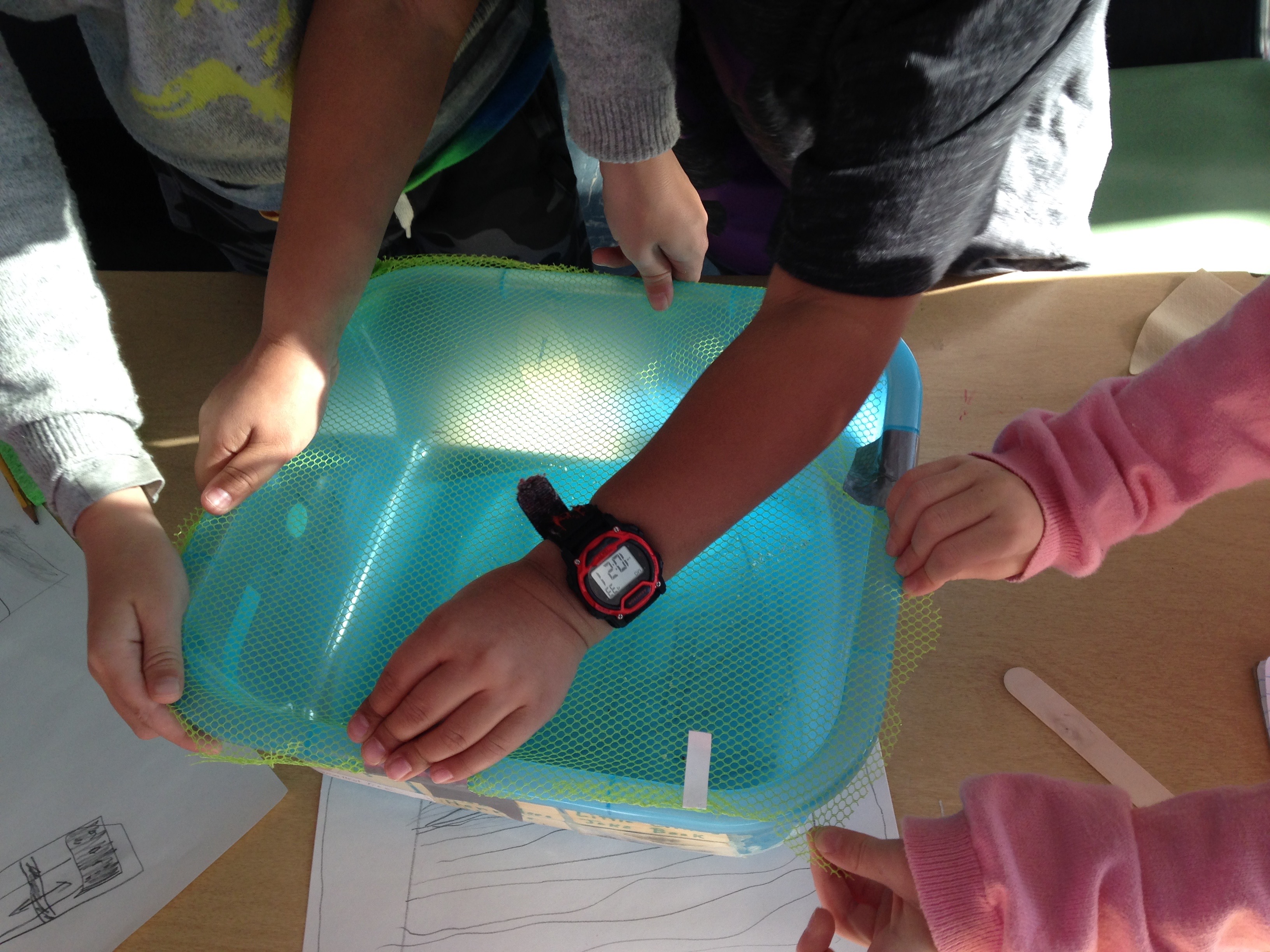
Students worked in groups to create model storm drains during one of our hand-off activities.
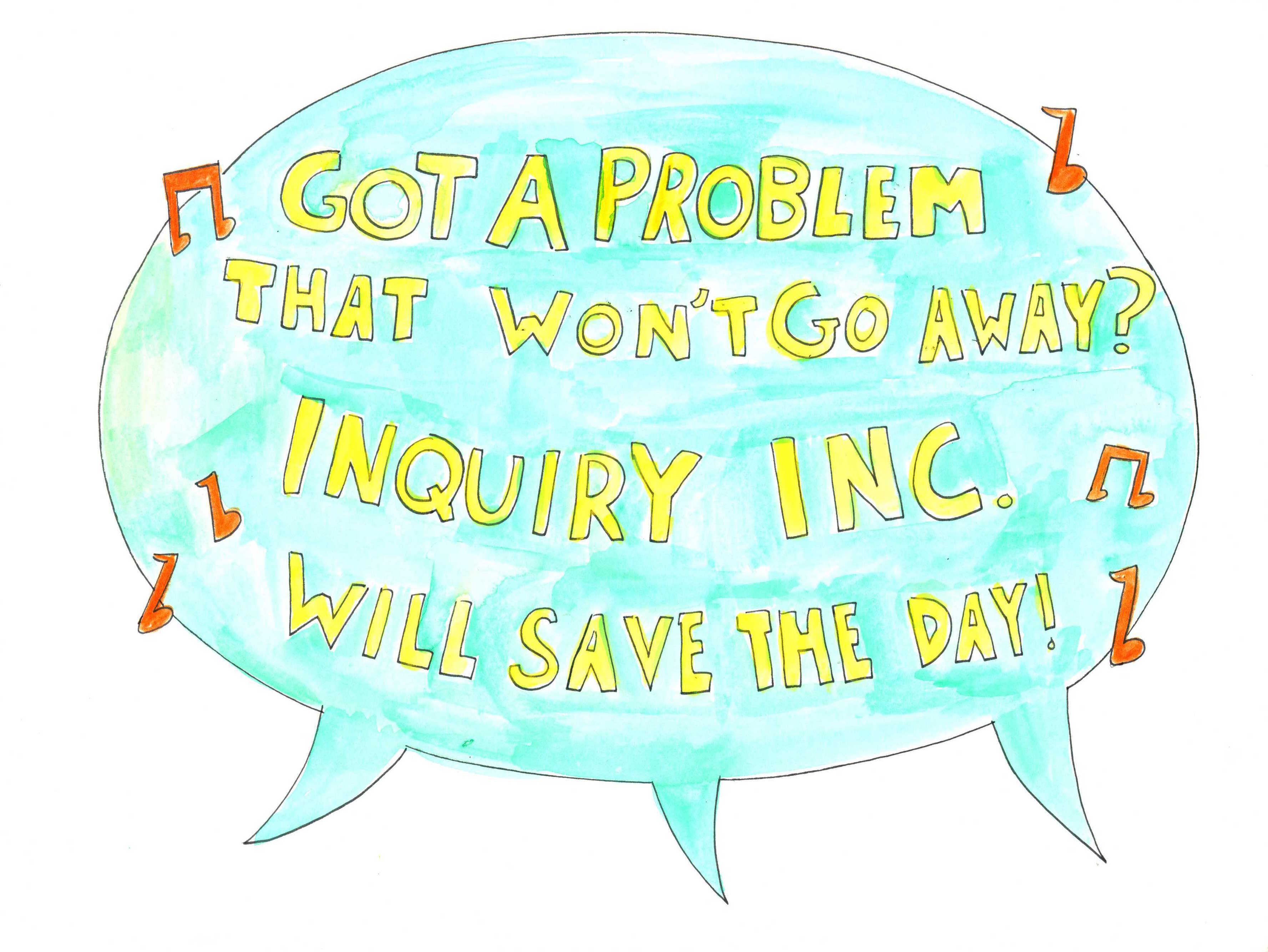
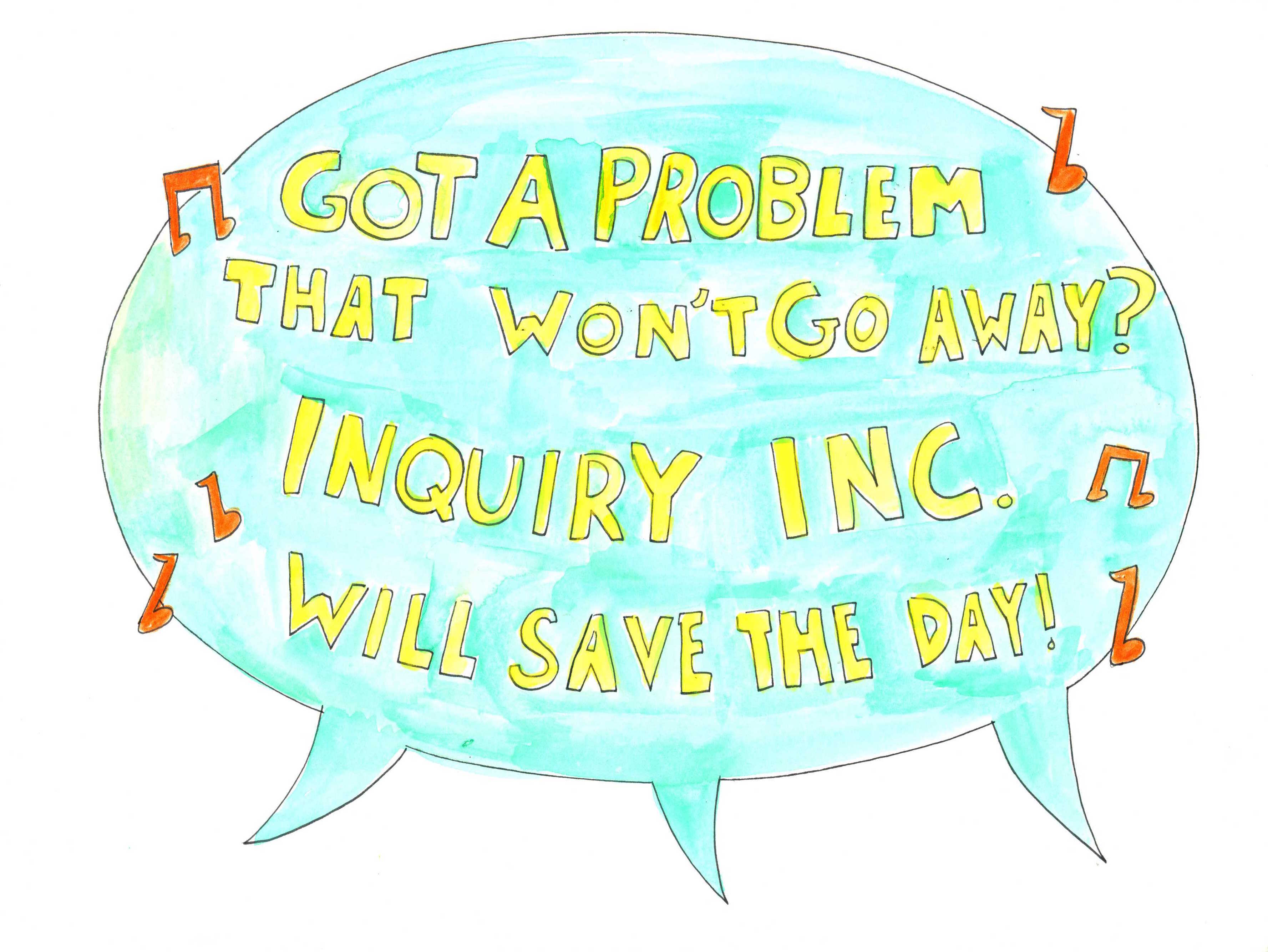
With an educative eye to the importance of inquiry, we designed our unit to transcend its topic. While our story interrogates the mysterious intricacy of storm-drains and weather patterns, a basal interest in knowledge building tactics informed our creative decisions. Woven into the fibers of our narrative, the transmission of these skills was best tested by observing reader discourse and engagement; in our pilot classroom, critical thinking was potently illustrated by our final hand-off activity, a project in which students designed and built model storm drains to better prevent real ducks from the entrapment our fictional ducklings endure. During this activity, student comments exposed careful attention: “How about we each draw what we think,” one student suggested, while another said, “I think we should have Plan A, Plan B, Plan C, and Plan D so if it doesn’t work we can do the next one.” An excited reader boisterously repeated, “I have an idea!” while his group member scribbled carefully on a sheet of red construction paper so as not to forget her theory. Inquiry Inc. characters model problem-solving skills, which similarly transcend the plot of our story. Characters’ slogan, “Got a problem that won’t go away? Inquiry Inc. will save the day!” was quickly adopted by our chorus of readers. In the text, one character encourages the sharing of “half-formed thoughts” while another asks a multitude of questions without timidity. The efficacy of these latent lessons is most tellingly illustrated by students’ comments, as cited above. Their sentiments show the ways in which stories, especially those that are interactive, serve as catalysts for powerful ingenuity.
Students quickly took to this Inquiry Inc. jingle!
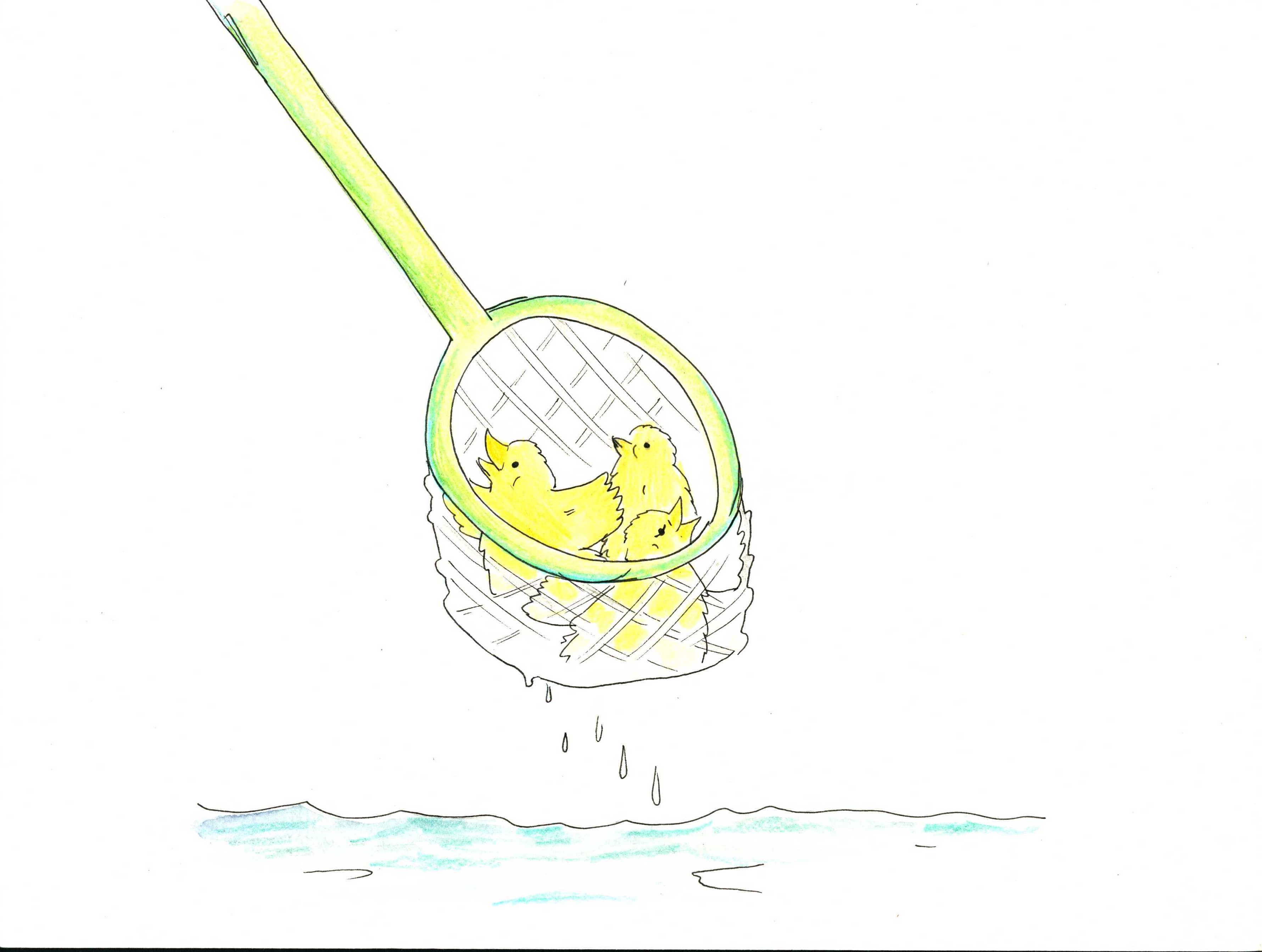
Katy Butler spoke of her students’ engagement, too, stating: “Students were immediately engaged in this lesson and very motivated by the tiny duckling pictures. It was interesting to see what they thought might be underground and definitely motivated me to think past just the story to their developing understanding of water systems.” In reflecting on their experience, students mentioned the thrill of doing “experiments,” or hand-off activities, “at the same time” as Inquiry Inc. characters, introducing an additional layer of collaboration: that of the interaction between characters and readers. One student exclaimed, “I am glad [Inquiry Inc.] rescued the ducklings. They even used our idea about the stick and the net!”
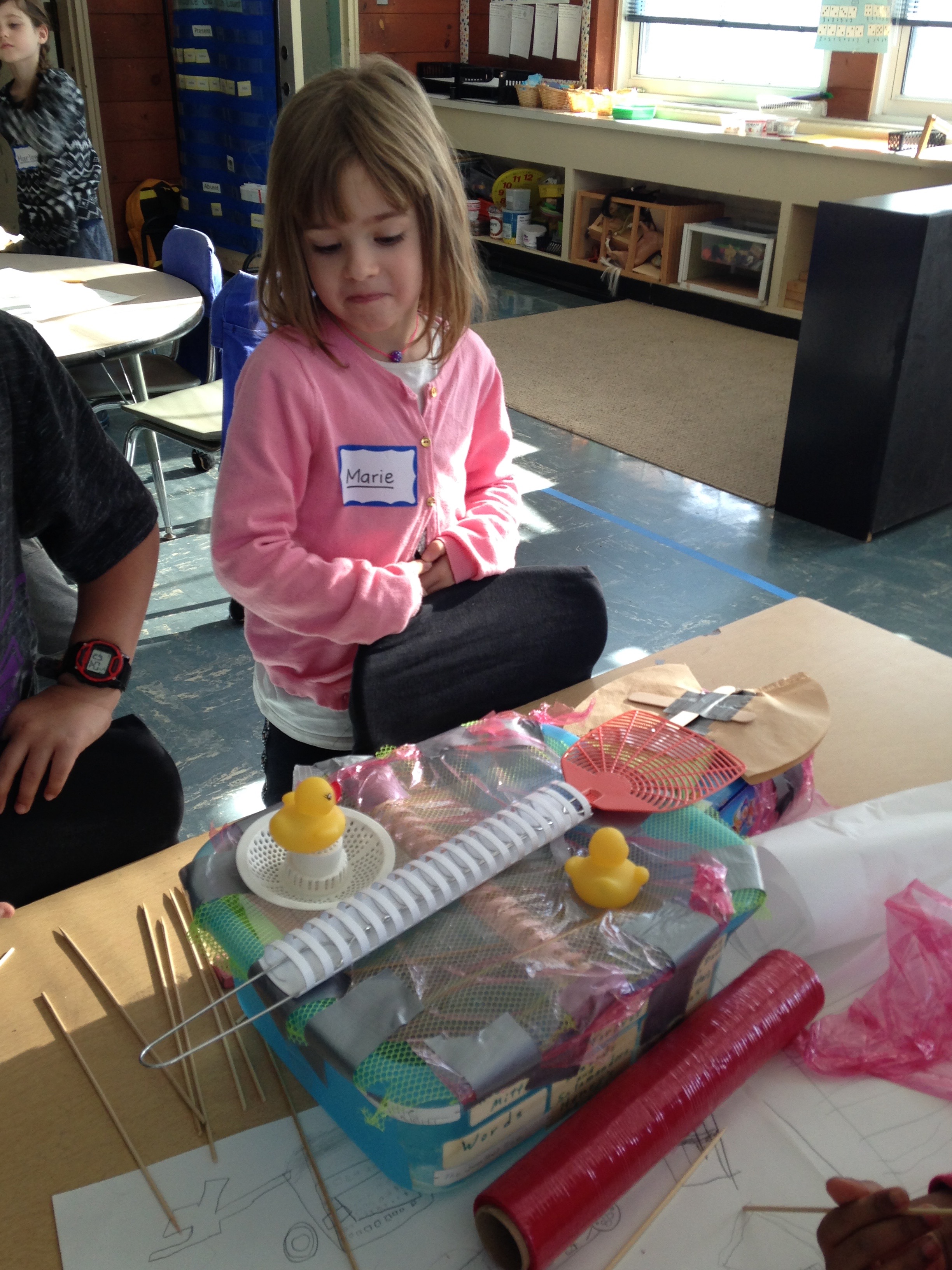
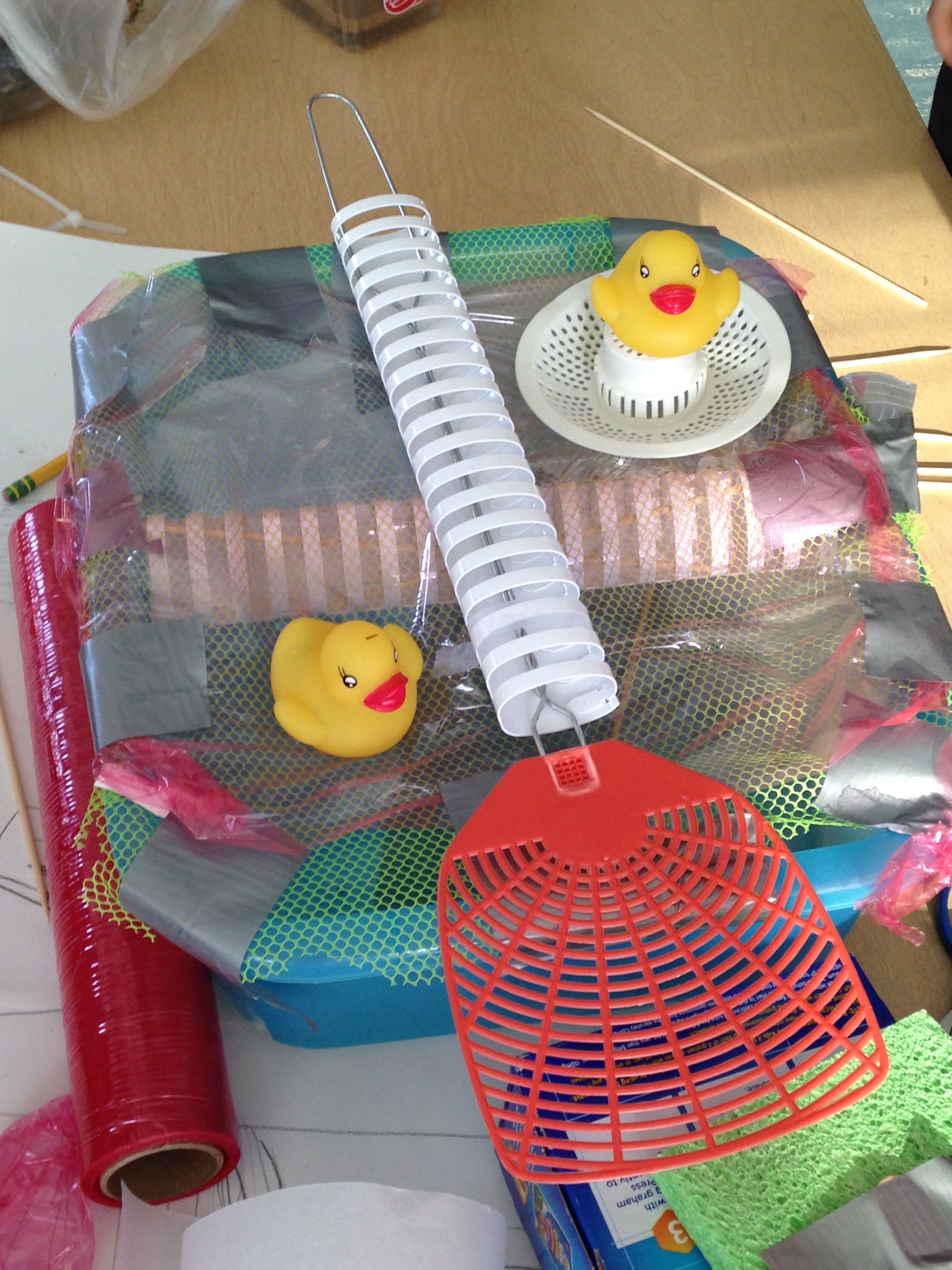
Students designed storm drains with an eye towards function and duckling safety.This group titled their project “The Scooper.” The fly swatter pictured above is actually used to catch leaves. Of their project, kids said: “I think people could really make a drain like ours with a scooper. So maybe we can share our ideas and they will build it. Cause we know a lot about drains now. And ducklings!”
Adaptability is another great feature of our Teaching as Storytelling text. While we encourage educators to delve into the projects and discussions prompted by our book, our story is equally enjoyable when read cover-to-cover in traditional read-aloud format. Teachers may also choose to institute new “hand-offs” where they see fit, continuing our tradition of collaboration. Though our final product is artfully packaged, we hope that it serves as an invitation for adaptation, evolving with each student encounter, turn of the page, and eager hand stretched into the air.
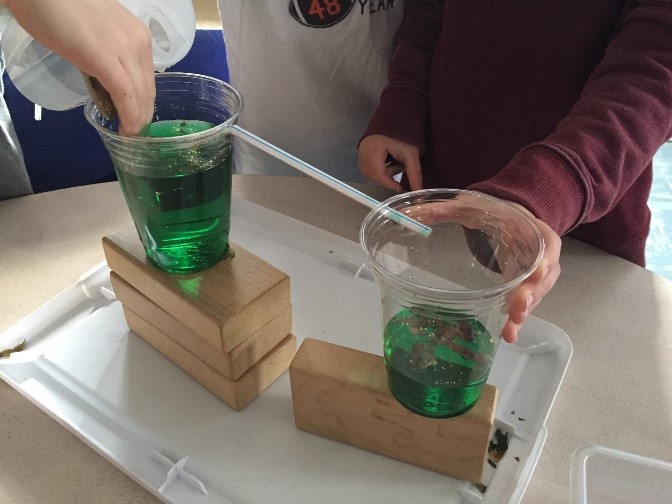
This emphasis on adaptation allows for seamless implementation in multiple educational contexts, too. Most notably, our field investigations, engineering design challenges, and emphasis on group discourse and theory-building, align perfectly with updated standards for Next Generation Science and Engineering Practice. These guidelines mandate that students ask questions and define problems; develop and use models; plan and carry out investigations; analyze and interpret data; construct explanations, design solutions, and engage in argument from evidence. Students’ reactions aligned with the goals of NGSS; one first-grader shared: “My favorite part was when we found out how to make the water go through the pipe so it could go from one drain to the other. My group even figured out you can hold the straw down and then let it up and more water goes through!”
Students then modeled the downhill flow of water through pipes to explain scientific processes to Inquiry Inc.
What better way to meet new standards and promote holistic, interdisciplinary thinking than to conduct scientific inquiry through the affective mode of story? Narrative theorists discuss the prospect of making the “ordinary extraordinary” by way of story-form, and we concur given our readers’ enthusiasm.
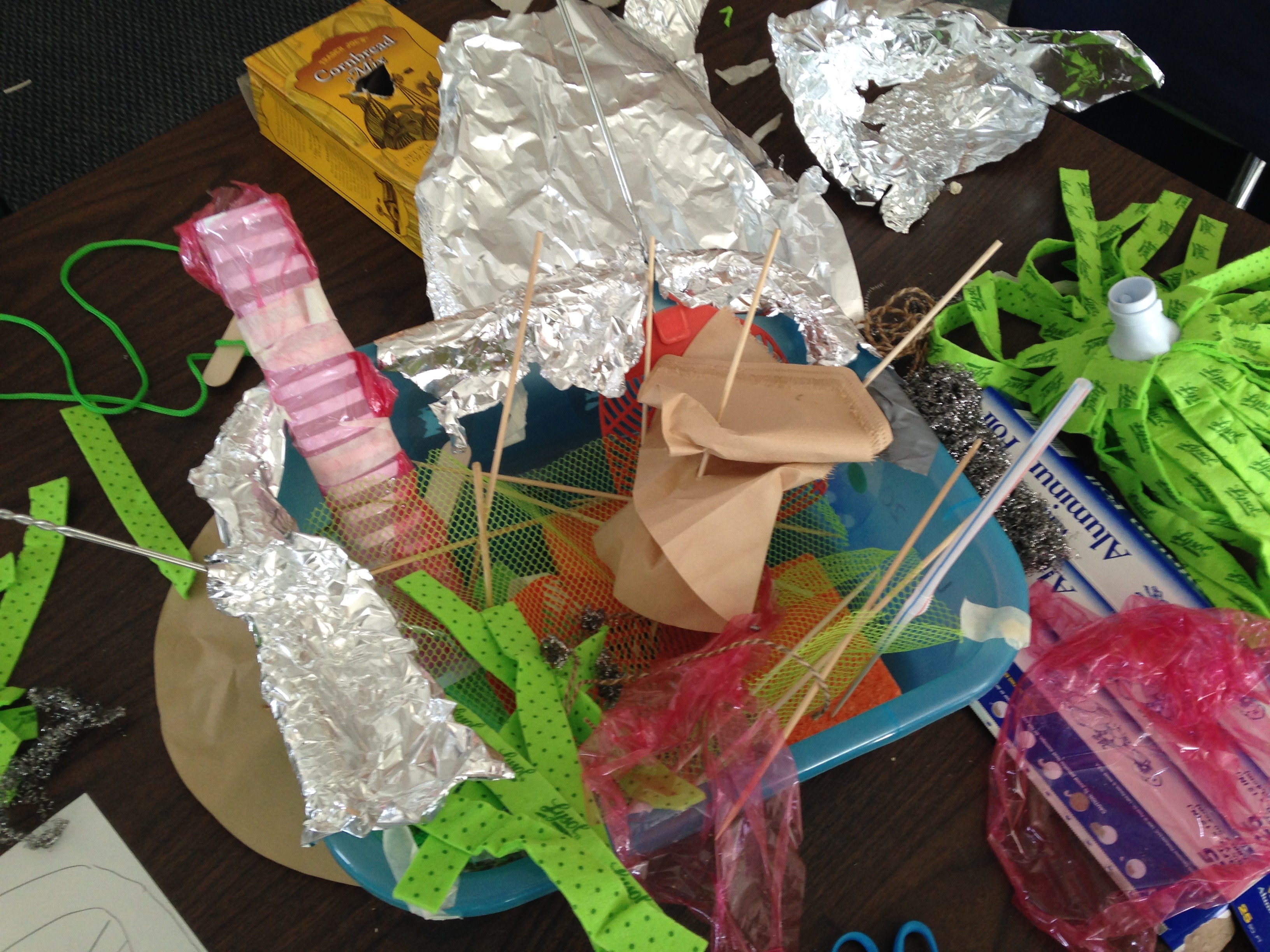
Making the “ordinary extraordinary” was exemplified by this group’s storm drain entitled “Too Many Ideas!”
Our story encourages students to be aware of the world around them, fostering inquisitive participation rather than passive reception. Regardless of topic or academic discipline, we care about students’ habits of mind, and we were thrilled to hear one student say: “I never thought so much about drains! Now I see them and wonder what is down there.” Katy Butler noted, too, that students’ discussions “extended beyond our water study times,” which affirms our contention that stories have a way of deepening students’ responsiveness to, not only academic material, but the people and communities around them. One student even announced, “Guess what? That half dollar I brought in yesterday fell down into a storm drain before school. I was wishing Inquiry Inc. was there to help!”
In this illustration created by Zoe Dong ‘18J and Sarah White ‘20, Inquiry Inc. saves the day (and the ducklings)!
As we look towards 2017, the Water Inquiry team eagerly awaits the opportunity to share our story with teachers. If you would like to pilot our illustrated story and its accompanying unit materials in your classroom, please contact Carol Berner at cberner@smith.edu for more information. Our first grade pilot teacher and group member Katy Butler will lead a professional development workshop this winter in which educators may learn about her experience teaching our scientific story unit. Stay tuned for more details, and we will see you next semester—Inquiry Inc. is ready to solve their next problem, and we will soon set to work drafting a new story (with pencils in hand, kept carefully away from storm drains)!
Best wishes to you, readers, for a wonderful year ahead! May it be filled with exploration, teaching, and learning.
Sincerely,
The Water Inquiry Team
Written and published by Brittany Collins on behalf of the Water Inquiry Team
As temperatures and leaves begin to change in Western Massachusetts, members of the Water Inquiry project are commencing their time at Smith with awakened fervor. Summer months did not stymie our productivity; in fact, group members collaborated online to work on character development and illustrations for our forthcoming narrative– a compelling account of a duckling rescue that is rife with opportunities for reader engagement and problem solving.
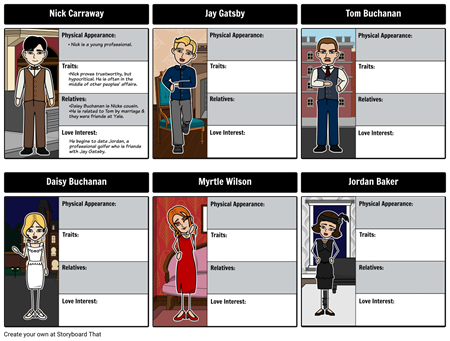
Group members used storyboards like the one pictured above to consider character development. Photo courtesy of storyboardthat.com
Just as rivers flow disparately into the ocean, so, too, do we find ourselves in the midst of a greater community this year– a storytelling “ocean” in which the Water Inquiry team is a subset of the overarching Teaching as Storytelling project chaired by professors Carol Berner and Al Rudnitsky. Together, we are joining similar focus groups to share writing, editing, and knowledge building techniques that strengthen our individual stories and allow us to interrogate “story form” thinking.
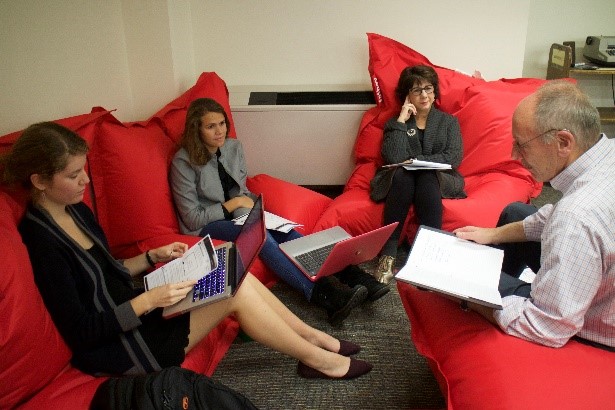
Our inaugural meeting occurred in Neilson Library’s new Knowledge Lab– a space that simultaneously provides structure and freedom in the pursuit of collaboration. Brightly colored beanbag chairs and large projector screens are just some of the tools that comprise this intellectual “clubhouse,” a space in which think-tanks like ours may refine developed projects or nurture nascent ideas. After sharing our work and listening to others’ stories, we were attuned to the subjectivity and commonality of our narrative research, considering that which is unique to Water Inquiry while engaging with intersecting goals and challenges that span all subsets (or all rivers, if we indulge our previous metaphor) of the Teaching as Storytelling research project.
Students work alongside Professors Al Rudnitsky, Susan Ethridge, and Carol Berner in the Knowledge Lab.
To ground our creative work together, we have researched the import and efficacy of story form to greater understand the neurobiological and developmental merits of its interdisciplinary presence in classrooms. Why, in other words, should we care about stories, and what makes them powerful tools for learning?
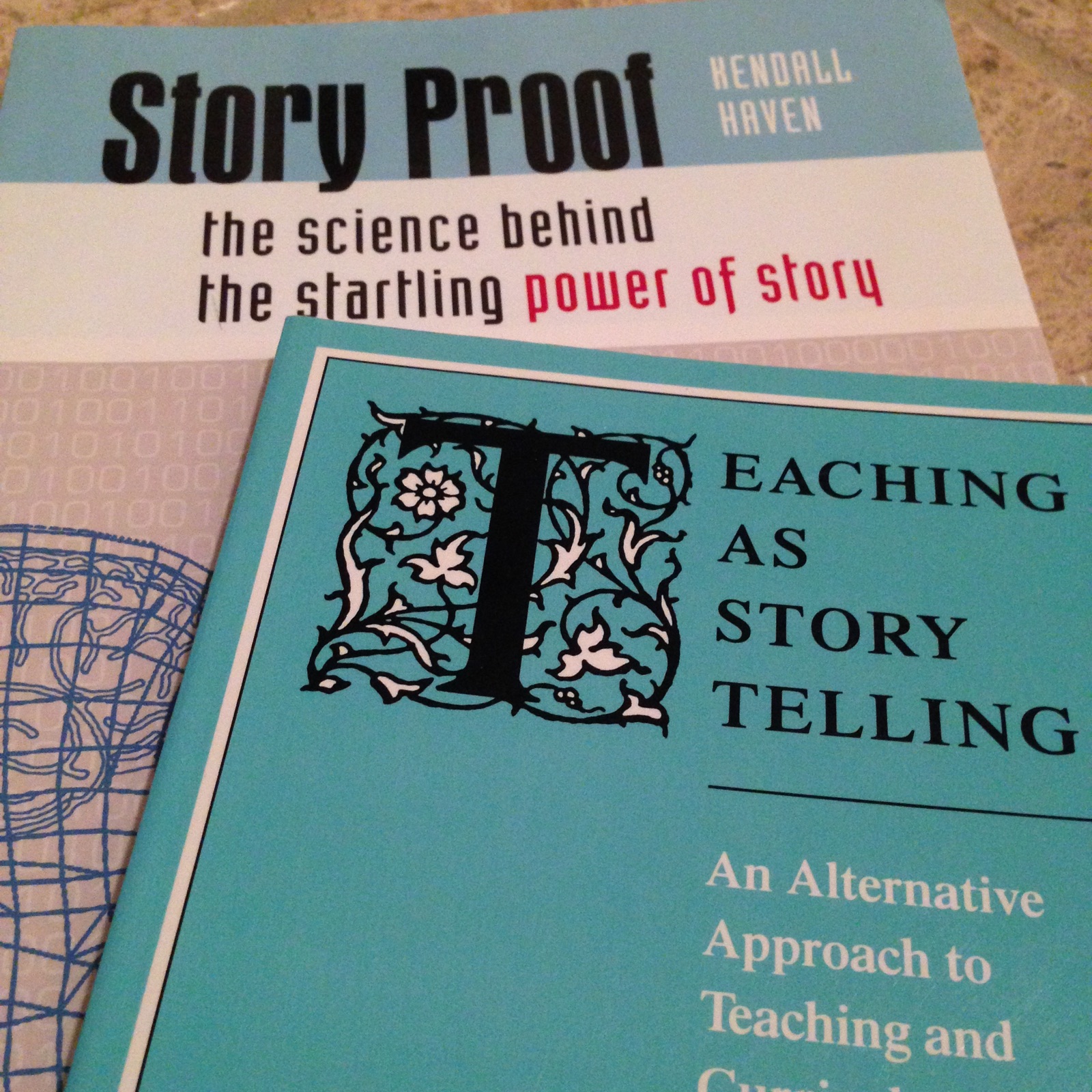
In doing so, we have found Kieran Egan’s Teaching as Storytelling and Kendall Haven’s Story Proof particularly useful resources in understanding narratology– a field of study that examines stories’ effects on perception– and the role of binarisms, schema theory, and cognitive development in story reception. Haven (2007) writes, “[stories create] context and relevance…evoke prior knowledge, provide details, [and] improve comprehension.” Did you know that the brain releases oxytocin, a neurochemical responsible for empathy and compassion, when one listens to (or reads) a story? Or that babies are born with a neurological predisposition for understanding the world through narrative formats? Our culture has utilized stories for so long, they have become genetically encoded in our species. Sounds like a powerful educational tool, if we do say so ourselves!
Story Proof and Teaching as Storytelling were helpful resources when researching narrative science.
We approach our work this year with a desire to scaffold scientific thinking and action in our readers; we hope that our stories transcend the page by inviting students to problem-solve, collaborate, and explore the world around them– creating “context and relevance” that excites and ignites. To meet these goals, we are using frequent group meetings to refine our creative methods and challenge our own schemas, rethinking the role of stories in students’ lives so that we may target our readers, not as passive recipients, but as active and engaged scholars who may intertwine their thoughts and ideas with our texts.
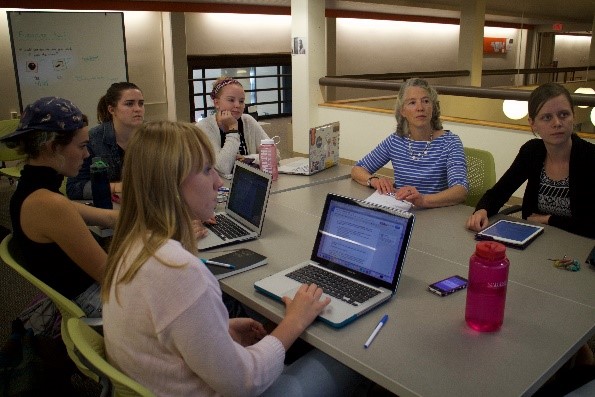
The Water Inquiry team gathers to revise its forthcoming duckling rescue story.
The efficacy of our work is best gauged by young readers, and it is with great excitement that we await the piloting of our duckling rescue story in classrooms. In the coming weeks, first grade students will put our newly strengthened characters to the test, and we look forward to a new method of collaboration– the reciprocal exchange between reader, author, and story.
Joining the Water Inquiry team this year are the following student participants:
Brittany Collins is an English and Education double major from Westhampton, MA. She attended the Smith College Campus School for three years and loves going to college on the same campus she explored as a child. In addition to her Water Inquiry work, she is the Editor in Chief of Voices & Visions, a literary journal sponsored by the Kahn Institute, and she will soon join the Jacobson Center tutoring staff. Outside of the classroom, Brittany enjoys dancing, powerlifting, and hiking; she completed her first 39.3 mile Avon walk after freshman year and has a special affinity for the trails of Northampton since her training process. Distance walking reawakened her love of nature—a love that she hopes to channel into Water Inquiry stories, inspiring young readers to explore books and backyards alike.
Anna Wysocki is a first year of Smith College who is from a small town called Hoosick Falls in upstate New York. She is undecided right now, but is considering to major in Neuroscience. She is excited to add her own interesting perspective to the water stories. Just this past year, Anna and the rest of the citizens living in her town discovered that their local water supply had been poisoned by a pollutant known as PFOA, which can have serious side effects overtime by accumulating in the blood and causing serious illnesses and cancers. Everyone had to stop drinking, cooking, and even bathing for long periods of time with the water. Anna represented the student body at a local press conference to bring about social change and ease the hysteria. She is excited to use this insight in the stories, and looks forward to what can stem from them!
Sarah White is a first year student at Smith College, and is excited to be working on the Water Inquiry Project. She is planning on majoring in studio art or the Study of Women and Gender. She is from Burlington, Vermont and spent most of her childhood exploring the forests and water around her home with her sisters. Before arriving at Smith she took a year off to road trip around the United States, camping and farming as she went. She is interested in writing and art, and in her free time can usually be found reading, cooking or outside.
Zoe Dong is a junior Studio Art major at Smith from Akron, Ohio. She’s very excited to be working as the illustrator for this project. You can view some of her work at www.zoedong.weebly.com.
To learn more about the characters who create our characters, please visit our About Us page.
Stay tuned for more exciting news from the Water Inquiry Team!
by Brittany Collins on behalf of the Water Inquiry Team
Water Inquiry group observing pond at Botanic Garden
What can you do with 100 hours? Ask any of the eleven K-3 teachers who collaborated with Smith students and faculty on the 2015-16 Water Inquiry project, or read on to see what we discovered about inquiry-based learning, water as a topic and outdoor exploration. At our final meeting in May, we asked teachers to reflect on what they learned not only in the hundred hours they invested in group discussion, but also in countless water investigations at Jackson Street, Leeds Elementary and the Campus School. Jan Szymaszek, third grade teacher, summed up what the collaboration offered: “Time and space to come together… to pursue vexing issues of teaching, learning and instructing in a way that supports and sustains rich and rigorous learning in science and overall.” We want to thank Smith’s Center for the Environment, Ecological Design and Sustainability for providing us with the time, space and tea to sustain our year-long inquiry.
Maria Garcia, K teacher, Jackson Street
What did we learn?
One way to think about what we learned is to check in on three goals we set at the beginning of the year:
Learn in and from outdoor surroundings, especially school yards.
Explore “water” as a topic that offers promising questions and problems of understanding.
Improve our understanding of how to spark and sustain scientific inquiry.
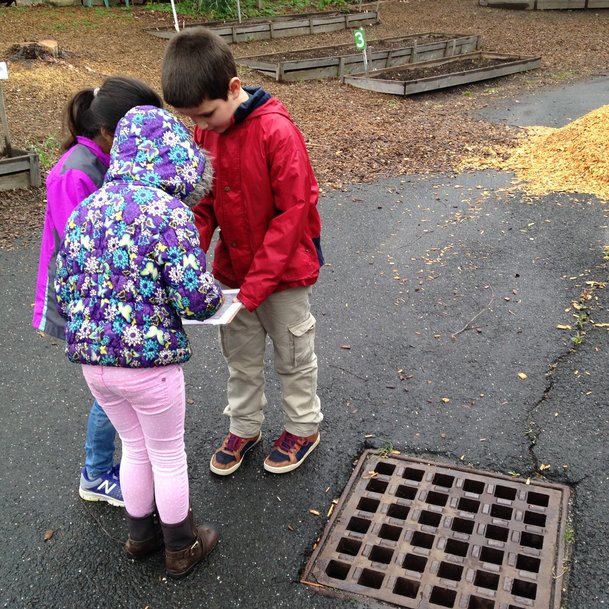
First graders map storm drains at Jackson Street
Outdoor investigations were highlights of the water inquiry project, both for teachers and kids. Going out in a downpour, looking up at clouds, peering down storm drains and watching the river after a storm, were moments that stood out for teachers because their students were deeply engaged in trying to explain phenomena in their world. Like their students, teachers’ curiosity and sense of wonder were inspired by exploring the Botanic Garden and following water downstream from the MacLeish Field Station. As third grade teacher Amanda Newton reflected, “Exploring the garden and bouncing half-formed ideas was helpful and inspiring.” Most recently, first graders in Katy Butler’s class have been mapping drains on their school grounds and discovering that there are actually three different kinds of water moving through underground pipes: clean, dirty and in-between.
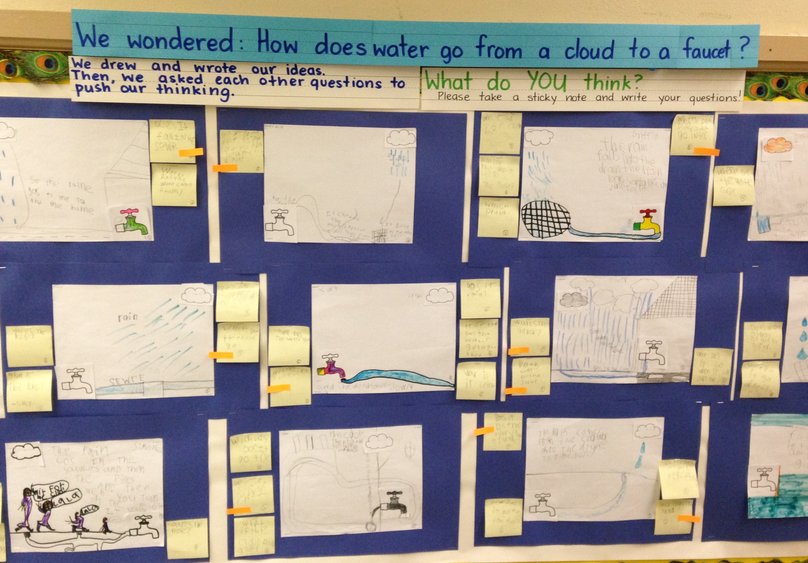
Questions and diagrams by first graders, Jackson Street
“There is something compelling about water.”
Everyone echoed this teacher’s comment. Building on initial ideas about “why water?” – it’s everywhere, it keeps changing forms, it sustains life, we have to improve how we manage it as a resource – teachers were struck by the vigor and persistence with which their students developed water questions, theories and explanations. A third grader wrote in her Nature Notes journal, “I love studying water.”
Teachers intend to continue working with overarching questions about water that emerge from children’s discussions, experiments, diagrams and outdoor investigations. We identified key ideas that raise promising problems of understanding, including: movement, cleanliness, human interactions, changing states and ownership.
Where does water come from? Where does water go?
What does water do? What do we do to water?
What do we mean by clean/dirty water? How/why/where does water get clean or dirty?
Who does water belong to?
One teacher reflected that water questions are “still alive” even when the classroom focus shifts to another topic: children bring new questions; revise their theories; and construct new explanations based on something that happens outside of school, like flying through clouds on an airplane (“Why is it bumpy inside the cloud but not outside the cloud?”)
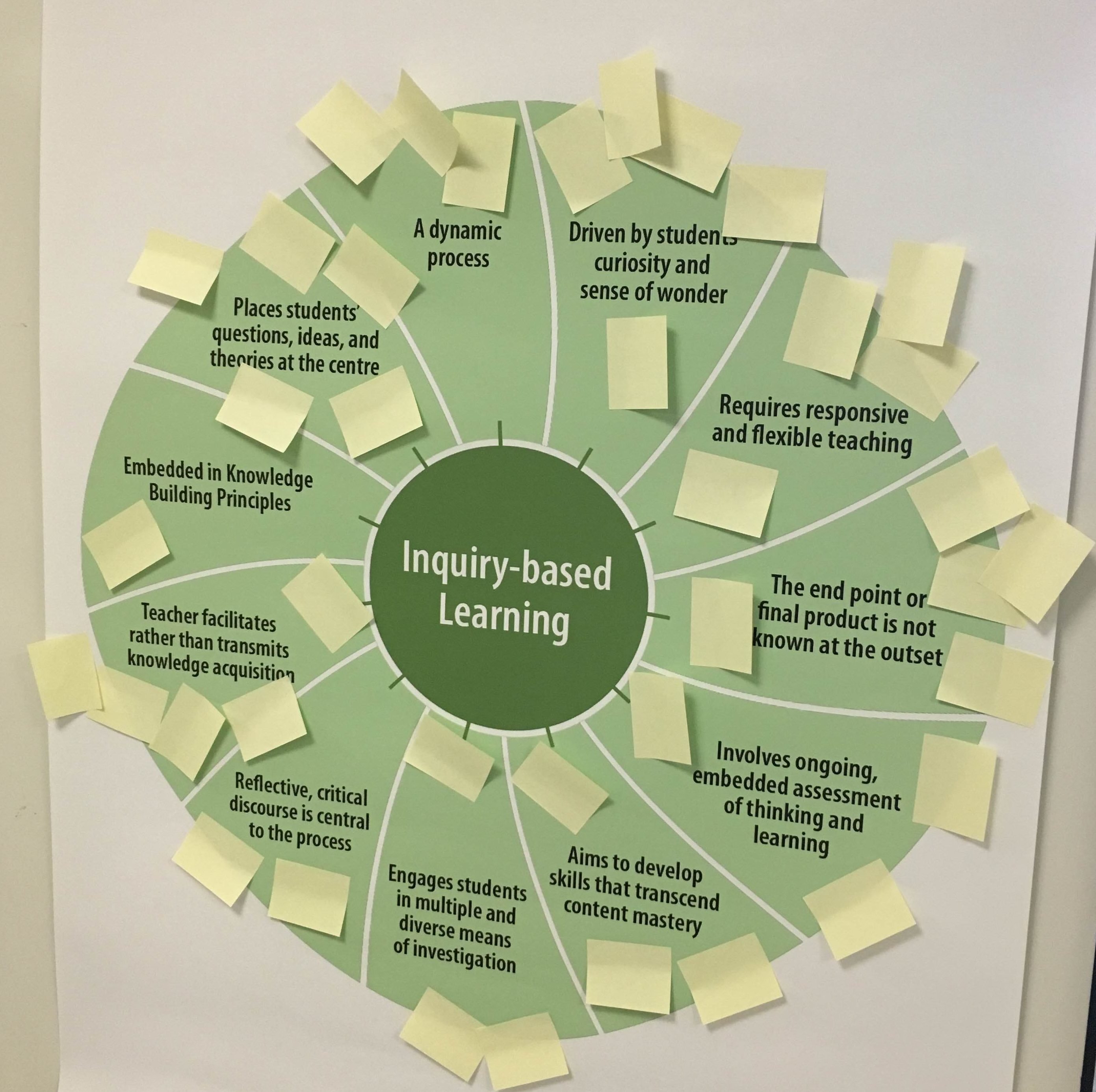
Chart from Natural Curiosity, University of Toronto
What are we learning about how to spark and sustain scientific inquiry? Teachers identified strategies, or “teacher moves,” from the water inquiry project that they found most helpful in supporting and advancing inquiry-based learning:
Start with a question to create a problem of understanding and “disturb thinking.
Draw (and revise) diagrams to imagine and map water flow (e.g. cloud-to-faucet).
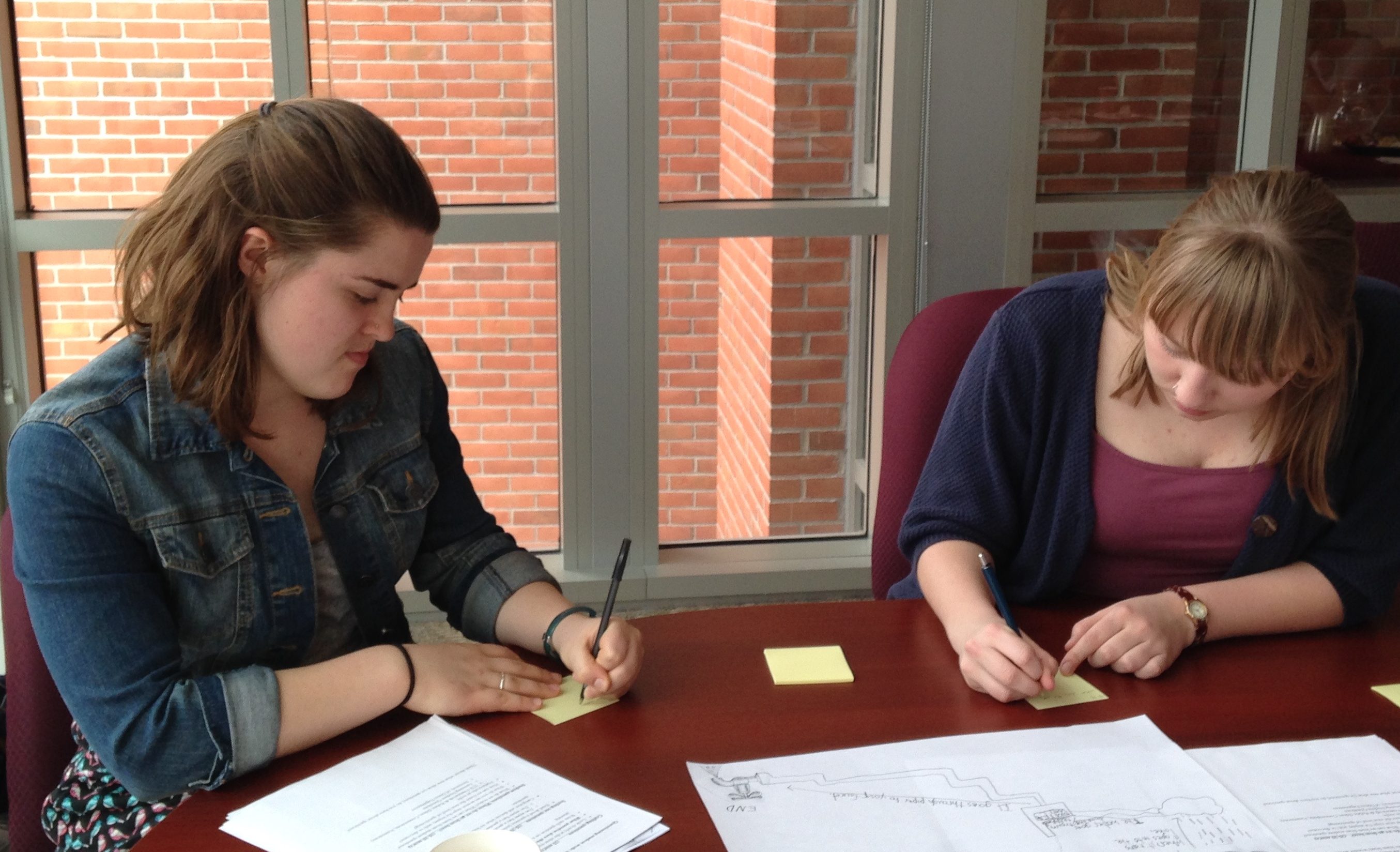
Question each other’s work, using post-it notes to develop and classify group ideas.
Be on the lookout for teachable moments.
Design experiments to investigate problems of understanding.
Be a co—learner (in collaboration/communication with students and colleagues).
The role of teacher as facilitator of idea-building, rather than transmitter of knowledge, was an important discussion throughout the year. As Kindergarten teacher Mary Ellen Reed reflected, “It is okay to let children/adults develop their own ideas over time through more observations, conversations, exploration.” Re-framing the role of the teacher raised lingering questions, including when and how to introduce authoritative sources. Teachers agreed unanimously that they want to continue with this collaborative approach to learning. They conclude that it is “fun and provocative,” gets them “engaged and involved in deep thinking about practice,” and “it’s refreshing to collaborate on how to move ideas forward.”
STUDENT PERSPECTIVES
What were our favorite parts of working on the project this year?
Hannah and Ruth analyzing student diagrams
Ruth Neils is a rising sophomore at Smith College and is double majoring in Education and Environmental Science and Policy: Throughout this year, what I found to be the most compelling, and also the most challenging, aspect of the project involved working with the water inquiry group to find ways to develop and foster student thinking. Looking at student work during classroom visits and roundtable discussions provided opportunities to focus on ideas and concepts that children were working to understand. It was challenging to uncover ways to guide students’ thinking while ensuring that questions and ideas about these topics were not just answered but discovered and understood. While this aspect of the project was difficult, I also found it incredibly valuable because it involved collaboration and problem solving using every member of the water inquiry group, which allowed ideas and half formed thoughts to develop into possible solutions and actions that could become an aid for all of the members of the group when they encountered a similar dilemma.
Hannah Searles is a rising junior at Smith College and is double majoring in Education and Psychology: What I found most compelling this year was thinking about how to begin and continue inquiry. There are so many intriguing questions and mysteries to be found in the world around us, and the genuine curiosity that it inspires is a perfect starting point. One of the things we talked about at the roundtables was how the teacher can be a co-learner. During the year, I realized how many gaps I had in my own knowledge about water! Using real questions inspired by natural curiosity seems to be a key to sustaining inquiry. One question that I found both compelling and challenging was how to balance natural inquiry and the introduction of authoritative sources. When should they be introduced? Should they? One of the things that I took away from this year is that it’s okay not to know the answers – inquiry can be messy, non-linear, and branch out in many different directions! The process is just as important, if not more, than the end product.
Images from Bob Hepner’s art studio, third grade water study, Campus School
Thank you to all of the teachers and children, and Smith students and faculty, who make this work exciting and productive. We look forward to collaborating next year and hope you and your students will help us rescue ducklings from a storm drain in our upcoming teaching-as-storytelling adventure (in the works this summer).
by Carol Berner, Ruth Neils and Hannah Searles on behalf of the Water Inquiry Group.
Follow up to the Questioning Activity by Katy Butler, First Grade Teacher, Jackson Street School
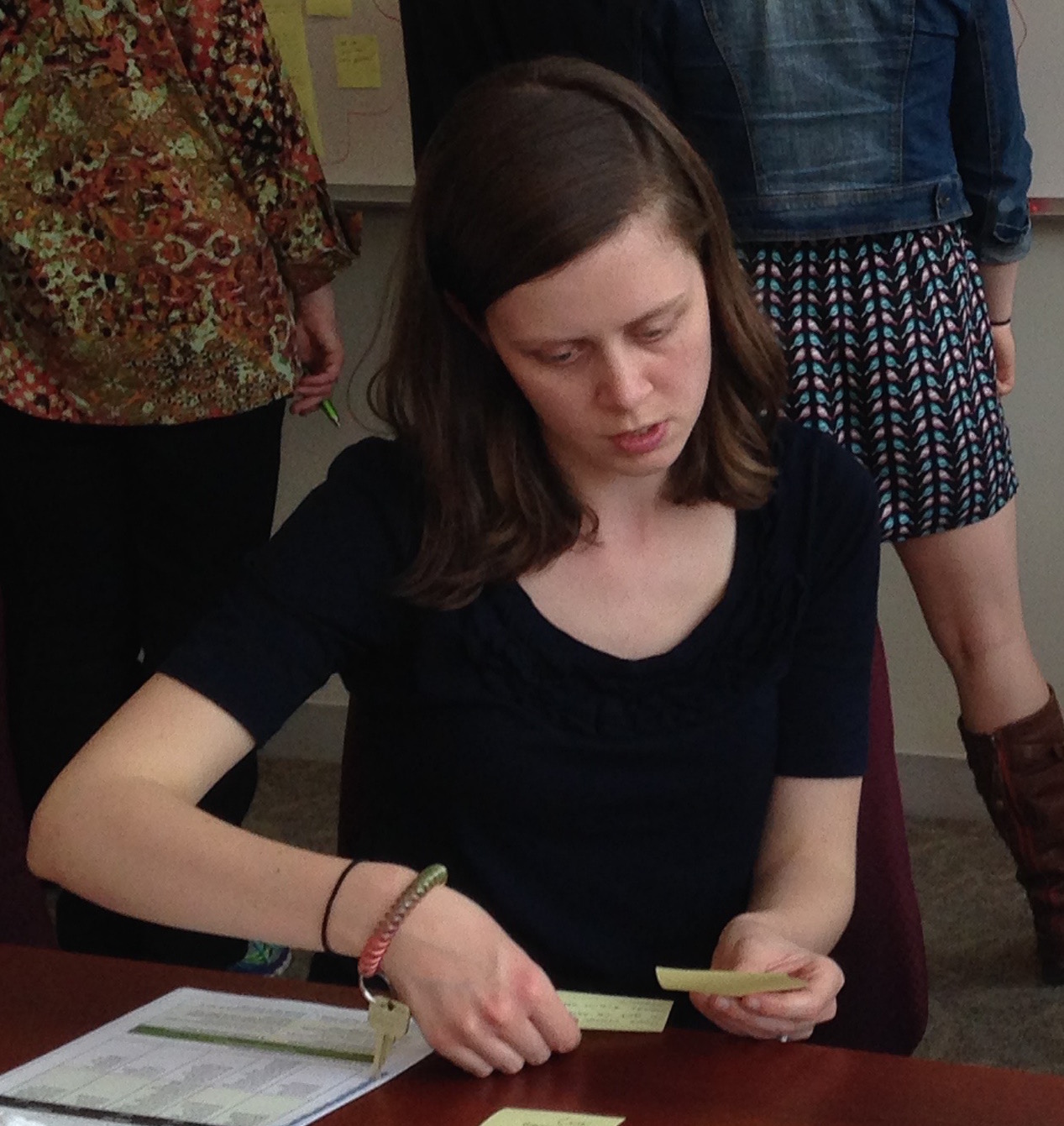
Katy Butler sorting questions
At our last round table discussion, Renee presented work she had done with her class.
Each student was given an image of a cloud and a faucet and asked to show how the water got from one to the other (just as we did this summer). Then she had her students look closely at the representations and ask questions they had or that would push their friends’ thinking. We tried this activity ourselves, organizing and categorizing our questions.
I tried this questioning activity with my first graders (they had just recently made their own cloud to faucet representations so I could see how their thinking had evolved since the fall). I collected and typed up their questions, and noticed a couple common themes. I am planning to organize the questions with them when we return from spring vacation, but I wanted to tap into a few more resources in the meantime. After searching the Northampton Public Works website, I emailed the directors of stormwater and wastewater treatment. They sent me two resources that I wanted to share with everyone!
Here is a section of the email I sent Northampton Public Works We came up with many questions, but most centered around gutters, drains, sewers, pipes and cleanliness. Here are some examples:
Does it fall in the sewer? Where does the water land? Does all water go in the sewer? Does water always go in the gutter? Where does it go after the rain? Where does it go in the pipes? Where does it get transported? How does it go in the sewer? How does it get to the home?
Which house does it go to? How does the pipe go to everyones house with one pipe?
Why is there only one pipe? Which drain does it go in? How does the water get to the faucet?
Where is the cleaner? How does it get clean?
Up until now, much of our inquiry has been investigated with experiments or observable phenomenon. Now I am unsure how to help students follow these questions without being able to “see” all the pipes. I also see a misconception about waste water and drinking water that is very interesting. I am writing to see if either of you might be able to help with our inquiry. Are there maps of the water pipe lines in Northampton? Is there a location where we could visit and see the gutter connecting to a pipe or series of pipes?
I heard back immediately, and here is part of one response that may be helpful to others: “I know the most about the stormwater system in the City of Northampton and I would be happy to help explain how the City’s different utilities work. There are three separate systems in the City:
Water (clean drinking water)
Sanitary Sewer (waste water from houses and buildings)
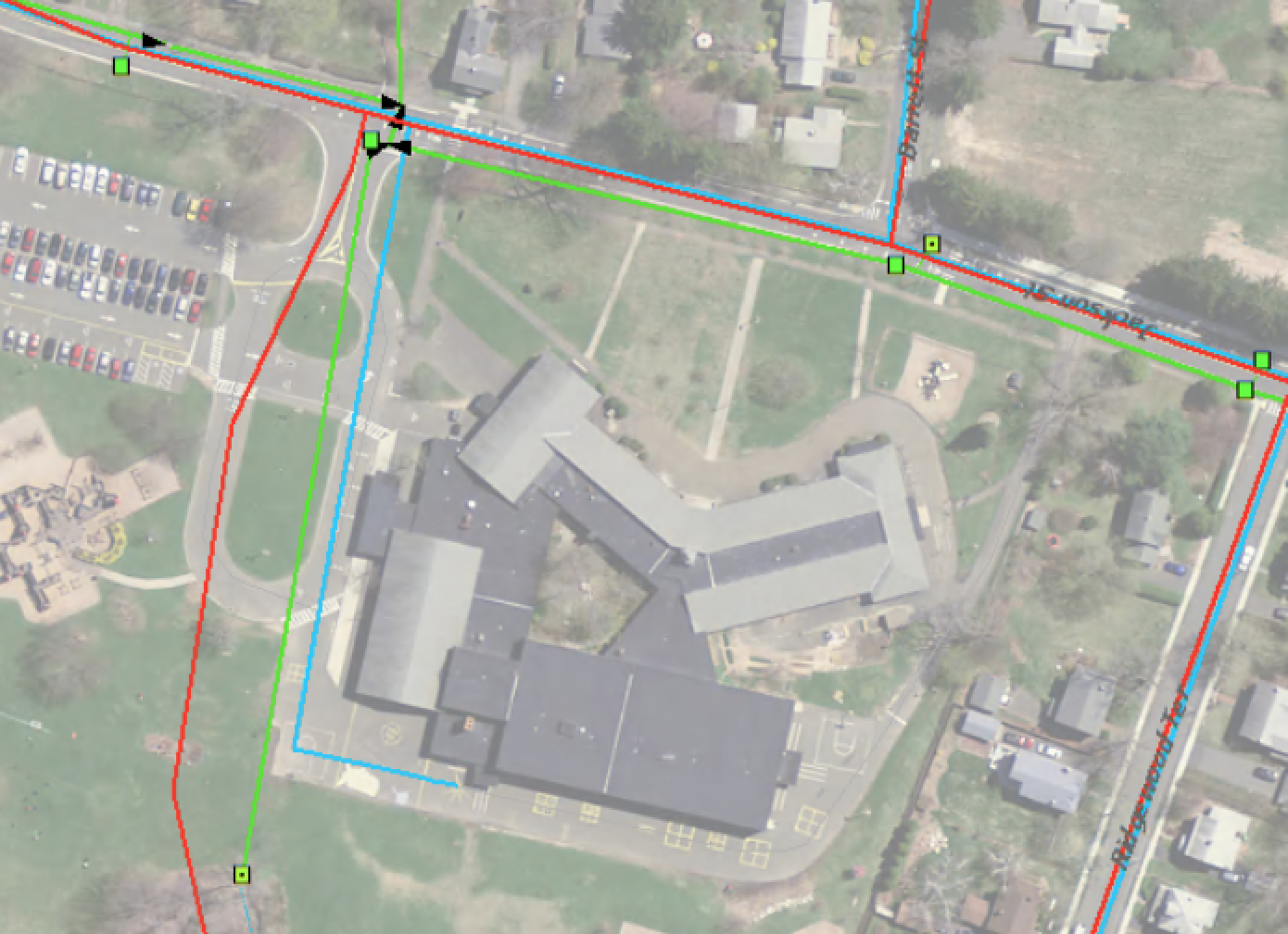
Solid blue is drinking water, red is sewer and green is stormwater with green squares for catch basins which are the grates in the roadways where rain water goes in. I believe there are more catch basins at Jackson Street School in the parking lot and around the property that are not on the map. The students could look for these and help us add them to the map. The dashed blue lines are brooks. I know maps may be difficult for the kids to understand so I’ll look for some pictures or diagrams that might help explain all these hidden systems and where water comes from and where it goes.
Here’s a quick description. The drinking water in Northampton comes from reservoirs in Whately and Williamsburg and runs through a water filtration plant in Williamsburg before flowing through pipes to everybody’s faucet. The waste water (toilets and drains inside buildings) from houses and buildings all flows through sanitary sewer pipes to the waste water treatment plant located off of Hockanum Road. The waste water treatment plant cleans up the waste water and then sends clean water to the Connecticut River. The stormwater that is collected in roads and parking lots flows through separate pipes to the nearest brook, wetland or river and does not go through any treatment plant. That’s why we need to be careful that we don’t put anything in the storm drains except clean water.”
Perhaps we could all help fill in catch basin maps! The map of Jackson Street School’s surrounding pipelines is especially exciting, and I plan to find more catch basins with the kids next week. I am working to plan a field trip to “see” this system in action, and may invite one of the water directors to our classroom once we have completed the storm drain map. I would be happy to help others get in contact with wastewater and stormwater departments if they are interested – perhaps we could all help fill in catch basin maps!